The Best Pillows for Neck Pain
A pillow does exactly one useful thing: it fills the gap between your head and the mattress. Get that height wrong and your neck spends the night bent. Here are six picks, ranked by how well they let you control it.
We earn a commission if you buy through our links. It doesn't affect our picks — and we never take free products. How this site is funded.
Quick picks
| # | Product | Best for | Price |
|---|---|---|---|
| 1 | 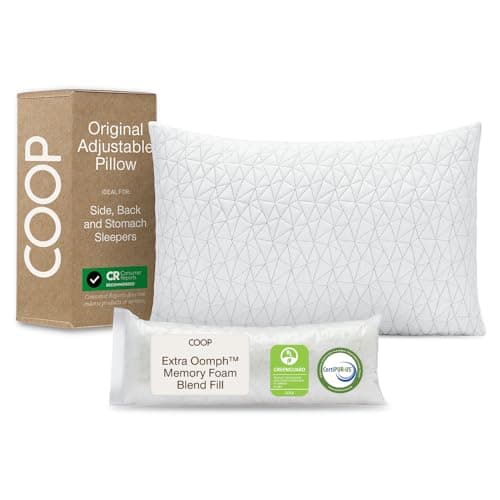 Coop Home Goods Original Adjustable Pillow, Queen The only honest recommendation on a page like this: nobody knows your correct loft, so buy the pillow that lets you find it. Best for: Most people, because you can change it | Most people, because you can change it | |
| 2 | 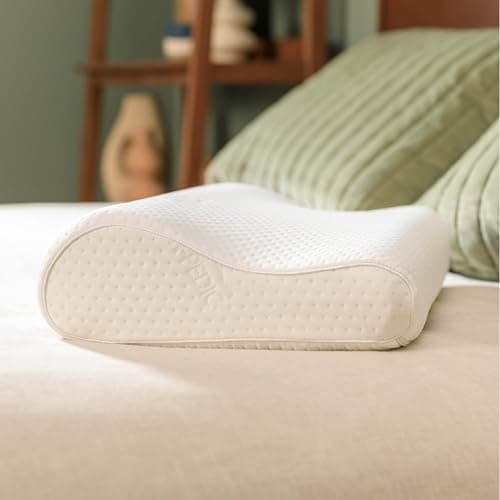 Tempur-Pedic TEMPUR-Ergo Neck Pillow, Medium Profile Sold in three profiles, which is Tempur-Pedic quietly admitting the thing this whole page is about: loft is personal. Best for: A fixed height that stays fixed | A fixed height that stays fixed | $109.00 · View on Amazon Price as of October 18, 2026. #ad — we earn a commission. |
| 3 | 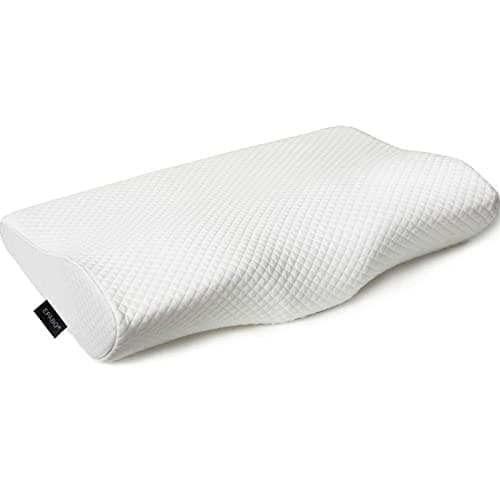 EPABO Contour Memory Foam Pillow The cheapest way to find out whether a contoured shape suits you, which is worth knowing before spending Tempur money on the idea. Best for: Trying a contour shape cheaply | Trying a contour shape cheaply | $36.99 · View on Amazon Price as of October 18, 2026. #ad — we earn a commission. |
| 4 | 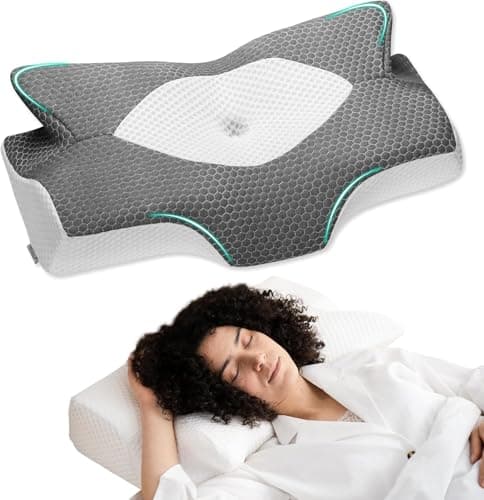 Elviros Cervical Memory Foam Pillow A more aggressively sculpted contour than the EPABO. That's either exactly what you want or exactly what you don't — there's not much middle ground. Best for: Back sleepers who want a defined shape | Back sleepers who want a defined shape | |
| 5 | 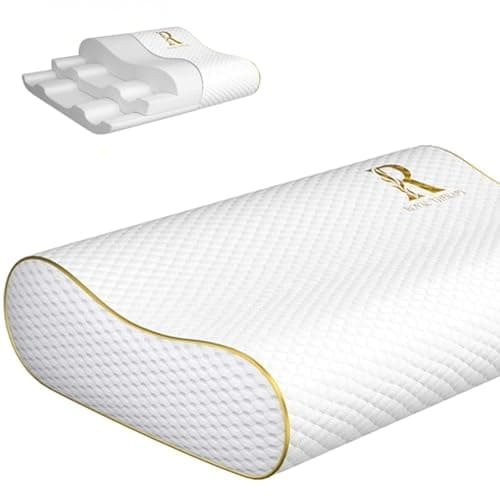 Royal Therapy Memory Foam Pillow, Queen Sits between the budget contours and the Tempur on price, without a clear argument for why. Fine, not remarkable. Best for: A middle-ground contour | A middle-ground contour | |
| 6 | 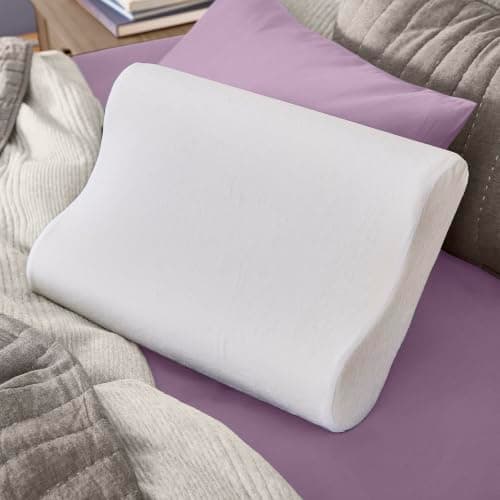 Sleep Innovations Memory Foam Contour Pillow, Queen The shape that started the category, from a brand that has been making it for years. Nothing clever, and that's the appeal. Best for: The classic contour, cheaply | The classic contour, cheaply | $48.99 · View on Amazon Price as of October 18, 2026. #ad — we earn a commission. |
What this page is, and what it isn't
Let's draw the line before we start, because this is a category where a lot of websites quietly step over it.
This is not medical advice. We are not doctors, we have no medical advisor, and we have no business telling you what is happening in your neck or what to do about it. No pillow on this page cures anything, and any site that tells you a particular pillow will fix your neck is making a claim it has no standing to make. If you have neck pain that persists, that is a question for a doctor — not for a review site, and certainly not for an Amazon listing with the word "orthopedic" in the title.
What we can talk about is geometry, because a pillow is an object with dimensions and that is a subject that doesn't require a medical degree. A pillow does exactly one useful thing: it fills the gap between your head and the mattress. How well it fills that gap determines the angle your neck holds for seven or eight hours. That is the whole remit of this page, and everything below stays inside it.
Loft is the entire conversation
Loft is the industry's word for height, and it is the only specification on a pillow listing that reliably predicts anything.
Here is the picture. Lie on your back on a flat floor with no pillow at all: there is a small gap under your neck where it curves, and your head rests on the ground. Now roll onto your side: suddenly there is a much bigger gap, because your shoulder is propping your whole upper body up and your head is hanging out in mid-air above the floor. Roll onto your front and the gap is essentially zero — your face is already at floor level.
Three positions, three completely different gaps. A pillow is the thing that fills whichever one you have. The target is the same in every case: your neck continuing the line of your spine, rather than being propped up at an angle or dropped below it. Too much loft and your head is pushed up, bending your neck one way. Too little and your head sags, bending it the other. There is no universally correct pillow height, only a correct one for your position and your build — which is precisely why a shop cannot sell you the right answer, and why any pillow marketed as right for everyone is marketed dishonestly.
Two variables set your number:
- Your sleeping position — the dominant factor by a wide margin. Side needs the most height, back needs a middle amount, front needs almost none.
- Your shoulder width— the adjustment within that band. Two side sleepers of the same height can need noticeably different pillows if one is broad-shouldered and the other isn't, because the shoulder is what sets the size of the gap.
Notice what isn't on that list: brand, price, fill chemistry, and every word ending in "-pedic". Those are the things listings lead with. The two that matter are a position and a measurement, and no listing knows either.
The mattress is half of the geometry
A detail that catches people out and makes them blame the wrong object: your pillow's effective height depends on the mattress under it.
A firm mattress leaves your shoulder sitting on top of the surface, so the gap under your head stays large and you need a taller pillow. A soft mattress lets your shoulder sink in, which raises the surface relative to your shoulder and shrinks the gap — so the same pillow that was right on the firm bed is now too tall. Change your mattress and your correct pillow height changes with it, which is why a pillow that was perfect in your old flat can feel wrong in the new bed and nothing about the pillow has changed at all.
Which is worth knowing before you buy your fourth pillow to fix a problem that lives underneath you. If the bed itself is the issue, a pillow is the wrong lever — our firmness guide covers how weight and position change what you should be on, and mattress support is the same geometric argument applied to the other end of your spine.
Why adjustable fill wins by default
Follow the logic and you arrive somewhere slightly awkward for a page that ranks pillows.
The correct loft depends on your position and your shoulder width and your mattress. Nobody selling pillows knows any of those three things about you. I don't either. So every fixed-height pillow — including every contour on this page — is a bet placed by a stranger on your body's dimensions, and the odds are set by how close to average you happen to be.
An adjustable pillow doesn't make that bet. You open it, take fill out until your head sits where it should, and stop. It replaces a guess with a measurement you take yourself, in your own bed, on your own mattress. That is not a clever feature — it is just the only design on this page that acknowledges the actual problem, and it is why the Coop leads a list that could easily have been six contour pillows.
The honest case against it: adjustable fill is a small ongoing chore. Shredded fill packs down and needs fluffing, and the pillow arrives overstuffed and does nothing for you until you engage with it. If you want to buy an object and never think about it again, a fixed contour in the right profile is a perfectly reasonable choice — you are simply making the bet deliberately rather than by accident.
What contour pillows actually do
A contour is the two-ridge shape you have seen: a raised bar along the edge, a scooped hollow behind it. The idea is legitimate. Your neck and the back of your head are not at the same height when you lie down, so a flat pillow has to compromise between them — the ridge supports the neck while the hollow lets the head settle lower, giving each what it needs. As a piece of industrial design it is a real answer to a real geometric problem.
The limitation is baked into the same sentence. A molded shape is a fixed set of assumptions about how far your neck sits from the back of your head and how wide your shoulders are. Match the mold and it feels purpose-built. Miss it and the ridge is now putting height exactly where you didn't want height, and no amount of persistence will change the shape of the foam. Contours are also cut for one position: roll from your back to your side in the night and you are lying on a shape designed for someone lying the other way.
So: try one if a flat pillow leaves your head dropping back, and try a cheap one first, which is the entire argument for the EPABO above. Just don't read the sculpting as sophistication. A more complicated shape is a more specific guess, not a better one.
The words on the listing that mean nothing
Several pillows on this page have "orthopedic", "cervical", "therapy" or "pain relief" in their titles. We have quoted that language where it appears because it is genuinely on the listing and you deserve to know what you are looking at. We have not repeated it as though it were information.
None of those words is regulated. No standard exists that a pillow must meet to print "orthopedic" on a box, no body approves the claim, and no test is failed by not qualifying. "Cervical" is simply the anatomical adjective for the neck — it describes where the shape is aimed and promises nothing about what happens when you lie on it. These words are on listings because they raise conversion rates, which is a fact about shoppers rather than about pillows.
The specifications that do carry information are dull by comparison: published height or profile, the shape, the fill material, and whether you can change any of it after it arrives. Every one of those is a physical property you could verify with your hands. That is the whole list.
Where a pillow stops
Worth repeating plainly, on a page that earns a commission when you buy one: a pillow controls the height of your head. That is its entire jurisdiction.
If your neck hurts and the cause is a pillow holding it at an angle for eight hours a night, changing the height is a sensible and very cheap thing to try. If the cause is something else, then no pillow on this page — or any page — is going to reach it, and buying a fourth one is just an expensive way of avoiding a conversation with someone qualified to have it. We can tell you which of these objects lets you control its dimensions. We cannot tell you what is wrong with you, and we are not going to pretend otherwise for a commission. Here is exactly how we pick, and what we refuse to claim.
The picks, in full
1. Best for Most people, because you can change it
Coop Home Goods Original Adjustable Pillow, Queen
The only honest recommendation on a page like this: nobody knows your correct loft, so buy the pillow that lets you find it.
Key specs
- Queen size
- Adjustable fill — the cover unzips and fill comes out
- Cross-cut memory foam and microfiber fill (per Coop Home Goods)
What's good
- You can add or remove fill, which means the pillow's height becomes a dial rather than a guess. Every other pillow on this page is a fixed bet on your body's dimensions
- Loose cross-cut fill can be pushed around, so the height under your neck and under your head don't have to be the same
- If you get it wrong on night one, you fix it on night two. No returns process, no waiting
What's not
- It arrives overfilled by most people's standards and does nothing for you until you actually open it and take fill out
- Loose fill needs re-fluffing or it packs down and your loft quietly drifts
- One of the pricier pillows here, and the thing you're paying for is a zip
Skip this one if
You already know exactly what height works for you and you want it to stay there without maintenance. A fixed contour like the Tempur-Ergo below holds its geometry indefinitely; a loose-fill pillow needs occasional attention.
2. Best for A fixed height that stays fixed
Tempur-Pedic TEMPUR-Ergo Neck Pillow, Medium Profile
Sold in three profiles, which is Tempur-Pedic quietly admitting the thing this whole page is about: loft is personal.
Price as of October 18, 2026. #ad — we earn a commission.
Key specs
- Medium profile (small and large profiles also listed)
- Solid TEMPUR foam
- Contoured shape
What's good
- Three published profiles mean you get to pick a height band up front instead of taking whatever one size the brand decided on
- Solid foam holds its shape for years — the height you buy is the height you keep, with no fluffing and no drift
- Tempur-Pedic publishes its profile options clearly and has a real returns operation behind them, which matters when you're buying a dimension sight unseen
What's not
- You have to choose the profile correctly before you've slept on it, and "medium" is Tempur-Pedic's word about their own range, not a measurement of you
- Solid TEMPUR foam is dense and insulating — this is a warm pillow by construction
- The most expensive pick here by a distance
Skip this one if
You aren't confident which profile you need. The entire risk of a fixed-height pillow lands on that one guess — buy the adjustable Coop above and dial it in instead of gambling.
3. Best for Trying a contour shape cheaply
EPABO Contour Memory Foam Pillow
The cheapest way to find out whether a contoured shape suits you, which is worth knowing before spending Tempur money on the idea.
Price as of October 18, 2026. #ad — we earn a commission.
Key specs
- Contoured memory foam
- Listed as "orthopedic" and "ergonomic" — the seller's words, not ours
What's good
- Contour pillows are a genuine geometry: a raised ridge under the neck and a hollow for the head, so the two get different heights instead of one flat compromise
- Cheap enough that finding out contours aren't for you is a minor annoyance rather than an expensive mistake
- A fixed shape doesn't drift the way a shredded fill does
What's not
- "Orthopedic" appears in the listing title and means nothing in particular — it is not a regulated term and no standard sits behind it
- A contour only works if your dimensions match the mold. If the ridge is the wrong height for your shoulder, the shape works against you
- Solid foam, so it insulates — see our cooling picks if you also sleep warm
Skip this one if
You move between your back and your side all night. A contour is cut for one position at a time, and rolling over puts your neck on a shape designed for someone lying the other way. Get an adjustable pillow.
4. Best for Back sleepers who want a defined shape
Elviros Cervical Memory Foam Pillow
A more aggressively sculpted contour than the EPABO. That's either exactly what you want or exactly what you don't — there's not much middle ground.
Key specs
- Contoured memory foam
- Listed as "cervical" — a description of the shape, not a claim we can verify
What's good
- The sculpting is more pronounced than a basic contour, which means a more defined neck ridge for people who find flat pillows let their head drop back
- Elviros lists several variants at different heights, so there's a size conversation to be had rather than one-size-fits-all
- Solid foam holds the geometry night after night
What's not
- A strongly-shaped pillow is a strong opinion about how you should lie. If you disagree with it, you will not get used to it
- "Cervical" is anatomical vocabulary in a product name. It tells you the shape is neck-focused; it tells you nothing about outcomes
- Dense foam, so the usual heat trade-off applies
Skip this one if
You sleep on your front. Every contour on this page assumes your head is either on its back or on its side — a sculpted ridge is actively unhelpful face-down, where you want the flattest, thinnest pillow you can find.
5. Best for A middle-ground contour
Royal Therapy Memory Foam Pillow, Queen
Sits between the budget contours and the Tempur on price, without a clear argument for why. Fine, not remarkable.
Key specs
- Queen size
- Contoured memory foam
- Listed as "contour cervical" — seller's terminology
What's good
- A queen-size contour, which is less common than you'd think — most contour pillows are cut standard and look lost on a large bed
- Moderate contouring: less committed than the Elviros, more shaped than a flat foam pillow
- Established enough on the platform that the listing is stable and stock rarely vanishes
What's not
- It is priced above the cheap contours without offering a geometry the cheap contours don't
- The brand name contains the word "therapy", which is marketing, not a credential
- Solid foam again — no airflow through the block
Skip this one if
You're shopping on price. The EPABO gives you the same basic contour idea for less, and if you're going to spend more than this, spend it on adjustability rather than on a slightly different molding.
6. Best for The classic contour, cheaply
Sleep Innovations Memory Foam Contour Pillow, Queen
The shape that started the category, from a brand that has been making it for years. Nothing clever, and that's the appeal.
Price as of October 18, 2026. #ad — we earn a commission.
Key specs
- Queen size
- Solid memory foam
- Contoured profile
What's good
- This is the archetypal two-ridge contour — if you have a picture in your head of what a contour pillow looks like, this is it
- Sleep Innovations has sold this line long enough that it's a known, stable quantity rather than a new listing with a new name
- Inexpensive for a queen-size solid foam pillow
What's not
- One fixed height. If the ridge isn't right for your shoulder width, there is nothing you can do about it
- Solid foam with no ventilation — the warmest construction, without the cooling cover the brand puts on its other pillows
- The design is old because it works, but also just old — nothing here has been rethought in a while
Skip this one if
You're a broad-shouldered side sleeper. A standard contour's ridge is cut for an average gap, and if your shoulder is wider than average it will leave your head dropping. You need height you can control — see our side sleeper picks.
Common questions
Can a pillow fix neck pain?
We are not the right people to answer that, and anyone selling you a pillow who answers it confidently is telling you something they cannot know. This is a review site with no medical advisor and no clinical expertise. What we can talk about is geometry: a pillow determines the height your head sits at relative to your shoulders, and a pillow that is too tall or too short holds your neck at an angle all night. That is a question about the dimensions of an object. If you have persistent neck pain, that is a question for a doctor — not for a pillow review site, and not for a product listing.
What loft (height) pillow should I use?
It depends on your sleeping position and your build, and the logic is straightforward once you see it. Side sleeping opens the biggest gap between your head and the mattress, because your shoulder is holding your head up off the bed — so side sleepers need the most height. Back sleeping opens a much smaller gap, so back sleepers need a medium-to-low pillow. Front sleeping opens almost no gap at all, so a thick pillow forces your head backwards; front sleepers want the thinnest pillow they can tolerate. Broad shoulders push you higher within your position's band; narrow shoulders pull you lower.
Are contour or 'cervical' pillows better than a normal pillow?
They are different, not automatically better. A contour pillow's shape gives your neck and the back of your head two different heights instead of one flat surface, which is a sensible idea in principle. The catch is that a molded shape is a fixed assumption about your proportions. If the ridge height matches your build it can feel excellent; if it doesn't, the shape is working against you and there is no adjustment available. That is the trade: a contour is a confident guess, and an adjustable pillow is an admission that a guess is what it is.
What does 'orthopedic' mean on a pillow listing?
Commercially, very little. It is not a regulated term, there is no standard a pillow must meet to use it, and no approval process sits behind it. Several listings on this page carry it, along with words like 'therapeutic' and 'pain relief', because those words sell pillows. Treat them as marketing vocabulary rather than as information. The things on a listing that actually tell you something are the physical ones: the height, the shape, the fill material, and whether you can change any of it after it arrives.
How long does it take to get used to a new pillow?
Give it a couple of weeks before you judge it, with one important exception. Foam softens slightly with use and your body adapts to a new sleeping surface, so the first few nights on any new pillow are unrepresentative and mild strangeness is normal. The exception: if something is actively hurting, do not spend two weeks 'adjusting' to it — stop, and if it persists, that is a conversation for a doctor rather than something to push through on the theory that a pillow needs breaking in.
Sources
Where the facts on this page come from. We cite other people's testing because we don't do our own — here's what that means.
Read next
- The Best Wedge PillowsFive wedge pillows sorted by incline - from a gentle reading angle to a steep reflux slope and adjustable recovery sets - with honest, non-medical notes on who each suits.
- How to Choose a PillowSleeping position sets pillow loft — side high and firm, back medium, stomach low or none — then fill, firmness, your mattress and cooling fine-tune it.
- The Best Memory Foam Pillows, Adjustable vs ContourSix memory foam pillows split by the only distinction that matters — adjustable shredded fill you can dial versus a fixed contour you must match to your position — with honest cons and a skip note on every one.
- The Best Travel PillowsSix travel pillows sorted by mechanism, not brand — because a plain U-pillow only stops sideways lean, and the thing that wakes you upright is your head dropping forward.
- The Best Pillows for Back SleepersSix pillows that hit the medium loft a back sleeper needs — enough to fill the neck's hollow without tipping the head forward — with honest cons on every pick.
- The Best Pillows, Picked by How You SleepSix pillows picked by sleeping position and fill type — side, back, stomach, adjustable vs fixed — with honest cons and a skip note on every one.
- The Best Pillows for Side SleepersSix pillows tall and firm enough to fill a side sleeper's shoulder gap without collapsing into it by midnight.
- The Best Cooling PillowsSix cooling pillows that actually move air, an honest read on gel infusions, and a note on who each one is wrong for.
- The Best Mattresses for Lower Back PainSix mattresses judged purely on support and spinal alignment — and why medium-firm, not firm, is where the evidence points.
- Mattress Firmness: The 1-10 Scale, HonestlyWhat the 1-10 firmness scale actually means, why one brand's 6 is another's 7, and how your bodyweight changes the answer.
- The Best Pillows for Combination SleepersSix pillows for sleepers who change position all night — adjustable, moldable picks you can set to a medium loft that survives side, back, and stomach — with honest cons and a skip note on every one.