The Best Pillows for Side Sleepers
Side sleeping props your head up on your shoulder and leaves a gap underneath roughly as wide as that shoulder is thick. Fill it properly and you need the tallest, firmest pillow in the shop. This is the clearest rule in bedding.
We earn a commission if you buy through our links. It doesn't affect our picks — and we never take free products. How this site is funded.
Quick picks
| # | Product | Best for | Price |
|---|---|---|---|
| 1 | Nest Bedding Easy Breather Memory Foam Pillow, Side Sleeper Built and sold for exactly this problem, with enough shredded fill to hold real height. The one I'd buy. Best for: Side sleepers, straightforwardly | Side sleepers, straightforwardly | Check price on Amazon → #ad — we earn a commission. |
| 2 | 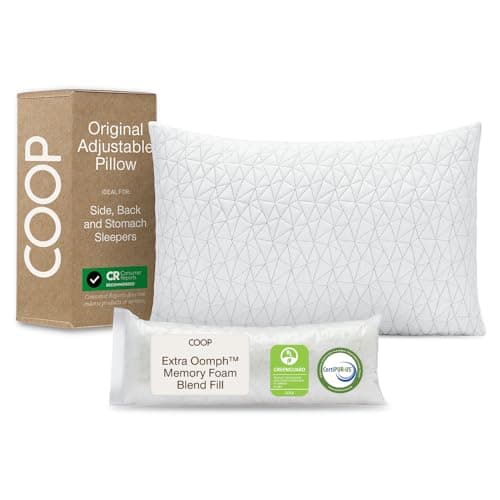 Coop Home Goods Original Adjustable Pillow, Queen The safest pick if you're not purely a side sleeper. It starts tall and you can take it down to whatever your shoulder actually needs. Best for: Side sleepers who also roll onto their back | Side sleepers who also roll onto their back | |
| 3 | 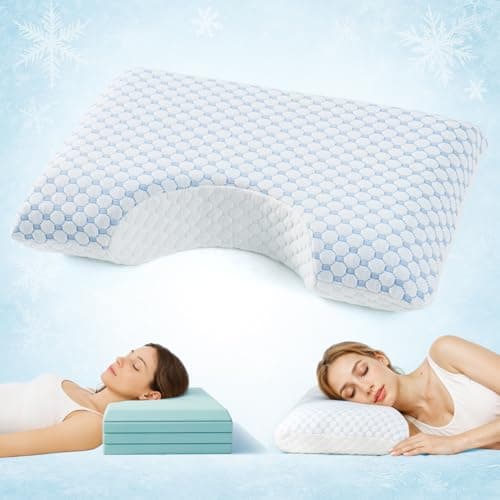 USlixury Side Sleeper Pillows, Adjustable 4-Layer Curved Adjusts by pulling out layers rather than handfuls of fill. Cruder than shredded, but far easier to get right. Best for: Dialing in height in fixed steps | Dialing in height in fixed steps | $36.88 · View on Amazon Price as of October 18, 2026. #ad — we earn a commission. |
| 4 | 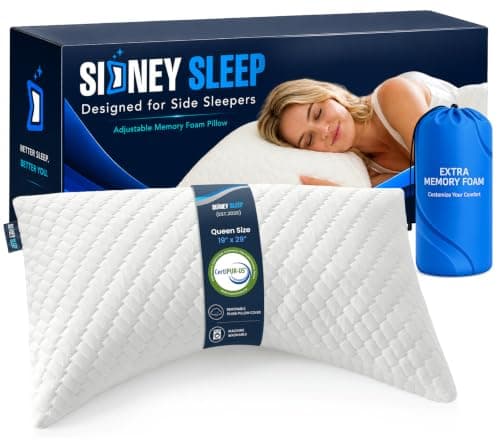 Sidney Sleep Adjustable Curved Pillow A curved profile plus adjustable fill — a shaped pillow that hasn't locked its height in as well as its outline. Best for: A shaped pillow you can still adjust | A shaped pillow you can still adjust | |
| 5 | 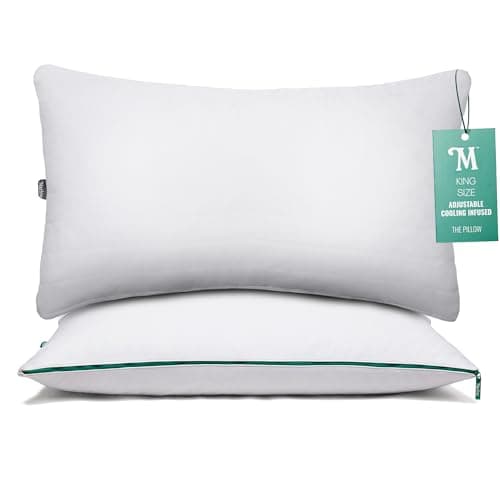 Marlow Adjustable Memory Foam Pillow Adjusts by zipping the sides in or out rather than by removing fill. Genuinely clever, and a narrower range than it sounds. Best for: Adjusting without opening anything | Adjusting without opening anything | $85.00 · View on Amazon Price as of October 18, 2026. #ad — we earn a commission. |
| 6 | 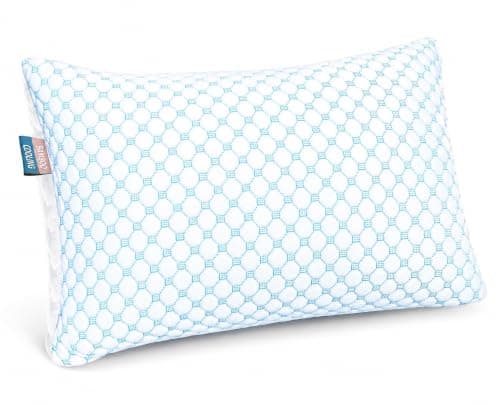 Nestl Cooling Pillows, Queen, Set of 2 Two shredded foam pillows for less than one of anything above. The material is right; the execution is basic. Best for: The cheapest shredded fill | The cheapest shredded fill | $45.59 · View on Amazon Price as of October 18, 2026. #ad — we earn a commission. |
The gap is the whole problem
Most bedding advice is mush — a fog of preference, marketing and things that are true for some people. Side sleeping is the exception. It has the clearest, most explainable rule in the entire shop, and once you have seen it you cannot unsee it.
Lie on your side on a hard floor with no pillow. Your shoulder is now carrying your upper body, holding your torso up off the ground. Your head is not on the ground — it is suspended in mid-air, above a gap. Reach up and you can put your hand in it. That gap is roughly as tall as your shoulder is thick, and for most adults it is a serious distance: several inches of empty space between your ear and the floor.
Everything follows from that. With no pillow, your head drops into the gap and your neck bends sideways to let it. Your job — the pillow's job, the only thing it is for — is to fill the space so your head stays level with your spine instead of sagging below it.
Now compare positions. A back sleeper's head rests almost on the surface, with only the small hollow of the neck to fill. A front sleeper has no gap at all; their face is already at mattress level. A side sleeper is the one position where an entire shoulder's worth of height has to come from somewhere. Side sleepers need the highest loft of any position, and it isn't close.
Which means firm, not soft
Here is the second half of the rule, and it is the half that gets people.
Height is worthless if it doesn't survive contact with your head. A human head is heavy, and it presses down on that pillow all night. A soft pillow — the kind that feels wonderful when you squeeze it in a shop — compresses under that load. It fills your shoulder gap for about ten seconds, and then it flattens and your head sinks exactly where it would have sunk without a pillow at all. You have paid for loft and received a pleasant sensation.
This is why the cheap fiber and down-alternative pillows that stack up on every bestseller list are wrong for you specifically. Loose fiber is mostly air, which makes it breathable and cheap and lovely to punch. It also means it has almost nothing holding it up. Under a head, all night, it collapses. That is not a defect — it is what loose fiber does, and for a back sleeper who needs very little height it is fine. For a side sleeper it is the one failure mode that matters.
So the side sleeper's specification is two words that rarely appear together on a listing: tall and firm. Not plush. Not cloud-like. Not hotel-soft. You want a pillow that is unimpressed by the weight of your head, and that is why every pick above is shredded foam, layered foam or solid foam, and why not one of them is a bag of fiber.
Working out your own height
You do not need a tape measure or an app. You need someone in the room, or a mirror and a phone.
Lie on your side on your bed, on the pillow you own now, in the position you actually fall asleep in. Have someone look at you straight on from the front. What you are checking is one line: does your nose point straight ahead, with your neck continuing the line of your spine? Or is your head tilted — chin dropping toward your chest, or pushed up toward the ceiling?
- Head sagging toward the mattress, neck bending downward — your pillow is too short, or it has collapsed. This is by far the most common result, because most pillows are sold to the average of all sleepers and side sleepers are at the extreme.
- Head propped up, chin pushing toward your chest — too tall. Less common in side sleepers, but it happens with aggressive contours or a stack.
- Nose straight ahead, spine in a line — that is the target, and now you know what height does it for you.
Do this test at bedtime and again in the morning if you can. A pillow that passes at 11pm and fails at 7am is a pillow that collapses, and it tells you the fill is too soft rather than too short — a completely different purchase.
Your shoulders set the number, so nobody else can
The size of your gap is set by the thickness of your shoulder. That is not a figure of speech; it is the measurement. Two people of identical height and weight can need visibly different pillows if one is broad-shouldered and the other isn't, because the shoulder is the thing propping the head up.
Which is why you will not find a recommended inch count on this page. Anyone publishing one is publishing an average, and an average is the one thing that is guaranteed not to be your shoulder. It is also the argument that decides this whole ranking: the picks at the top adjust, and the picks lower down don't. When the correct answer is a number only your own body knows, a pillow that lets you change the number is categorically better than a pillow that guesses — and it is why the same logic drives our loft and support geometry page, which works through the same problem for people who aren't sure which position they even sleep in.
The mattress is the other half of this
A pillow can only fill the gap your mattress leaves it. Change the mattress and the gap changes — which means the correct pillow changes too, and people blame the pillow.
Firm mattress: your shoulder sits on top of the surface, taking your full upper-body weight against something that won't yield. The gap under your head stays at its maximum, so you need a tall pillow, and your shoulder takes the pressure. Soft mattress: your shoulder sinks in, the surface rises up around it, and the gap between your ear and the mattress shrinks — so the same pillow that was perfect on the firm bed is suddenly too tall, and your head gets pushed forward.
This is the reason side sleepers generally do better on softer beds. A surface with some give lets the shoulder in instead of fighting it, which both reduces the pressure through that joint and shrinks the gap your pillow has to fill. It is the same geometry, one layer down. If you are buying a pillow because side sleeping is uncomfortable, be honest about whether the object under you is the actual problem — our mattress picks for side sleepers are the other half of this exact argument, and if you are on a firm bed and unwilling to replace it, a topper is the cheap version of the same fix.
And there is a second gap further down that this page does not solve. On your side, your top leg has nothing under it either, so it falls forward and drags your pelvis into a twist your head pillow can do nothing about. The fix is the same idea applied to your knees - our knee pillow picks sort that category by height, because the gap between your knees is set by your hips exactly the way the gap under your head is set by your shoulder.
What I'd actually do
Buy an adjustable shredded foam pillow. Start with it full, because as a side sleeper you are the one customer who probably needs most of it. Do the mirror test. Take out a handful, sleep on it, check again. Stop when your nose points straight ahead.
That is the whole method, and it takes a week of half-attention. What makes it worth doing is that the side sleeper rule is unusually knowable: there is a gap, it is the width of your shoulder, and either your pillow fills it or it doesn't. Almost nothing else in a bedroom resolves that cleanly. Most of this shop runs on preference and marketing — this one runs on a measurement you can see in a mirror. Here is exactly how we pick, and what we refuse to claim.
The picks, in full
1. Best for Side sleepers, straightforwardly
Nest Bedding Easy Breather Memory Foam Pillow, Side Sleeper
Built and sold for exactly this problem, with enough shredded fill to hold real height. The one I'd buy.
#ad — we earn a commission.
Key specs
- Shredded foam blend (per Nest Bedding)
- Sold as a side sleeper model (the brand's own designation)
- Adjustable — fill can be removed
What's good
- Shredded fill packs densely enough to hold a tall loft under the weight of a head, which is the specific thing a side sleeper needs and the specific thing loose fiber cannot do
- Adjustable, so if your shoulder is narrower than the brand assumed you take fill out rather than living with it
- Nest Bedding is a mattress brand with a real returns operation rather than an Amazon-only listing
What's not
- The most expensive pillow here, and a good part of what you're paying for is the brand's own supply chain rather than a material advantage
- Shredded fill packs down over months, so the loft you set is not permanent — it needs occasional fluffing
- Sold as one pillow, where several picks below are sets of two
Skip this one if
You switch to your back for half the night. This is built tall for a shoulder gap, and that same height pushes your head forward when you roll over. A more moderate adjustable — the Coop below — handles both positions better.
2. Best for Side sleepers who also roll onto their back
Coop Home Goods Original Adjustable Pillow, Queen
The safest pick if you're not purely a side sleeper. It starts tall and you can take it down to whatever your shoulder actually needs.
Key specs
- Queen size
- Adjustable fill — the cover unzips
- Cross-cut memory foam and microfiber fill (per Coop Home Goods)
What's good
- Arrives generously filled, which for once is the right default: a side sleeper is the one customer who probably needs all of it, and removing fill is easier than sourcing more
- Loose cross-cut fill lets you push height toward the neck end and leave the head end lower — a side sleeper's gap isn't uniform
- You can re-tune it when you change mattress, which changes how far your shoulder sinks and therefore your correct height
What's not
- It does nothing for you until you open it and take fill out — it is a kit, not a finished object
- Packs down and needs fluffing, or your carefully-set loft drifts downward without you noticing
- Pricier than the sets below, and it's one pillow
Skip this one if
You want the tallest, firmest thing you can get and you never sleep on your back. Buy the Nest above — it's purpose-built for the maximum-gap case and you won't be fighting it back up to height.
3. Best for Dialing in height in fixed steps
USlixury Side Sleeper Pillows, Adjustable 4-Layer Curved
Adjusts by pulling out layers rather than handfuls of fill. Cruder than shredded, but far easier to get right.
Price as of October 18, 2026. #ad — we earn a commission.
Key specs
- Adjustable 4-layer curved design (as listed)
- Sold as a side sleeper model
What's good
- Layer-based adjustment is repeatable in a way loose fill isn't — you can remove a layer, sleep on it, and put it back exactly as it was if you were wrong
- Four layers means four known heights, which is more than any fixed pillow offers and requires no judgment about handfuls
- The curve is cut to give a shoulder somewhere to go rather than pressing against it
What's not
- Four steps is coarse. If your correct loft sits between two layers, you cannot get there
- USlixury is an Amazon-native brand with no history to lean on and a name assembled from a thesaurus
- Layered foam has less airflow than shredded fill, so it runs warmer
Skip this one if
You want fine control over height. Layers give you four options; shredded fill gives you a continuous dial. If you're fussy about this — and side sleepers should be — the Coop or Nest are better tools.
4. Best for A shaped pillow you can still adjust
Sidney Sleep Adjustable Curved Pillow
A curved profile plus adjustable fill — a shaped pillow that hasn't locked its height in as well as its outline.
Key specs
- Curved shape (as listed)
- Adjustable fill (as listed)
- Listed for neck and shoulder support — the seller's framing
What's good
- A curved profile is a genuine geometric idea for a side sleeper: a shaped edge gives the shoulder somewhere to sit rather than the pillow riding up on it and lifting your head too high
- Adjustable fill on top of the shaped design, so the outline is fixed but the height isn't — most shaped pillows make you take both as sold
- Worth a look if rectangular pillows leave you shoving the corner around to get your shoulder comfortable
What's not
- A shape only helps if it lands where your body actually is, and shoulders vary more than pillow designers admit
- A shaped pillow is a strong opinion about your sleeping posture — you're locked into using it one way round
- Awkward in a standard pillowcase, which is a small but daily irritation
Skip this one if
You share a bed and swap sides, or you just want a pillow that works whichever way you throw it down. A shaped, oriented pillow demands you place it correctly every night — a rectangular adjustable doesn't care.
5. Best for Adjusting without opening anything
Marlow Adjustable Memory Foam Pillow
Adjusts by zipping the sides in or out rather than by removing fill. Genuinely clever, and a narrower range than it sounds.
Price as of October 18, 2026. #ad — we earn a commission.
Key specs
- Memory foam fill (as listed)
- Adjustable via external side zips (per Brooklinen)
What's good
- The zips change the pillow's height and firmness from the outside — no handfuls of foam on the bedroom floor, no bin bag of leftover fill in a cupboard
- Adjustment is completely reversible and takes seconds, so experimenting costs you nothing
- Marlow is Brooklinen's pillow line, so there's a real company and a real returns process behind it
What's not
- Zipping the sides in changes the loft less dramatically than removing fill does — the range is narrower than a Coop's
- For a broad-shouldered side sleeper, even the tallest setting may not be tall enough, and there's no way to add more
- You're paying a premium for the mechanism
Skip this one if
You have broad shoulders and need serious height. The zip system adjusts within a range, and that range tops out lower than a packed shredded pillow. Buy the Nest and pack it out.
6. Best for The cheapest shredded fill
Nestl Cooling Pillows, Queen, Set of 2
Two shredded foam pillows for less than one of anything above. The material is right; the execution is basic.
Price as of October 18, 2026. #ad — we earn a commission.
Key specs
- Queen size
- Set of 2
- Shredded memory foam fill (as listed)
- "Cooling" is the seller's line name
What's good
- Shredded memory foam is the correct fill for a side sleeper, and this is the cheapest route to it on the page — two pillows for a fraction of the Nest
- Shredded fill means some ability to push the loft around even where a listing doesn't advertise adjustment
- A set of two, so both sides of a bed are sorted at once
What's not
- Nestl runs several near-identical cooling listings — check you're on the size and count you meant before you order
- "Cooling" is a line name doing marketing work; the shredded structure is what actually moves air
- The cheapest fill on the page, and it will pack down soonest
Skip this one if
You want one pillow that holds its height for years. This is a two-for-the-price-of-nothing set that'll need replacing sooner — if the pillow matters, the Nest or the Coop are the ones to spend on.
Common questions
What loft pillow do side sleepers need?
The highest of any sleeping position, and the reason is pure geometry rather than preference. When you lie on your side, your shoulder holds your upper body up off the mattress and your head hangs in the space above it. The gap between your ear and the mattress is roughly as tall as your shoulder is thick — for most adults that is a substantial distance, far more than a back sleeper's gap and vastly more than a front sleeper's. The pillow's job is to fill it. Broad shoulders need more height than narrow ones, which is why a single recommended number would be useless and why adjustable pillows dominate this list.
Should a side sleeper's pillow be firm or soft?
Firm, and this catches people out because a soft pillow feels nicer in the shop. Softness in a pillow means it compresses under weight, and your head is heavy. A soft pillow fills your shoulder gap for about ten seconds, then collapses under the load and leaves your head sagging toward the mattress for the rest of the night — which is the exact problem you bought it to solve. A firm pillow holds its height against the weight of your head. For a side sleeper, height that collapses is the same as no height at all.
Is one pillow enough, or should I stack two?
One correctly-sized pillow beats two stacked, though stacking is a reasonable diagnostic. If you find yourself doubling up, that is useful information: your gap is bigger than your pillow, and you should be shopping for more loft rather than more pillows. The problem with a stack is that it moves. Two pillows slide against each other through the night and your height changes without you noticing, so you get the loft you wanted at bedtime and something else by 3am. Use the stack to learn what height you need, then buy a single pillow that delivers it.
Why does my shoulder hurt when I sleep on my side?
We are not going to guess at that — it is not something a review site can diagnose, and if it persists it is a question for a doctor rather than for a shopping page. What we can say is the geometric part: a side sleeper puts most of their upper-body weight through one shoulder against the mattress, so the surface underneath matters as much as the pillow on top. A mattress that is too firm doesn't let the shoulder sink in, which is why side sleepers generally do better on softer beds. That is about the mechanics of objects, not about you.
Do you get paid for these recommendations?
We earn an Amazon commission if you buy through our links, and that funds the site. We do not take free products, we do not sell placement, and no brand sees this page before it publishes. The rate is effectively identical across every pillow here, so there is nothing on this page we make more money by recommending — which is why the cheapest pick and the most expensive one are described with the same bluntness.
Sources
Where the facts on this page come from. We cite other people's testing because we don't do our own — here's what that means.
Read next
- The Best Knee PillowsSeven knee pillows sorted by height and shape - between-the-knees contours for side sleepers, a half-moon bolster for back sleepers, a strapped one that stays put, and the budget entry.
- The Best Pregnancy PillowsFive pregnancy pillows sorted by shape (U, J and extra-long), covering budget, cooling and small-bed options - with honest notes on bed space and who should skip each.
- The Best Firm PillowsFive pillows firm enough to hold their loft under a head all night instead of collapsing flat — solid foam, adjustable packed firm, and heavily-filled down — with honest cons and a skip note on every one.
- The Best Pillows for Back SleepersSix pillows that hit the medium loft a back sleeper needs — enough to fill the neck's hollow without tipping the head forward — with honest cons on every pick.
- The Best Mattresses for Side SleepersSix mattresses with comfort layers deep enough to let a shoulder and hip sink — the actual problem side sleepers are trying to solve.
- The Best Cooling PillowsSix cooling pillows that actually move air, an honest read on gel infusions, and a note on who each one is wrong for.
- The Best Pillows for Neck PainSix pillows ranked by loft and support geometry — plus a straight answer about what a pillow can and cannot do for your neck.
- Mattress Firmness: The 1-10 Scale, HonestlyWhat the 1-10 firmness scale actually means, why one brand's 6 is another's 7, and how your bodyweight changes the answer.
- The Best Pillows for Combination SleepersSix pillows for sleepers who change position all night — adjustable, moldable picks you can set to a medium loft that survives side, back, and stomach — with honest cons and a skip note on every one.
- The Best Body PillowsSix body pillows sorted by the thing that actually matters — shape — for side sleepers and pregnancy, with an honest note on who each is wrong for.