Baffle Box vs Sewn Through
Buy baffle box if the fill is down or feather and the room gets genuinely cold - the fabric walls between compartments are what let the fill reach full loft instead of being pinched flat at every seam. Buy sewn-through if the fill is polyester and the comforter lives inside a duvet cover, where the cold lines do not matter and the price difference does.
We earn a commission if you buy through our links. It doesn't affect our picks — and we never take free products. How this site is funded.
Two ways to stop fill moving, with different consequences
Every comforter has the same engineering problem: loose fill inside a fabric bag will drift to wherever you compress it least, and a comforter with all its fill in two corners is a blanket with lumps. The two standard solutions look similar on a product photo and behave very differently in a cold room.
Sewn-through — usually sold as box stitch or quilted — sews the top and bottom fabric layers directly to each other in a grid. The fill sits in the squares. It works, it is cheap, and at every stitch line the two faces are pressed together with nothing in between. Those lines are thin spots: a grid of places where heat leaves more easily than it does through the lofted squares.
Baffle box solves the same problem by sewing strips of fabric — baffles — between the two faces, creating three-dimensional compartments. The faces never touch. The fill reaches its full height across the entire comforter, including at the edges of each box. There is no point on the surface where the thickness drops to zero.
When the difference is real, and when it is academic
The cold-seam penalty is not a constant. It scales with three things, and if all three are against you it is the difference between a comforter that works and one you end up putting a blanket over.
- How cold the room is. In a heated bedroom in the high 60s, a stitch line is a slightly cooler stripe on a warm surface. In a cold room it is a path for heat you actually need.
- What the fill is. Down is springy and compresses hard into a seam, so the contrast between a lofted square and a pinched stitch line is dramatic. Polyester fiber is stiffer and bulkier per ounce — it does not collapse into the seam as completely, so the contrast is milder. This is the single most important point on the page and the one no listing makes: sewn-through hurts a down comforter far more than it hurts a synthetic one.
- Whether there is a cover over it. A duvet cover lays a continuous layer of fabric across every seam. It does not restore loft, but it evens out the surface temperature enough that most people stop noticing. An insert that lives inside a cover is the case where sewn-through is genuinely fine.
Put those together and you get the rule at the top of this page. Natural fill plus a cold room plus a bare comforter is the case for baffles. Polyester fill inside a cover in a normal bedroom is the case for saving the money.
What each construction does to lifespan
Comforters rarely die from wear in the fabric; they die from uneven fill. Both constructions prevent gross migration, but they fail differently.
A sewn-through comforter concentrates every bit of mechanical stress onto the stitch lines, which are already the weakest part of the assembly because the needle has perforated both faces. When one seam opens, the fill in that square is free, and the repair is a visible patch. A baffle-box comforter spreads that load across internal fabric walls, so a failure is usually internal and gradual rather than sudden.
None of that outranks the fill itself. Fill power and fill weight predict how a comforter ages far better than stitching does, and a budget polyester fill will flatten on its own schedule however carefully it is sewn in. If yours has already gone flat, that is sometimes recoverable and sometimes the end — here is how to tell.
The construction words you will see, translated
| On the listing | What it is physically | Cold spots? | Typical price |
|---|---|---|---|
| Baffle box | Fabric walls between the faces, 3D compartments | No | Higher |
| Box stitch / sewn through | Faces stitched to each other in a grid | Yes, at every seam | Lower |
| Diamond / channel quilted | Sewn through in a different pattern | Yes - pattern changes the look, not the physics | Lower |
| Ultrasonic / bonded | Faces heat-pressed together, no thread at all | Yes - and only works on synthetics | Lowest |
One useful tell: if a listing is proud of its stitching it names the construction. If it shows you a quilted pattern and never uses either phrase, assume sewn-through — baffles cost money and sellers who paid for them say so.
How to buy, in order
- Decide on the fill first. Down or down alternative changes more about how a comforter sleeps than stitching ever will, and it determines how much the seams will cost you.
- Decide whether it lives in a cover. If yes, you can buy sewn-through with a clear conscience and spend the difference on the cover. If it is going on the bed bare, the stitching is visible as well as thermal.
- Then match the construction to the room. Cold room plus natural fill plus bare on the bed is where baffles earn their price — see winter comforters. Everything else is a budget decision.
- Check what else the listing publishes. A seller who names the construction usually also names the fill, the shell and the size. One who names none of them is selling adjectives — our comforter guide has the full checklist.
The four picks below are two of each, so you can see the trade rather than take our word for it: two baffle-box comforters at opposite ends of the price range, and two honest sewn-through inserts that are the right buy in the case this page describes.
Quick picks
| # | Product | Best for | Price |
|---|---|---|---|
| 1 | 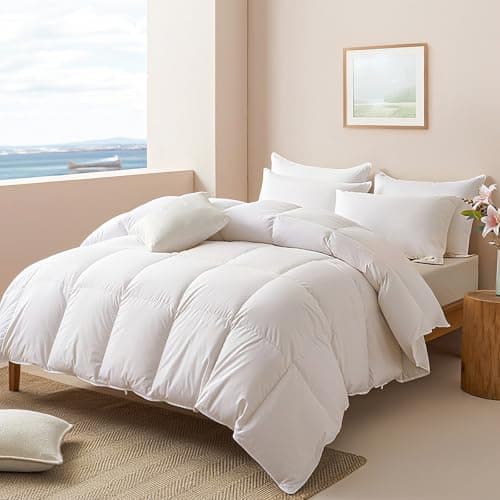 APSMILE Goose Feather Down Fibers Comforter, Baffle Box The cheapest way onto baffle-box construction. The fill is feather-forward rather than pure down, which is exactly why it costs what it does - but the stitching is the real thing and the cotton cover is stated. Best for: Baffle box without the down price | Baffle box without the down price | $79.99 · View on Amazon Price as of October 18, 2026. #ad — we earn a commission. |
| 2 | 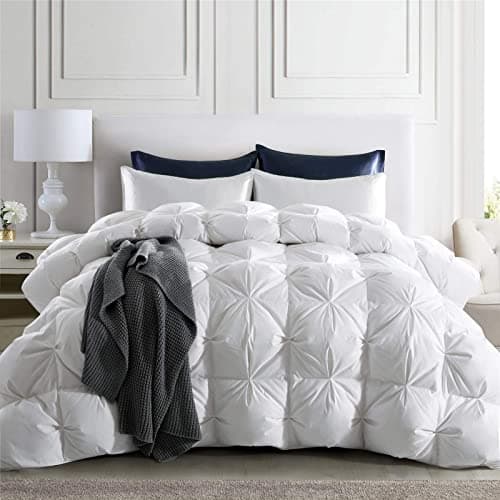 puredown 800 Fill Power Goose Down This is what the construction is for. Real down clusters, a stated 800 fill power, a cotton shell and baffle boxes to hold the loft - the combination where every element is pulling the same direction. Best for: Baffle box done properly | Baffle box done properly | |
| 3 | 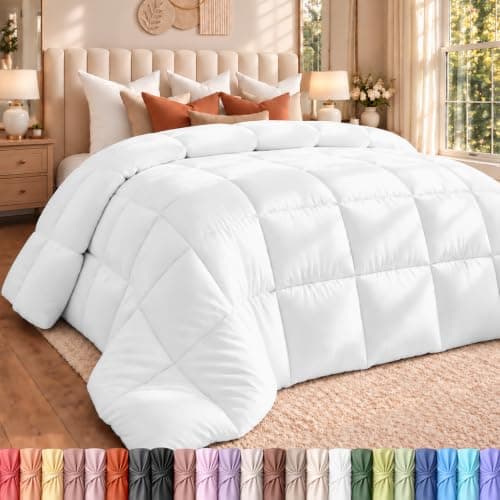 Utopia Bedding Quilted Box-Stitched Duvet Insert The case for the cheaper construction, made honestly. Inside a duvet cover with a polyester fill, the cold seams of a box stitch cost you very little - and this costs a fraction of a baffled insert. Best for: Sewn-through, where sewn-through is fine | Sewn-through, where sewn-through is fine | $29.98 · View on Amazon Price as of October 18, 2026. #ad — we earn a commission. |
| 4 | 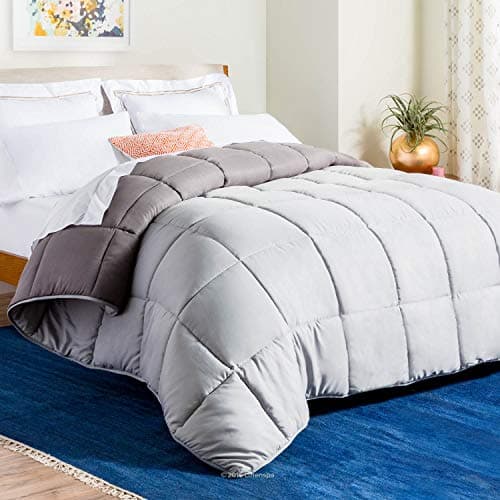 Linenspa Reversible Down Alternative Comforter Box stitching with eight duvet loops, which is the sensible compromise: use it bare in a mild room, then tie it inside a warmer cover when the seams start to matter. Best for: Sewn-through you can use bare now and cover later | Sewn-through you can use bare now and cover later | $44.99 · View on Amazon Price as of October 18, 2026. #ad — we earn a commission. |
The picks, in full
1. Best for Baffle box without the down price
APSMILE Goose Feather Down Fibers Comforter, Baffle Box
The cheapest way onto baffle-box construction. The fill is feather-forward rather than pure down, which is exactly why it costs what it does - but the stitching is the real thing and the cotton cover is stated.
Price as of October 18, 2026. #ad — we earn a commission.
Key specs
- Goose feather and down fibers (as listed)
- Baffle box construction (as listed)
- Organic cotton cover (as listed)
- "All season warmth" (as listed)
- "Quill-free" (as listed)
- Queen, 90 x 90 in
What's good
- Baffle box is stated on the listing, which means fabric walls between compartments rather than stitching pinched through - so the fill reaches full loft and there is no grid of cold seams across the top of the bed
- An organic cotton cover is named, and a natural-fiber shell is what lets moisture pass out of a feather fill instead of being held against it
- "Quill-free" is a meaningful claim on a feather product - quills working through a thin shell are the standard complaint about cheap feather comforters
What's not
- "Goose feather down fibers" is a feather-forward blend, not a pure down duvet. Feather has quills and structure: it is heavier and less lofty than down for the same warmth
- No fill power and no fill weight are published, so the warmth is a word rather than a figure
- "All season" is the vaguest warmth claim in bedding - it means neither light nor heavy and commits to nothing
Skip this one if
You want a true winter weight or you want the fill power stated. The puredown below publishes both; this one publishes neither.
2. Best for Baffle box done properly
puredown 800 Fill Power Goose Down
This is what the construction is for. Real down clusters, a stated 800 fill power, a cotton shell and baffle boxes to hold the loft - the combination where every element is pulling the same direction.
Key specs
- 800 fill power goose down (as listed)
- 100% cotton shell, 700 thread count (as listed)
- Baffle-box, extra warmth (as listed)
- Full/Queen
What's good
- It is sold as goose down rather than "down feather fiber", so the fill is the fluffy clusters that insulate rather than the flat quills that pad out a cheaper blend - and baffle boxes exist to give exactly that kind of fill room to expand
- 800 fill power is a published, measured figure rather than the word "high" - one of very few comforter listings that commits to a number you can compare
- A tightly woven cotton shell is what keeps down clusters from working their way out through the fabric, which is the slow failure mode of a cheap down comforter
What's not
- It is several times the price of everything else on this page, and most of that is the fill rather than the stitching
- "Extra warmth" is genuinely warm - in a heated bedroom this is too much comforter, and an over-warm duvet gets kicked off rather than slept under
- Down needs careful laundering: a commercial machine, a long low-heat dry, and no fabric softener
Skip this one if
Your bedroom is warm, or you want a comforter you can wash at home on a Sunday. Both of the sewn-through picks take a normal machine wash; this one does not.
3. Best for Sewn-through, where sewn-through is fine
Utopia Bedding Quilted Box-Stitched Duvet Insert
The case for the cheaper construction, made honestly. Inside a duvet cover with a polyester fill, the cold seams of a box stitch cost you very little - and this costs a fraction of a baffled insert.
Price as of October 18, 2026. #ad — we earn a commission.
Key specs
- Down alternative fill (as listed)
- Box stitched (as listed)
- Corner tabs (as listed)
- Machine washable (as listed)
- Queen, 88 x 88 in
What's good
- Polyester fill does not compress into the seams the way down does, so the cold-line penalty of sewn-through stitching is smaller with a synthetic fill than with a natural one
- Corner tabs tie it into a cover, and a cover adds its own insulating layer over the top of every seam - which is the practical answer to the cold-line objection
- Machine washable at home on a normal cycle, which no down comforter on this page is
What's not
- Box stitching sews straight through the comforter, so there genuinely is a grid of thin, fill-free lines you can feel with your hand in a cool room
- Budget polyester plus box stitching is the combination most likely to go flat early - a few-years insert, not a decade one
- No stated warmth weight, so the loft is unspecified
Skip this one if
This is going on the bed bare, in a cold room. Sewn-through seams are visible as well as cool, and a bare box-stitched insert looks like what it is.
4. Best for Sewn-through you can use bare now and cover later
Linenspa Reversible Down Alternative Comforter
Box stitching with eight duvet loops, which is the sensible compromise: use it bare in a mild room, then tie it inside a warmer cover when the seams start to matter.
Price as of October 18, 2026. #ad — we earn a commission.
Key specs
- Down alternative fill (as listed)
- Box stitch construction (as listed)
- 8 duvet loops (as listed)
- Reversible, two colors (as listed)
- All-season (as listed)
- Queen
What's good
- Eight duvet loops mean the cold-seam problem has a cheap fix built into the product - put a cover over it and the cover insulates across every stitch line
- Reversible and washable, from a brand with a long and stable Amazon trading history rather than a six-month one
- It is the cheapest honest route to a warmer bed in a mildly cool room, where the difference between constructions is academic
What's not
- It is an all-season weight, so in a genuinely cold room you will feel both the weight and the seams
- Box stitch again: a grid of fill-free lines, and on a reversible comforter the stitching shows on both faces
- Polyester fill does not move moisture the way down or wool does
Skip this one if
Your bedroom is genuinely cold and this will be your only cover. In that room the construction question stops being academic and baffle box earns its money.
Common questions
What is baffle box construction?
Strips of fabric - the baffles - sewn vertically between the top and bottom layers of a comforter, dividing it into three-dimensional compartments. Because each compartment is a box rather than a flattened pocket, the fill inside it can expand to its full height across the whole area, including at the edges where the walls are. The two fabric faces never touch each other, so there is no point on the comforter where the fill thickness drops to zero.
What is sewn-through or box-stitch construction?
The top and bottom fabric layers stitched directly to each other in a grid, with fill trapped in the squares between the stitch lines. It is cheaper to make, it holds fill in place perfectly well, and at every stitch line the two layers are pressed together with nothing between them. Those lines are the compromise: a grid of thin spots across the comforter, each one a path for heat to leave more easily than the lofted squares around it.
Can you feel the cold spots on a sewn-through comforter?
In a cold room, yes - run your hand across one and the stitch lines are noticeably thinner than the squares. Whether that matters depends on three things: how cold the room is, what the fill is, and whether there is a duvet cover over the top. In a heated bedroom under a cover, most people never notice. In a cold bedroom with a bare comforter and a down fill that compresses hard into the seams, it is the difference between a comforter that works and one you supplement with a blanket.
Is baffle box worth paying extra for?
It is worth paying extra for when the fill is good enough to need the room. Down clusters are springy and lofty, and a baffle gives them space to reach full height - which is the whole point of buying down. Pay for baffles when you are also paying for down or a high-loft natural fill, and in a room that actually gets cold. Do not pay for baffles on a budget polyester insert that is going to live inside a duvet cover, because you are buying a solution to a problem you do not have.
Does a duvet cover cancel out the cold seams?
It reduces them substantially. A cover adds a continuous layer of fabric over the whole comforter, including across every stitch line, so the thin spots are no longer the thinnest part of the stack. It does not add loft - the fill is still pinched to nothing at the seam - but it does even out the surface temperature in a way that makes a box-stitched insert perfectly comfortable in most bedrooms. This is the main reason an insert-plus-cover setup is such good value.
Which construction lasts longer?
Baffle box, usually, for a reason that has nothing to do with the stitching strength. Fill migration is what kills a comforter: fill drifts away from the areas you compress most and piles up elsewhere, and you end up with thin patches. A box stitch prevents migration between squares but concentrates all the stress on stitch lines that are already the weakest part of the fabric, and once a seam opens the fill in that square is gone. Baffles spread the load across fabric walls instead. That said, the fill quality matters more than either: cheap polyester goes flat on its own schedule regardless of how it is sewn in.
Sources
Where the facts on this page come from. We cite other people's testing because we don't do our own — here's what that means.
Read next
- The Best Down ComfortersSix down comforters worth buying, the difference between real down and the feather blends most listings hide, and how fill power, fill weight and the shell decide what you get.
- The Best Duvet InsertsSix duvet inserts worth buying, plus the two numbers sellers conflate, why baffle-box construction beats box stitching, and how to pick warmth for your room.
- The Best Comforters for WinterSix genuinely warm comforters for a cold bedroom, sorted by how each fill holds heat - premium down, temperature-regulating wool, and dense down alternative - with an honest note on who should skip each.
- What Is Fill Power?Fill power measures the loft and quality of down — how many cubic inches one ounce fluffs up to fill — so higher fill power means fluffier, warmer-for-its-weight down. It is not the same as warmth: that depends on fill power and fill weight together. Here's how to read the number and the typical quality bands.
- How to Choose a ComforterFive levers decide a comforter: fill (down, down alternative, wool, or cotton), warmth level for your climate, finished comforter versus insert-plus-cover, size and drape, and construction and care.
- Why Is My Down Comforter Flat?The difference between a clumped comforter and a dead one, the long low-heat dry that revives the first, and the three tests that identify the second.
- The Best Comforters Under $50Under $50 the fill is polyester and the shell is thin - the decision is construction, not luxury. Five cheap comforters ranked on stitching, loops, stated size and whether you can wash them at home.