Why Is My Down Comforter Flat?
Nine times out of ten it is moisture, not age. Down clusters mat together when damp and dry into clumps, and the fix is a long tumble on low heat with dryer balls - often two or three hours, far longer than people expect. Try that before you buy anything, because a comforter that has merely clumped is not a comforter that is finished.
We earn a commission if you buy through our links. It doesn't affect our picks — and we never take free products. How this site is funded.
Flat usually means damp, not dead
Down insulates by structure. Each cluster is a three-dimensional branching shape that holds a pocket of still air, and a comforter is warm because it contains millions of them holding millions of pockets. Compress those clusters and you lose the air; the fabric is almost incidental.
Water is what compresses them. Wet down clusters mat together and, as they dry, stick to each other in dense lumps — leaving the spaces between the lumps with almost no fill in them. The result is a comforter that is thick in patches and flat elsewhere, and it reads to the hand exactly like a comforter that has worn out.
It usually has not. In our experience of this category the most common cause of a flat down comforter is an incomplete dry — the outside felt dry, the center of the fill was not, and the matting set. That is recoverable, and the fix is below. Try it before you spend anything.
The fix: a much longer dry than you think
- Use a big enough drum.A queen comforter needs room to tumble. If it cannot rotate freely it will not dry evenly, which is how this happened. A laundromat's large machine is the right tool and the cheapest part of the job.
- Low heat, never high. High heat can scorch the fine down filaments and damages the shell. Low or even no heat with air circulation is slower and safer, and time is what does the work here, not temperature.
- Add two or three dryer balls (or clean tennis balls). They are not a gimmick — they physically beat the clumps apart as the drum turns, which is the only thing that separates matted clusters.
- Go far longer than feels reasonable. Two to three hours total is normal for a queen down comforter. Stop every 30 minutes or so, take it out, and break any remaining lumps apart with your hands before putting it back.
- Check the center, not the surface. Squeeze the middle of a few boxes between your fingers. Any coolness or heaviness means moisture, which means keep going.
- Then shake it out hard — two corners, then the other two — and leave it loose on the bed overnight before putting a cover back on.
If it has merely been stored compressed rather than washed, skip to steps 3, 4 and 6: a 30-minute tumble with dryer balls and a hard shake restores most of the loft a vacuum bag took away. The same mechanical logic applies to pillows, which is covered in how to fluff a pillow.
Clumped or finished? Three tests
Do these after a thorough dry, because a damp comforter fails all three for the wrong reason.
| Test | Clumped (fixable) | Finished (not fixable) |
|---|---|---|
| Shake it out | Moves as distinct lumps you can break by hand | Uniformly limp; nothing to break |
| Light through it | Thin between lumps, fill still present overall | Whole areas with no fill at all |
| Shell condition | Seams intact, no leaking | Down working out through the fabric or seams |
That third row is the one people miss. A shell that has started leaking fill is a terminal diagnosis regardless of how the loft feels today, because the comforter is actively losing the thing that makes it warm — and that is also the failure that re-filling cannot solve, since the new fill escapes the same way. The full replacement checklist is here.
Why it went flat in the first place
- Washed too often. Every cycle is mechanical damage. Down clusters fracture and lose the springiness that fill power measures. The fix is a duvet cover washed weekly so the comforter needs washing once or twice a year instead.
- Fabric softener. It coats the filaments and collapses the branching structure that holds air. Never use it on down, and the rest of the routine is here.
- Sewn-through stitching. If the comforter is pinched flat along every seam, it was never going to hold even loft — that is construction, not wear. Baffle box vs sewn through explains the difference and when it is worth paying for.
- It was feather, not down."Goose feather down fiber" is a feather-forward blend. Feather is flatter and far less springy than down clusters, so it starts with less loft and loses it sooner. If your comforter never felt lofty, this is probably why — the same distinction applies to pillows.
- It was stored compressed. Months in a vacuum bag flatten clusters, and most of that comes back with a tumble. Store it loose instead.
If it is genuinely done, buy for loft retention
Three specs predict whether the next one stays lofty, and all three are printed on good listings:
- Fill power, published as a number. Fill power literally measures how much volume an ounce of down occupies — which is to say how springy it is. A listing that says "high" and stops has told you nothing.
- Baffle-box construction. Fabric walls between compartments, so the fill reaches full height everywhere rather than being pinched at every stitch line.
- A tightly woven natural shell. It keeps fill in and lets moisture out. Both matter here: moisture is what mats clusters, and a leaking shell is what empties the comforter.
The three picks below are ordered on exactly that: the cheapest route to baffle-box construction, the one that publishes a fill weight, and the one that publishes a fill power. Our ranked list is on best down comforters, and if the next one is going inside a cover, duvet inserts is the better page to shop.
Quick picks
| # | Product | Best for | Price |
|---|---|---|---|
| 1 |  APSMILE Goose Feather Down Fibers Comforter, Baffle Box If the old one is genuinely finished, this is the cheapest way to get the construction that resists going flat. Baffle boxes and a cotton cover for roughly the price of a sewn-through synthetic. Best for: Replacing a flat comforter on a budget | Replacing a flat comforter on a budget | $79.99 · View on Amazon Price as of October 18, 2026. #ad — we earn a commission. |
| 2 |  Egyptian Bedding Goose Down & Feather Fiber The mid-price pick that tells you how much fill is actually in it. A stated 48 oz in a baffle-box build is a real answer to the question of why the old one went thin. Best for: A published fill weight, which is what you are really buying | A published fill weight, which is what you are really buying | $164.95 · View on Amazon Price as of October 18, 2026. #ad — we earn a commission. |
| 3 | 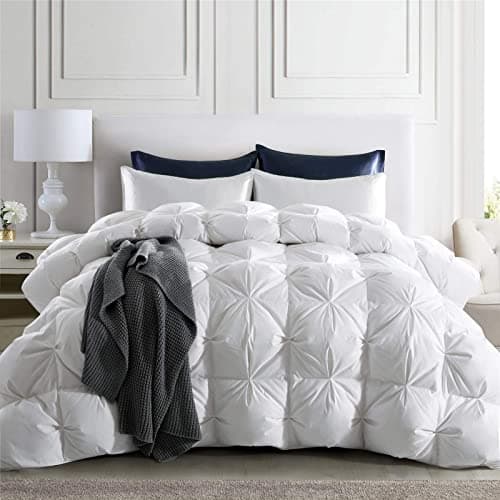 puredown 800 Fill Power Goose Down The construction that resists going flat on every axis at once: real down clusters at a published 800 fill power, baffle boxes, and a tight cotton shell to keep the fill where it belongs. Best for: Not having this problem again | Not having this problem again |
The picks, in full
1. Best for Replacing a flat comforter on a budget
APSMILE Goose Feather Down Fibers Comforter, Baffle Box
If the old one is genuinely finished, this is the cheapest way to get the construction that resists going flat. Baffle boxes and a cotton cover for roughly the price of a sewn-through synthetic.
Price as of October 18, 2026. #ad — we earn a commission.
Key specs
- Goose feather and down fibers (as listed)
- Baffle box construction (as listed)
- Organic cotton cover (as listed)
- "All season warmth" (as listed)
- "Quill-free" (as listed)
- Queen, 90 x 90 in
What's good
- Baffle box construction (as listed) is the single best defense against the flat-patches problem: fabric walls between compartments hold the fill at full height instead of pinching it to nothing at every seam
- An organic cotton cover is named, and a breathable natural shell lets the moisture that causes matting pass out of the fill rather than sitting in it
- "Quill-free" is a meaningful claim on a feather product - quills poking through a thin shell are the other common way a cheap feather comforter dies
What's not
- "Goose feather down fibers" is feather-forward rather than pure down, and feather is flatter and less springy than down clusters - it starts lower and has less loft to lose
- No fill power and no fill weight published, so the loft is a word rather than a figure
- "All season" commits to nothing about warmth
Skip this one if
Your old comforter went flat because the fill was cheap. This is a step sideways in fill quality and a step up in construction - if you want both, go up a pick.
2. Best for A published fill weight, which is what you are really buying
Egyptian Bedding Goose Down & Feather Fiber
The mid-price pick that tells you how much fill is actually in it. A stated 48 oz in a baffle-box build is a real answer to the question of why the old one went thin.
Price as of October 18, 2026. #ad — we earn a commission.
Key specs
- Goose down & feather-fiber blend (as listed)
- 48 oz fill weight, all-season (as listed)
- Baffle-box design (as listed)
- Queen 90x90
What's good
- A stated 48 oz fill weight is unusual and genuinely useful - fill weight is how much material is in there, and a comforter that went thin usually did not have much to begin with
- Baffle-box design (as listed) keeps that fill distributed at full loft rather than letting it pinch flat along stitch lines
- A down-and-feather blend recovers loft when dried properly, which is the whole premise of the fix described above
What's not
- "Goose down & feather fiber" is a blend, not pure down - the feather portion is heavier, flatter and less lofty, which is exactly why 48 oz of it costs what it does
- No fill power is stated alongside the weight, so you know how much fill there is but not how good it is
- Like any natural fill it needs careful laundering, and careless laundering is how comforters end up flat in the first place
Skip this one if
You want maximum loft for minimum weight. That is what fill power buys, and the puredown below publishes it.
3. Best for Not having this problem again
puredown 800 Fill Power Goose Down
The construction that resists going flat on every axis at once: real down clusters at a published 800 fill power, baffle boxes, and a tight cotton shell to keep the fill where it belongs.
Key specs
- 800 fill power goose down (as listed)
- 100% cotton shell, 700 thread count (as listed)
- Baffle-box, extra warmth (as listed)
- Full/Queen
What's good
- Down clusters are springy by structure - they recover from compression in a way feather and polyester fiber do not, and that recovery is literally what fill power measures
- 800 fill power is a published, measured figure rather than the word "high", which makes this one of very few comforter listings you can compare on loft at all
- A tightly woven 700-thread-count cotton shell is what stops down working out through the fabric, which is the slow leak behind a lot of mysteriously thinning comforters
What's not
- It is several times the price of the other two picks here
- "Extra warmth" is genuinely warm - in a heated bedroom this is too much comforter
- Down needs a commercial machine and a very long low-heat dry; the better the down, the more it punishes a rushed wash
Skip this one if
Your bedroom is warm, or you want bedding you can throw in a home washer. Both of those lead to the behavior that flattens comforters.
The cheap stuff worth having
The fix above needs one thing you may not own: something to tumble with the comforter and break up the clumps mechanically as it dries.

Smart Sheep Wool Dryer Balls (XL, 6-Pack)
Thrown in on low heat with a pillow or comforter, they knock the clumps of damp fill apart as it tumbles — which is the whole difference between dried and lumpy.
Skip it if What you're drying is memory foam or latex. Neither belongs in a dryer at all, and no amount of tumbling changes that.
$19.95 · View on AmazonPrice as of October 18, 2026. #ad — we earn a commission.
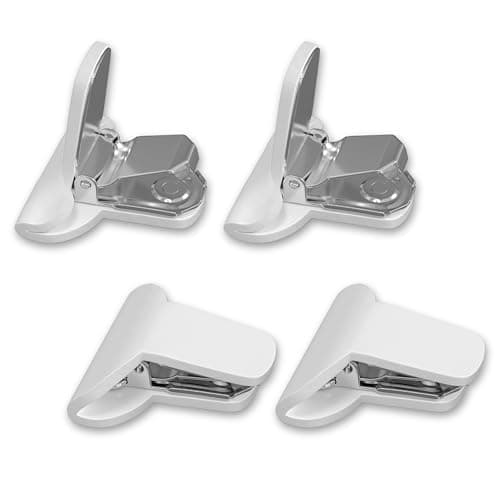
Fresh Ideas Comforter Clips for Duvet Covers (4-Pack)
Clips that grip the insert through the cover, so the duvet stops migrating into one corner overnight. The retrofit for an insert that came without corner loops.
Skip it if Your insert has loops and your cover has ties. Use those — a sewn-in tie holds better than anything clipped on from outside.
Common questions
Why did my down comforter go flat after washing?
Because it was not dried for long enough. Down clusters mat together when wet, and a comforter that comes out of the dryer feeling dry on the outside is very often still damp at the center of the fill - which then dries in matted clumps, leaving flat areas between them. This is the single most common cause of a flat down comforter and it is reversible: put it back in on low heat with a few dryer balls and keep going well past the point you think it is finished, often two to three hours in total, stopping to break clumps apart by hand.
How do you fluff a down comforter?
Mechanically, and the dryer does it best. A tumble on low or no heat for 20 to 30 minutes with two or three dryer balls separates compressed clusters and redistributes fill. Between washes, shake it hard by two corners and then by the other two every time you make the bed - that alone keeps loft noticeably better. Hanging it outside on a dry, breezy day helps too, because ambient moisture in the fill is what makes clusters stick to each other in the first place.
How do I know if the down is dead rather than just clumped?
Dry it thoroughly first, because a damp comforter always looks dead. Once it is genuinely dry: shake it out and watch. Clumped fill moves as lumps and can be broken apart with your hands. Dead fill is uniformly limp - it does not spring back, there are no lumps to break, and the comforter hangs rather than puffs. The second test is the window test: lay it flat and look across it with light behind. Thin patches with no fill in them at all mean the fill has migrated permanently, and that is not recoverable.
Can you add fill to a down comforter?
Technically yes, practically almost never worth it. Some specialist bedding services will open, clean, re-fill and re-sew a down comforter, and for a genuinely high-end duvet with intact baffles that can make sense. For anything in the typical Amazon price range, the cost of the service approaches the cost of a new comforter with a better construction - and if the shell has started leaking fill or the baffles have failed, re-filling it just gives the new down the same place to escape from.
Does a duvet cover make a comforter flat?
A cover does not flatten fill, but a badly matched one can make a comforter look flat. If the cover is tighter than the comforter, it compresses the loft at the edges and the whole thing reads thinner than it is. If the cover is much larger, the comforter slides into a lump and leaves flat empty areas - which looks identical to fill migration and is not. Match the cover size to the insert, tie the corners, and the apparent problem usually disappears.
How do I stop it happening again?
Three habits. Wash it as rarely as possible by keeping it inside a duvet cover and washing the cover weekly instead - every wash cycle is mechanical damage to the fill. When you do wash it, use a machine big enough that it can tumble freely, skip fabric softener entirely, and dry it for far longer than feels necessary with dryer balls in. And shake it out when you make the bed. Those three cost nothing and matter more than which comforter you own.
Sources
Where the facts on this page come from. We cite other people's testing because we don't do our own — here's what that means.
Read next
- The Best Down ComfortersSix down comforters worth buying, the difference between real down and the feather blends most listings hide, and how fill power, fill weight and the shell decide what you get.
- The Best Duvet InsertsSix duvet inserts worth buying, plus the two numbers sellers conflate, why baffle-box construction beats box stitching, and how to pick warmth for your room.
- What Is Fill Power?Fill power measures the loft and quality of down — how many cubic inches one ounce fluffs up to fill — so higher fill power means fluffier, warmer-for-its-weight down. It is not the same as warmth: that depends on fill power and fill weight together. Here's how to read the number and the typical quality bands.
- How to Wash a Comforter or Duvet InsertA wash-and-dry method for comforters and duvet inserts by fill — down and feather, down-alternative and polyester — plus the machine-size problem that quietly ruins big comforters, the duvet-cover shortcut, and the honest test for when to replace instead.
- How Often Should You Replace a Comforter?Four one-minute tests for whether a comforter is done - loft, fill distribution, smell and warmth - plus the single habit that doubles the life of the next one.
- Baffle Box vs Sewn ThroughThe two ways a comforter is stitched, what each does to warmth and lifespan, and why a cheap baffle-box comforter can be a worse buy than an honest sewn-through one.
- How to Fluff a Pillow (by Fill Type)How to bring loft back to a flat pillow by fill type — hand-fluffing and a low-heat dryer for down and poly, kneading and air for foam, redistributing hulls for buckwheat — plus the fold test for when it's a replacement, not a laundry job.