The Best Feather Pillows
Buy the puredown feather-and-down standard pair. A 100% cotton shell over a feather core is the whole formula, and this is the cheapest version of it from a seller with a long trading history. Four more below for a denser shell, a gusseted edge, and the one worth buying singly first.
We earn a commission if you buy through our links. It doesn't affect our picks — and we never take free products. How this site is funded.
Quick picks
| # | Product | Best for | Price |
|---|---|---|---|
| 1 | 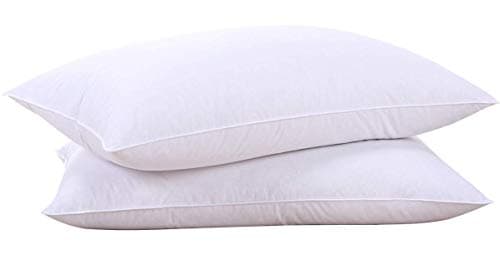 puredown Goose Feathers and Down Pillows, Standard (Set of 2) The formula that matters on this shelf is a feather-and-down blend inside a 100% cotton shell, and this is the least expensive version of it from a seller with years of Amazon trading history behind it. Sold as a pair, which is how feather pillows should be bought. Best for: Most people, and the cheapest route to the right formula | Most people, and the cheapest route to the right formula | |
| 2 | 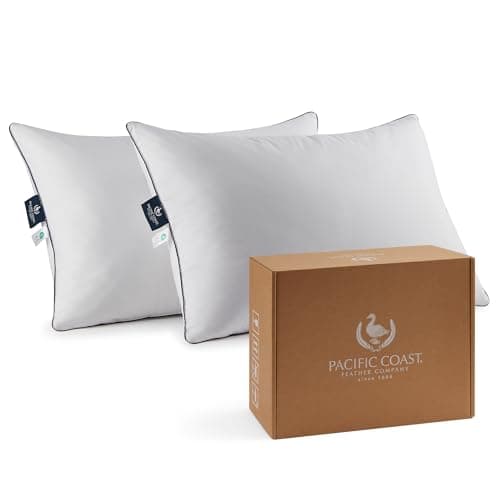 Pacific Coast Goose Feather and Down Bed Pillows, Standard (Set of 2) The only pick here whose listing commits to a firmness and a downproof shell in writing. Pacific Coast has supplied hotels for decades, and this is the pillow that answers the question of what extra money buys on this shelf: specifications you can hold them to. Best for: The premium end, where the money visibly goes somewhere | The premium end, where the money visibly goes somewhere | |
| 3 | 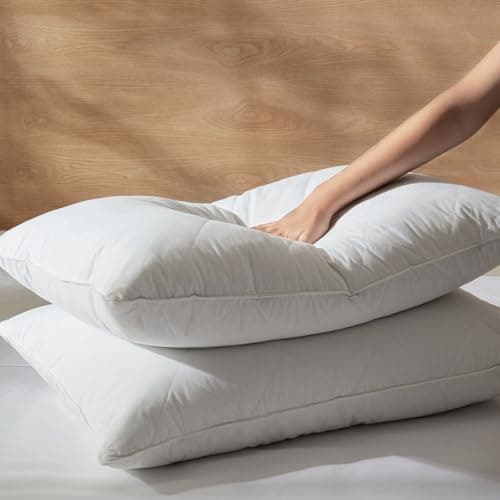 Three Geese White Goose Feather Cotton Pillows, Queen (Set of 2) 600 thread count organic cotton is the tightest weave published by any listing on this page, and on a feather pillow the weave is the durability story. It is also the most specific listing here: shell, thread count, firmness and dimensions are all printed. If quills poking through is what put you off feather pillows before, this is the pick that addresses it directly. Best for: The densest shell, and the best-documented listing here | The densest shell, and the best-documented listing here | $49.98 · View on Amazon Price as of October 18, 2026. #ad — we earn a commission. |
| 4 | 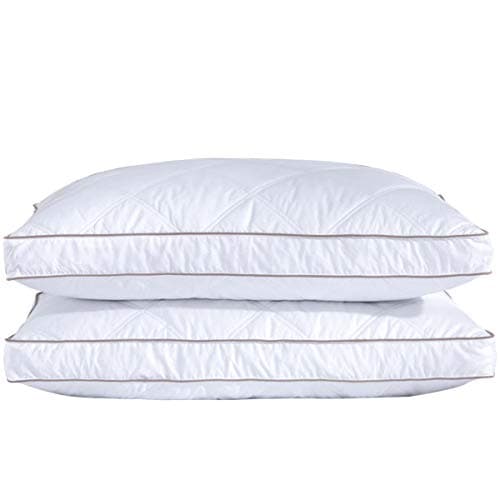 puredown Gusseted Goose Feathers and Down Pillows, Standard/Queen (Set of 2) A gusset is a vertical side wall sewn around the edge of the pillow, and it is the only construction trick that keeps a feather pillow from flattening to its edges. If you sleep on your back and wake up with your chin on your chest, this is the one structural answer feather has. Best for: Back sleepers who want the height to survive the night | Back sleepers who want the height to survive the night | |
| 5 | 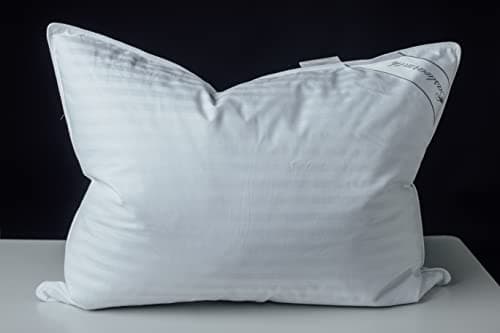 Eastwarmth Goose Down Feather Soft Pillow, Standard (Single) The only single pillow here, and that is why it is on the page. Feather is a polarizing feel and most listings make you buy two to find out - this one lets you spend the least possible to answer the question, with a stated size and a cotton shell. Best for: Buying one to find out whether you like feather at all | Buying one to find out whether you like feather at all | $24.99 · View on Amazon Price as of October 18, 2026. #ad — we earn a commission. |
Feather is not down, and the difference is a quill
These two words get used interchangeably in bedding listings and they describe different parts of the same bird. Down is the soft undercoat: three-dimensional clusters with no shaft running through them, which trap air and weigh almost nothing. A feather is outer plumage, built around a stiff central quill.
That quill explains everything below. It gives a feather pillow structure a pure down pillow does not have, which is why feather pillows feel supportive and a little crunchy rather than cloud-like. It makes them heavy. It lets you punch one into a shape that stays. And it is the thing that eventually works its way out through the shell and pricks your ear at 2am. The full comparison is here, and if what you actually want is the weightless version, our down picks are a different page and a different price bracket.
One practical note before the criteria: almost nothing on this shelf is pure feather. Every pick on this page is a feather-and-down blend, with feather doing the supporting and a share of down softening the surface. That is the normal construction, not a compromise.
The four things worth checking, in order
We ranked these on construction you can read off the listing, because construction is what we can verify and feel is what we cannot. In rough order of how much each one changes the pillow:
- The shell, first and by a distance.A feather pillow's weak point is quill migration, and the only thing standing between a quill and your face is the weave. 100% cotton is the floor. Tightly woven or "downproof" cotton is better. A polyester shell over a feather fill is a pillow that will shed, and it is the clearest single reason to walk past a cheap listing.
- Whether the listing commits to anything. Fill weight, feather-to-down ratio, firmness, stated dimensions. Most feather listings publish none of these, and the ones that do are telling you something about the seller as much as about the pillow. This is where the premium picks on this page actually earn their premium.
- Gusset or plain.A gusset is a vertical side wall sewn around the pillow's edge. It holds loft out to the edges instead of letting the pillow flatten into a pancake with a lump in the middle. For a fill that compresses as readily as feather, it is the one structural fix available.
- Single or pair, and what that really costs. Feather pillows are usually sold two to a pack, which makes the sticker price look higher than the per-pillow price. Comparing a pair against a single is the most common way people mis-shop this shelf.
What is deliberately not on that list is thread count as a comfort claim, cover fabric adjectives, and anything described as hotel-grade. Thread count matters here only as a proxy for how tightly the shell is woven, which is a durability question rather than a softness one — and the number lies more often than it helps.
How the five compare, from the listings
| Pick | Shell stated | Firmness stated | Gusset | Pack |
|---|---|---|---|---|
| puredown Standard | 100% cotton | Not stated | No | 2 |
| Pacific Coast | Downproof cotton | Medium-firm | No | 2 |
| Three Geese | 600 TC organic cotton | Soft | No | 2 |
| puredown Gusseted | 100% cotton | Not stated | Yes | 2 |
| Eastwarmth | 100% cotton | Soft | No | 1 |
Look at the "firmness stated" column. Two of five listings decline to tell you how firm the pillow is at all, and one of the two that say "soft" also recommends itself to side sleepers — a claim soft feather cannot support. That is the state of this shelf, and it is why the pick with a downproof shell and a published medium-firm rating sits second rather than fifth despite costing the most.
What premium actually buys on this shelf
This is the question people arrive asking, so here is the straight version. The feathers are a commodity. A budget feather pillow and an expensive one can hold broadly similar fill, and no listing on this page publishes enough detail to prove otherwise. What the extra money reliably buys is three things:
- A better shell. Downproof weave or a high thread count cotton, which is the difference between a pillow that sheds quills in year two and one that mostly does not.
- Published specifications. A stated firmness and stated dimensions mean you can predict the pillow instead of discovering it. That sounds like paperwork, and it is the main reason returns happen.
- A company behind it. An established bedding supplier has a warranty department. An Amazon-native label has a storefront.
What it does not buy is a different night's sleep. The real upgrade on this shelf is moving from a polyester-shelled no-name pillow to a cotton-shelled one from a seller with history. Moving from there to the priciest feather pillow in the aisle is buying confidence — a legitimate thing to buy, as long as you know that is what you are doing.
Who should not buy a feather pillow
We would rather talk you out of this category than sell you the wrong pillow in it. Feather is a bad answer if:
- You sleep on your side with broad shoulders. Feather compresses under load, so the loft you need to fill the shoulder gap is exactly the loft it will not hold. Side sleepers want something that resists.
- You have a feather or down allergy, or you are reacting to dust mites rather than to the fill. A zippered protector helps with mites; down alternative is the honest answer for the feathers themselves.
- You want a pillow you never think about. Feather pillows need fluffing. If a pillow you reshape every morning sounds like a chore rather than a ritual, foam holds its own shape and asks nothing of you.
- You run hot. Dense fill under a tight cotton shell is not a breathable combination. Airflow beats gel, and feather has less of it than shredded foam or latex.
Living with one: fluff it, protect it, do not over-wash it
Three habits decide whether a feather pillow lasts two years or ten. Fluff it every morning — pick it up, punch both ends toward the middle and shake it out, which takes about four seconds and is the entire maintenance routine. Zip a pillow protector on underneath the pillowcase, because body oil is what makes a feather pillow heavy and sour over time, and a protector means the thing you wash weekly is a thin cover rather than the fill.
And wash the pillow itself rarely. Feather survives a gentle machine cycle, but the drying is where it goes wrong: low heat, much longer than you expect, with dryer balls in to break the clumps apart. The full method is on our pillow washing guide, and the fold test tells you when washing has stopped being the answer.
About the prices on this page
We do not type prices into pages. The figure on each button comes from our own price check against the live listing, stamped with the date it last ran, because a typed price is wrong within a week and a wrong price is the fastest way to lose a reader. Note that four of these five are pairs rather than singles — compare the per-pillow figure, not the sticker.
Feather and down is also what the better hotels put on a bed, usually gusseted and in a tight high-thread-count shell, sold in pairs. What hotel collection actually means decodes the phrase and ranks five two-packs behind it.
What we will not tell you
We have not slept on these five pillows, we have no test lab, and we are not going to invent a support score for a feather pillow. Everything ranked above is construction read off the listing and the material behavior that follows from it — a quill is stiff, feather compresses, a tight weave holds fill in. Where a listing declines to publish a spec, we have said so rather than filling the gap with an adjective. That is the method, and here is the longer version of it.
The picks, in full
1. Best for Most people, and the cheapest route to the right formula
puredown Goose Feathers and Down Pillows, Standard (Set of 2)
The formula that matters on this shelf is a feather-and-down blend inside a 100% cotton shell, and this is the least expensive version of it from a seller with years of Amazon trading history behind it. Sold as a pair, which is how feather pillows should be bought.
Key specs
- Goose feather and down fill (as listed)
- 100% cotton cover (as listed)
- Standard size (as listed)
- Set of 2 (as listed)
- Hotel collection (as listed)
What's good
- A 100% cotton shell is the single spec that decides whether a feather pillow is tolerable: tightly woven cotton holds the quill tips in, and the polyester shells on cheaper listings do not
- A feather core with down in the blend means it sculpts around your head and stays where you push it - the one thing a solid foam pillow can never do
- Sold as a pair, so you are not paying single-pillow pricing twice to get a matched bed
What's not
- Feather pillows need fluffing every morning or they stay in whatever shape you left them, which is a daily habit no foam pillow asks of you
- The listing does not publish a feather-to-down ratio or a fill weight, so you cannot know in advance how dense it will be - the spec gap that separates this from the Pacific Coast pick
- Quills work through any shell eventually. Cotton slows it down, it does not stop it
Skip this one if
You are a side sleeper with broad shoulders. Feather compresses under load, so the loft you need at the shoulder gap is exactly the loft this will not hold - see our side sleeper picks instead.
2. Best for The premium end, where the money visibly goes somewhere
Pacific Coast Goose Feather and Down Bed Pillows, Standard (Set of 2)
The only pick here whose listing commits to a firmness and a downproof shell in writing. Pacific Coast has supplied hotels for decades, and this is the pillow that answers the question of what extra money buys on this shelf: specifications you can hold them to.
Key specs
- Goose feather and down fill (as listed)
- Downproof 100% cotton shell (as listed)
- Medium-firm support (as listed)
- Standard size, set of 2 (as listed)
- Hotel pillow for sleeping (as listed)
What's good
- "Downproof" is a real construction term, not an adjective - it means a weave tight enough to stop feather tips migrating out, and it is the most useful word on any feather pillow listing
- A published firmness is rare on this shelf; it means you can predict the pillow before it arrives instead of discovering it
- Pacific Coast is a long-standing bedding supplier rather than an Amazon-native label, so there is a company behind the warranty rather than a storefront
What's not
- It is the most expensive pick here and the construction is still feather and down - you are buying a better shell and a stated spec, not a different sleeping experience
- Medium-firm on a feather pillow still means it compresses overnight; firm, for feather, is a relative word
- Feather and down together means this is not an allergy-friendly pillow whatever the shell says
Skip this one if
You want the cheapest acceptable feather pillow. The puredown pair does the same job for less, and the honest gap between them is specification confidence rather than comfort.
3. Best for The densest shell, and the best-documented listing here
Three Geese White Goose Feather Cotton Pillows, Queen (Set of 2)
600 thread count organic cotton is the tightest weave published by any listing on this page, and on a feather pillow the weave is the durability story. It is also the most specific listing here: shell, thread count, firmness and dimensions are all printed. If quills poking through is what put you off feather pillows before, this is the pick that addresses it directly.
Price as of October 18, 2026. #ad — we earn a commission.
Key specs
- Soft goose feather and down fill (as listed)
- 600 thread count organic cotton cover (as listed)
- Soft support (as listed)
- Queen, 20 x 28 in (as listed)
- Listed for side and back sleepers (as listed)
What's good
- A 600 thread count cotton shell is denser than anything else on this page publishes, and a denser weave is the mechanical answer to quill migration
- It publishes a real dimension - 20 by 28 inches - alongside the shell, the thread count and the firmness, which is more specification than any other listing here commits to
- A true queen footprint is longer than a standard, which suits anyone who moves around at night rather than sleeping in one spot
What's not
- The listing calls it soft and also recommends it for side sleepers, and those two things do not sit together - a soft feather pillow will not hold a side sleeper's shoulder gap
- A tighter shell traps more heat than a looser one, so the spec that fixes quills works slightly against you if you sleep warm
- No fill weight or feather-to-down ratio published, the same gap as most of this shelf
Skip this one if
You sleep hot. A high-thread-count shell over a dense feather fill is one of the less breathable combinations in the pillow aisle - our cooling picks are a better starting point.
4. Best for Back sleepers who want the height to survive the night
puredown Gusseted Goose Feathers and Down Pillows, Standard/Queen (Set of 2)
A gusset is a vertical side wall sewn around the edge of the pillow, and it is the only construction trick that keeps a feather pillow from flattening to its edges. If you sleep on your back and wake up with your chin on your chest, this is the one structural answer feather has.
Key specs
- Goose feather and down fill (as listed)
- Gusseted construction (as listed)
- 100% cotton cover (as listed)
- Standard / Queen, set of 2 (as listed)
- Hotel collection (as listed)
What's good
- The gusset holds a consistent height from the center out to the edge, so the whole pillow stays usable instead of only the middle
- Gusseted pillows keep their shape inside a pillowcase better, which means less daily fluffing than a plain-sewn feather pillow needs
- Same cotton shell and the same brand history as the top pick, for a very similar outlay
What's not
- A gusset adds loft, and extra loft is wrong for stomach sleepers - this is the pick most likely to crane your neck if you sleep face-down
- More fill in a taller pillow means more weight, and feather pillows are already heavy to move around
- Gusset seams are extra stitching, which is extra places for a quill to find its way out over the years
Skip this one if
You sleep on your stomach, or you already use a thin pillow and like it. Added loft is the entire point of a gusset and it is the wrong direction for you.
5. Best for Buying one to find out whether you like feather at all
Eastwarmth Goose Down Feather Soft Pillow, Standard (Single)
The only single pillow here, and that is why it is on the page. Feather is a polarizing feel and most listings make you buy two to find out - this one lets you spend the least possible to answer the question, with a stated size and a cotton shell.
Price as of October 18, 2026. #ad — we earn a commission.
Key specs
- Goose down and feather fill (as listed)
- 100% cotton shell (as listed)
- Soft, supportive (as listed)
- Standard, 20 x 26 in (as listed)
- One pillow (as listed)
What's good
- One pillow at the lowest outlay on the page is the honest way to test a feel you may dislike, rather than committing to a matched pair
- It publishes an actual dimension - 20 by 26 inches - which is more than several pricier listings here manage
- Soft is a real and useful answer if you are a stomach sleeper or you layer two pillows, rather than a shortfall
What's not
- Eastwarmth is an Amazon-native brand with no trading history to check and no returns operation beyond Amazon's own
- A soft feather fill compresses further than anything else here, and it will need fluffing most mornings
- Buying singly costs more per pillow than any of the pairs above, so if you already know you like feather this is the expensive way to buy two
Skip this one if
You already know feather suits you. Buy one of the pairs - per pillow they are cheaper and the shells are better documented.
The cheap stuff worth having
Two cheap add-ons that matter more on a feather pillow than on any other kind: a zippered protector, because feather fill cannot take a weekly wash, and dryer balls, because a wet feather pillow dries into clumps without something knocking it apart.
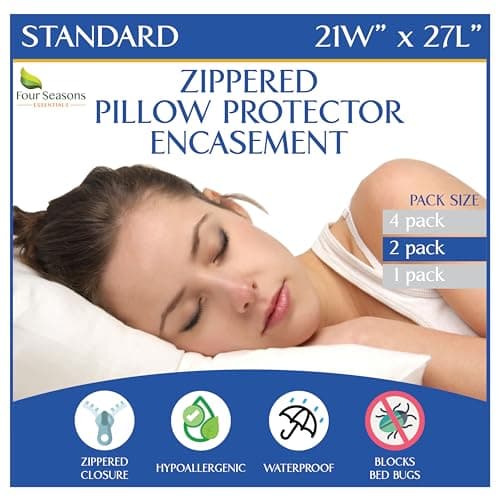
Four Seasons Essentials Zippered Pillow Protectors (Set of 2)
Zip one under each pillowcase and it catches the sweat and hair oil before any of it reaches the fill — so the weekly wash is a thin cover, not the whole pillow.
Skip it if You already wash your pillows on schedule and don't mind the job. A protector buys convenience and a longer-lived pillow, not a better night's sleep.
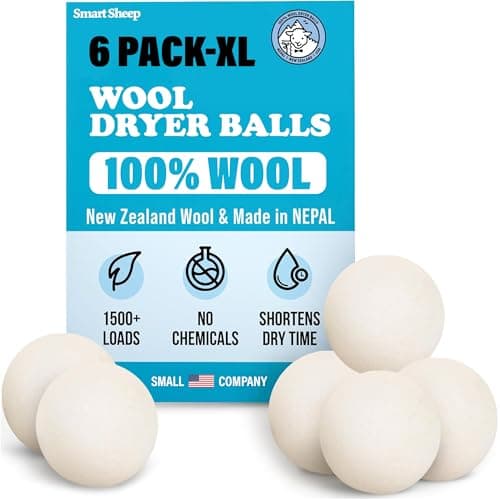
Smart Sheep Wool Dryer Balls (XL, 6-Pack)
Thrown in on low heat with a pillow or comforter, they knock the clumps of damp fill apart as it tumbles — which is the whole difference between dried and lumpy.
Skip it if What you're drying is memory foam or latex. Neither belongs in a dryer at all, and no amount of tumbling changes that.
$19.95 · View on AmazonPrice as of October 18, 2026. #ad — we earn a commission.
Common questions
What is the difference between a feather pillow and a down pillow?
They come from the same bird and behave nothing alike. Down is the soft undercoat - three-dimensional clusters with no quill, which trap air and almost no weight. Feathers are the outer plumage, each one built around a stiff central quill. That quill is the whole difference: it gives a feather pillow structure, support and a bit of crunch, and it is also the thing that eventually works its way through the shell and pricks you. Most pillows sold as feather pillows are actually a blend, with feather doing the supporting and a percentage of down softening the surface. A pillow sold as down will be mostly or entirely clusters, costs several times more, and has almost no structure at all.
Are there big differences between a premium and a budget feather pillow?
Yes, but not where the marketing points. The feathers themselves are a commodity, and a budget pillow and a premium one may hold very similar fill. What the extra money reliably buys is the shell and the paperwork: a downproof, tightly woven cotton cover that keeps quills in, a published firmness so you know what is arriving, a stated fill weight, and a company with a warranty operation behind it. What it does not buy is a fundamentally different night's sleep. The honest version is that going from a polyester-shelled no-name pillow to a cotton-shelled one from an established seller is a real upgrade, and going from there to the most expensive feather pillow on the shelf is mostly buying specification confidence.
Do feather pillows poke you?
Some will, eventually, and any listing claiming otherwise is overselling. A quill is a stiff shaft and it migrates toward the surface every time you compress the pillow. Three things slow it down: a high thread count cotton shell, a downproof weave, and a pillow protector zipped on underneath the pillowcase. The usual remedy when a quill does find its way out is to pull it from the outside rather than push it back, and to turn the pillow so the worn patch is not under your ear. If a brand new pillow is already shedding quills through the shell, that is a shell problem and worth returning.
Can you wash a feather pillow?
You can, carefully, and most of the listings here say machine washable - but the drying is the part that goes wrong. Wash on a gentle cycle with a small amount of detergent in a machine big enough for the pillow to move, then run a second rinse to get the soap out of the fill. Drying is the long part: low heat, far longer than you expect, with wool dryer balls or clean tennis balls in to break the clumps apart as the feathers dry. A feather pillow put away even slightly damp develops a smell that never fully leaves, which is the real argument for zipping a protector on and washing that instead.
Are feather pillows good for side sleepers?
Usually not, and this is the most important thing on this page. Side sleeping opens a gap between your ear and the mattress roughly as wide as your shoulder, and a pillow's only job is to fill it without bending your neck. Feather compresses under load, so the loft measured in the shop is not the loft left at 4am with your head on it - you end up with your neck angled down for most of the night. Back and stomach sleepers are the natural market for feather, because the gap they need filled is shallow and a pillow that gives way is an advantage. A broad-shouldered side sleeper wants a firm, high pillow that resists compression instead.
Why do hotel pillows feel like this?
Because most of them are exactly this: a feather core for support with a down or down-blend layer on top, inside a tight cotton shell, and two of them on every bed. It is also why a hotel bed feels different from a firm foam pillow at home - you can punch a feather pillow into a shape and it stays there. The part hotels do not advertise is the daily labor: housekeeping fluffs and reshapes those pillows every single morning, and a feather pillow that nobody fluffs is a flat feather pillow by the end of the week.
How often should a feather pillow be replaced?
Use the fold test rather than a calendar. Fold the pillow in half and let go - if it springs back open it still has structure, and if it stays folded the fill has broken down and it is not supporting anything. Feather pillows often outlast synthetic ones because broken quills still have some loft to give, but they also get heavier and denser with years of absorbed body oil, which is the point at which replacing beats washing.
Sources
Where the facts on this page come from. We cite other people's testing because we don't do our own — here's what that means.
- Sleep Foundation - feather pillows (fill, construction and care)
- Sleep Foundation - down vs down alternative
- Sleep Foundation - how to choose a pillow
- Responsible Down Standard - what certified down and feather means
- Oeko-Tex Standard 100 - what textile certification covers
- FTC - Endorsement guides (why this disclosure exists)
Read next
- The Best Down PillowsSix real goose down and feather pillows, sorted by how much down is actually in them — plush pure down to firmer feather blends — with honest cons and a skip note on every one.
- The Best Down Alternative PillowsSix down alternative pillows — the soft, washable, hotel-style fiber pick — ranked by plushness, gusset support and cooling, with honest cons and a skip note on every one.
- Down vs Feather PillowsDown is the soft cluster that lofts and cradles; feather is the flat, springy fill with quills that add support but can poke. Blends split the difference. How each sleeps and which fill fits you.
- What Is Fill Power?Fill power measures the loft and quality of down — how many cubic inches one ounce fluffs up to fill — so higher fill power means fluffier, warmer-for-its-weight down. It is not the same as warmth: that depends on fill power and fill weight together. Here's how to read the number and the typical quality bands.
- How to Wash Pillows (by Fill Type)A wash-and-dry method for every pillow fill type — down, down-alternative, memory foam, latex and buckwheat — plus the protector trick that cuts the job in half and the fold test for when it's time to replace one.
- When to Replace Your PillowThe honest signs a pillow is finished — lost loft, permanent lumps, waking stiff, yellowing and odor — plus rough lifespans by fill type and the fold and flat-hand tests that tell you for sure.
- The Best Pillows for Back SleepersSix pillows that hit the medium loft a back sleeper needs — enough to fill the neck's hollow without tipping the head forward — with honest cons on every pick.
- The Best Reading PillowsA reading pillow stands or falls on three things: how far up your back it reaches, whether the fill collapses under load, and whether the cover comes off. Five backrests ranked on all three, with the wedge-pillow distinction made plain.