The Best RV and Camper Mattresses
The first thing about an RV mattress isn't firmness or foam — it's size, because an "RV short queen" is 60x74, not the 60x80 queen you sleep on at home. Measure the platform first, then pick a boxed bed that fits it. Six that do, and who each is wrong for.
We earn a commission if you buy through our links. It doesn't affect our picks — and we never take free products. How this site is funded.
Quick picks
| # | Product | Best for | Price |
|---|---|---|---|
| 1 | 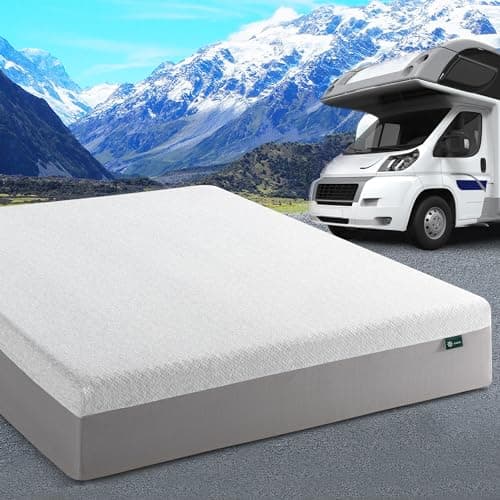 Zinus 10" Short Queen Ultima RV Memory Foam The safe default for a main RV bed: a full 10 inches of memory foam cut to short-queen dimensions, from the most established boxed-mattress name on Amazon. Best for: Most RVs (main bed) | Most RVs (main bed) | $285.78 · View on Amazon Price as of September 10, 2026. #ad — we earn a commission. |
| 2 | 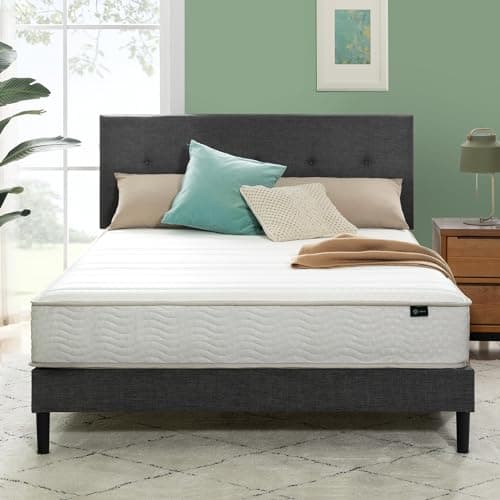 Zinus 8" Short Queen Foam and Spring RV The one to buy if flat memory foam feels like quicksand to you. A foam-over-spring build in short-queen sizing gives you push-back and a little bounce that all-foam can't. Best for: Support with some bounce | Support with some bounce | $199.21 · View on Amazon Price as of September 10, 2026. #ad — we earn a commission. |
| 3 | 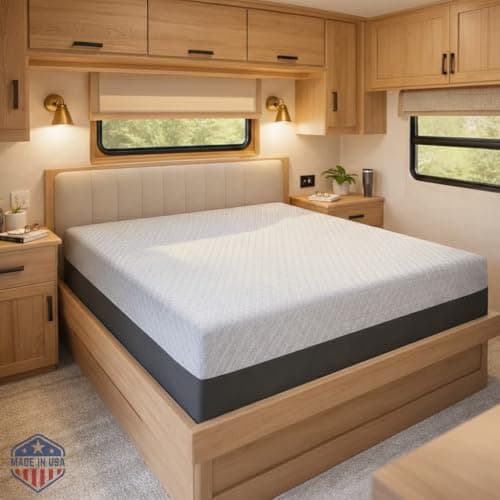 Celestial Sleep 10" RV Short Queen The pick for anyone who wants the paperwork to match the pitch: a 10-inch short queen that states made-in-USA, CertiPUR-US, Oeko-Tex and fiberglass-free all on one listing. Best for: Certified, made in USA | Certified, made in USA | $269.95 · View on Amazon Price as of September 10, 2026. #ad — we earn a commission. |
| 4 | 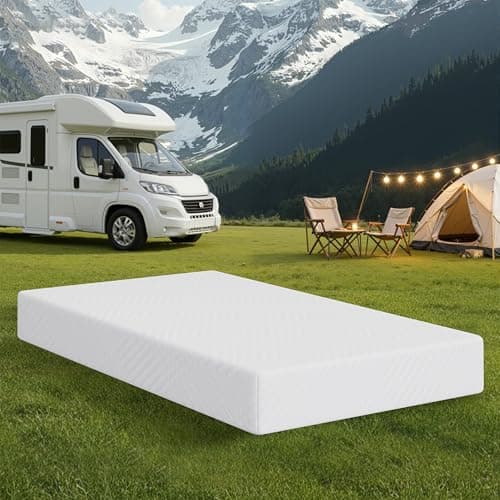 MLILY 8" RV Short Queen Memory Foam The other 8-inch route for a short-queen platform: green-tea-infused memory foam in a box, from a mattress maker rather than an anonymous RV-size reseller. Best for: Brand-name 8-inch foam | Brand-name 8-inch foam | $209.00 · View on Amazon Price as of September 10, 2026. #ad — we earn a commission. |
| 5 | 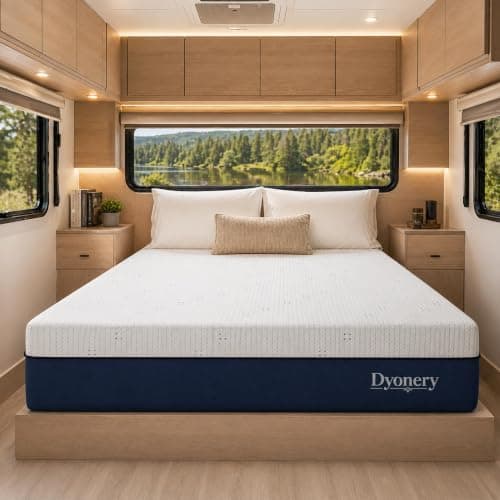 Dyonery 10" RV Short Queen Gel Memory Foam A 10-inch short queen with a gel-infused comfort layer — the honest version of a cooler foam bed for a camper, as long as you know what gel can and can't do. Best for: Gel-foam alternative | Gel-foam alternative | |
| 6 | 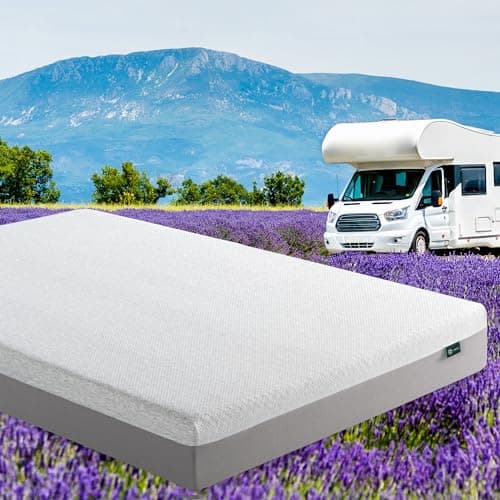 Zinus 8" Short Queen Ultima RV Memory Foam The bunk-and-tight-space pick: the same Ultima line as the 10-inch main-bed choice, in a low-profile 8-inch build that fits where a thicker bed won't. Best for: Thin, light, for tight bunks | Thin, light, for tight bunks |
Measure the platform before you shop anything else
Every other decision about an RV mattress comes second to this one, so start here: an RV short queen is not a queen.A standard queen is 60 inches wide by 80 long. An RV short queen is 60 wide by 74 or 75 long — the same width, but a good five or six inches shorter. Buy a normal "queen" because the width matched and it will hang off the foot of your platform, foul a slide-out, or refuse to lie flat under a wardrobe door. It's the most common RV mattress mistake there is, and it happens because the word on the listing looks familiar.
And short queen is only the most common odd size. RVs are built to no single standard, so you'll also run into RV king (usually wider and shorter than a home king), three-quarter beds, and bunk mattresses cut to whatever dimensions the coachbuilder felt like using that year. Two campers of the same length can have different bed sizes. This is why the only reliable first step is a tape measure: get the actual width, length, and — just as important — the vertical clearance above the platform for the bed in question, and write all three down before you look at a single product. Our mattress sizes guidelays out how RV dimensions differ from the household sizes you already know, and it's worth five minutes before you spend anything. Every pick on this page is an RV short queen, because that's the size the majority of campers use — but confirm yours is one before you assume.
The reason to be this fussy up front is that size is the one thing you cannot fix after the fact. A firmness you dislike you can soften with a topper. A bed that runs a little warm you can help with sheets and ventilation. A mattress that's five inches too long simply does not fit, and no amount of anything rescues it. Get the numbers right first, and the rest of this page is about choosing well within them.
Why a boxed mattress is the only sane way to bed a camper
Once the size is settled, the format is the next thing that actually matters, and here the RV answer is clearer than it is at home: buy a boxed, compressed mattress, not a traditional one. A bed-in-a-box arrives rolled and vacuum-sealed down to something one person can carry, and you unbox it in place on the platform. A traditional innerspring, by contrast, comes full-size, heavy, and unbendable — and now picture wrestling that through a 28-inch camper door, around a dinette, and onto a bed tucked into a corner or lofted over the cab. The boxed format was built for exactly this problem. Our bed-in-a-box guidecovers how the compression works and what to expect when you cut it open; the short version is that it's the format that turns a two-person furniture struggle into a one-person job.
Within the boxed world, the choice is between all-foam and a foam-over-spring build, and for an RV that choice leans foam for a practical reason: memory foam compresses smallest.It ships in the most manageable box, is the lightest to lift onto a bunk, and contours and isolates motion well on a narrow bed where you and a partner are close together. That's why four of the six picks here are foam and why the Zinus 10-inch is the default recommendation. If you want the full case for the material, our memory foam guide goes deep, but the RV-specific point is simply that it packs down the smallest and handles the easiest.
A foam-over-spring build — like the Zinus 8-inch foam-and-spring here — adds two things foam can't: support that pushes back when you shift your weight, and a little bounce that makes getting in and out easier rather than feeling like you have to climb out of a hug. It also leaves open channels for air, which, as we'll get to, is worth more in a sealed camper than in a bedroom. The trade is motion transfer: springs carry a restless partner's movement across the bed, and on a narrow RV mattress you feel that more. Foam if you value easy handling and motion isolation; foam-over-spring if you want support and bounce and don't share with someone who tosses.
How thick — headroom decides, not comfort
Thickness is where RV shopping diverges hardest from buying a bed for a bedroom, because in a camper the ceiling is part of the equation. At home, thicker is mostly just more bed. In an RV, thickness you don't have the clearance for is a bed you crack your head on every time you sit up. So the rule is: match the thickness to the space, not to some idea that more inches is always better.
For a main RV bed with normal headroom, 10 inches is the sweet spot. That's enough comfort foam over enough support core that a full-sized adult isn't feeling the platform through it every night, which is exactly the promise a thinner bed can't always keep. The Zinus 10-inch, the certified Celestial, and the gel Dyonery are all built for this job. For a tight bunk, a drop-down, or a cabover where you sit up close to the ceiling, drop to 8 inches: you keep the headroom, and the bed stays light enough for one person to lift into place. The 8-inch Zinus Ultima exists for precisely that spot, and the 8-inch MLILY and foam-and-spring pick suit lower-clearance main beds too. Thinner than 8 inches is really only right for a child or an occasional guest, where a light body doesn't compress a deep comfort layer anyway.
The practical takeaway is to measure your vertical clearance the same way you measured length and width. Sit up in the bed and see how much room is over your head; that number decides your thickness far more than any comfort preference does. A 10-inch bed you keep bumping into is a worse buy than an 8-inch one you fit under comfortably.
Small-space stuff: fiberglass-free, and the damp nobody warns you about
Two things matter more in an RV than they do in a house, purely because of the size of the space. The first is what the mattress is made of. Every mattress sold in the US has to pass a federal open-flame test, and the cheapest way to meet it is a woven fiberglass sock under the cover as a fire barrier. Left zipped up it's inert — but if the cover ever comes off, the fibers can shed and spread, and that's a far worse problem in a small sealed camper you live in at close quarters than in a spare bedroom. So a stated fiberglass-free build is worth looking for here specifically: the Celestial and Zinus picks state their certifications plainly, and the same logic that makes it a good idea on a cheap home bed applies double in an RV. Our cheap mattresses pageexplains the fiberglass question in full and why "CertiPUR-US" on the foam and "fiberglass free" on the fire barrier are two separate checks, not one.
There's a related first-day point worth setting expectations on: off-gassing.Cut open any boxed foam bed and there's a chemical smell as the foam releases the volatile compounds it was sealed in with at the factory. In a house it clears in hours to a few days with a window open. In a camper, that same smell is concentrated in a fraction of the air volume, so it's more noticeable and slower to clear — the last thing you want is to unbox the mattress the night you arrive at a campsite and then try to sleep on it. Unbox it at home instead, let it expand and air out in a ventilated room for a day or two before the trip, and you'll drive out with the worst of it already gone. It fades on its own; the only mistake is trapping it in a sealed rig with you.
The second is a care point almost nobody mentions until it's already a problem: the damp underneath.RV mattresses sit on solid platforms or storage boxes with essentially no airflow beneath them. Warm, humid air from your body meets the cooler deck under the mattress and condenses there — the same physics that fogs a cold window — and because it can't escape, it builds into damp patches and eventually mildew on the underside. This is a ventilation problem, not a mattress defect, and no construction on its own solves it. The fixes are simple once you know to do them: lift the mattress slightly off the solid deck so air can move under it (an under-mattress ventilation mat or camper slats do this), run a fan or the RV's vent, and peel the mattress up off the platform every so often to let it dry out. It's the sort of thing worth doing from day one rather than discovering three months in.
That underside airflow point is also why the honest note runs through every foam pick on this page: foam insulates rather than ventilates, and a camper already traps heat and humidity better than a house does. A foam-over-spring build helps a little; a gel infusion, like the Dyonery's, slows the surface warm-up but saturates partway through the night and doesn't move any air. If sleeping hot is your real complaint, be clear-eyed that no all-foam RV bed truly cools — our cooling mattress page explains why a coil core is the only construction that ventilates all night, and why the compact foam beds that make sense for a camper are a genuine trade against that.
What we can't measure — and what we can
Here's the part a lot of "best RV mattress" lists skip: we haven't slept on any of these, and there's no test lab behind this site. We can't hand you a firmness reading, a durability score, or a temperature number, and anyone who prints one for a niche RV-size bed they bought online last week is inventing it. We also can't tell you how your specific camper's ventilation and humidity will treat a given bed — that varies too much by rig and climate to reason about honestly from a listing.
What we cando is reason from construction and from the facts the sellers publish, and be plain about the difference. A short queen fits a short-queen platform and a home queen doesn't — that's geometry. Foam compresses smaller and ships easier than an innerspring — that's physics. Foam insulates and springs ventilate; 10 inches suits a main bed and 8 inches suits a bunk; a stated fiberglass-free label is worth more in a small sealed space. Those are the levers you can actually pull without pretending to a lab we don't have. So measure your platform, pick the thickness your headroom allows, choose foam for easy handling or foam-over-spring for support and air, and mind the damp underneath from the first night. Do that and the size-first method on this page gets you the right bed for your camper, and the "skip this one if" on each pick tells you when it's the wrong one.
The picks, in full
1. Best for Most RVs (main bed)
Zinus 10" Short Queen Ultima RV Memory Foam
The safe default for a main RV bed: a full 10 inches of memory foam cut to short-queen dimensions, from the most established boxed-mattress name on Amazon.
Price as of September 10, 2026. #ad — we earn a commission.
Key specs
- 10" RV short queen memory foam
- Medium firm (as listed)
- Bed in a box
- RV short queen (about 60 x 74)
What's good
- It's already cut to the short-queen footprint, so you skip the whole problem of a home queen overhanging the platform by six inches — the single most common RV mattress mistake, solved by buying the right size in the first place
- Ten inches is a genuine main-bed depth: enough comfort foam over enough support core that an adult isn't feeling the platform through it, which the 8-inch beds can't always promise
- Zinus has sold boxed foam for years, so the listing is stable and there's an actual company behind the warranty — not a given at the marketplace end of the RV-size niche
What's not
- It's all-foam, so it insulates rather than ventilates — in a camper that already traps heat and humidity, there's no coil core moving air through the bed
- "Medium firm" is Zinus's own word with no scale behind it; read it as intent, not a measurement
- At 10 inches it's the wrong pick for a tight bunk where headroom is the constraint — measure your clearance before you assume it fits
Skip this one if
Your bed is a bunk or a drop-down with limited headroom. Ten inches eats clearance you may not have up there — drop to one of the 8-inch picks below, which are built for exactly that job.
2. Best for Support with some bounce
Zinus 8" Short Queen Foam and Spring RV
The one to buy if flat memory foam feels like quicksand to you. A foam-over-spring build in short-queen sizing gives you push-back and a little bounce that all-foam can't.
Price as of September 10, 2026. #ad — we earn a commission.
Key specs
- 8" RV short queen, foam over springs
- Medium feel (as listed)
- Bed in a box
- RV short queen
What's good
- Springs under the foam do two things memory foam won't: they push back when you shift your weight, and they leave open channels for air, which matters more in a sealed camper than in a bedroom you can throw a window open in
- The bounce makes getting in and out easier — it doesn't hug and hold you the way a foam bed does, which some sleepers find genuinely hard to move on
- Eight inches keeps it low-profile enough for a main bed with modest headroom, and it still compresses into a box you can carry through a camper door
What's not
- Springs carry a partner's movement across the bed, so on a narrow RV mattress a restless bedmate is felt more than on solid foam
- The thin foam layer over the springs gives less deep contouring than a 10-inch all-foam bed, so a side sleeper's shoulder gets less room to sink
- "Medium feel" leans toward support over plushness here — fine for backs, less forgiving for a hip that needs to settle
Skip this one if
You share the bed and one of you moves a lot at night. Springs transmit motion; take one of the all-foam picks, which isolate a partner's tossing far better in a small bed.
3. Best for Certified, made in USA
Celestial Sleep 10" RV Short Queen
The pick for anyone who wants the paperwork to match the pitch: a 10-inch short queen that states made-in-USA, CertiPUR-US, Oeko-Tex and fiberglass-free all on one listing.
Price as of September 10, 2026. #ad — we earn a commission.
Key specs
- 10" RV short queen memory foam
- Made in USA (as listed)
- CertiPUR-US, Oeko-Tex, fiberglass-free (as listed)
- Medium
What's good
- It states fiberglass-free plainly, which matters more in an RV than almost anywhere: you're in a small sealed box, and a fiberglass fire barrier that sheds if the cover ever comes off is the last thing you want in a space that size
- CertiPUR-US covers the foam's chemistry and Oeko-Tex covers the textiles — two separate reassurances, both stated, which is unusually thorough disclosure for a niche RV-size bed
- A stated made-in-USA build usually means a shorter, more traceable supply chain than an anonymous import, and a company you can actually reach if the short-queen sizing is off
What's not
- It's all-foam, so the same heat-and-humidity trade-off applies — the certifications say nothing about airflow, and there's no coil core to move any
- "Medium" is the seller's own label with no scale behind it, so try to confirm the feel against a bed you know before committing
- A smaller brand than Zinus means fewer long-run listings and reviews to lean on, even with the certifications in hand
Skip this one if
You're shopping purely on price. The certifications and the domestic build are what you're paying a small premium for — if you just want an 8-inch foam bed from a real manufacturer, the MLILY below costs less and states no certification at all.
4. Best for Brand-name 8-inch foam
MLILY 8" RV Short Queen Memory Foam
The other 8-inch route for a short-queen platform: green-tea-infused memory foam in a box, from a mattress maker rather than an anonymous RV-size reseller.
Price as of September 10, 2026. #ad — we earn a commission.
Key specs
- 8" RV short queen memory foam
- Green tea infused (as listed)
- For RVs, campers and trailers (as listed)
- Bed in a box
What's good
- MLILY is an actual mattress manufacturer rather than an RV-size relabeler, so there is a company behind the foam if something is wrong with it on arrival
- The listing is cut specifically for RVs, campers and trailers, which matters more than it sounds — short queen is a size that generic listings get wrong by two inches
- Eight inches is low-profile and light, so it compresses small, carries easily through a camper door, and suits a main bed where headroom is tight
What's not
- The listing does not state a firmness, so you are buying a feel you cannot check in advance — the one spec that decides whether an 8-inch foam bed suits you
- "Green tea" is an odor-control claim, not a sleep feature; it does nothing for support, temperature or durability
- All-foam and only 8 inches deep, so there's less material than a 10-inch bed to split between cushioning and support before you reach the base
Skip this one if
You weigh much over 200 lb or you want a firmness stated in writing before you commit. Eight inches of unrated foam is thin cover for a heavier body — take the medium-firm Zinus 10-inch or the foam-and-spring pick for more support and a published feel.
5. Best for Gel-foam alternative
Dyonery 10" RV Short Queen Gel Memory Foam
A 10-inch short queen with a gel-infused comfort layer — the honest version of a cooler foam bed for a camper, as long as you know what gel can and can't do.
Key specs
- 10" RV short queen gel memory foam
- Medium support (as listed)
- Bed in a box
- RV short queen
What's good
- Gel adds thermal mass that slows how fast the surface warms up, which takes the edge off a foam bed's worst habit — useful in an RV where you can't always crank the AC to fix it
- Ten inches gives it a genuine main-bed depth, so the comfort layer has room to contour before you meet the support core
- It's cut to short-queen dimensions out of the box, so it drops onto a standard RV platform without the overhang problem a home queen creates
What's not
- Gel is a surface tweak, not a cooling system — it slows the warm-up, then saturates partway through the night, because there's still no coil core moving air underneath
- Dyonery is a smaller marketplace brand, so there's a shorter track record behind the listing and the warranty than with Zinus
- "Medium support" is the seller's own wording with no scale attached, so confirm the feel against a bed you know if you can
Skip this one if
You genuinely sleep hot and think gel will fix it. It won't — it only delays the warming. If heat is the real problem, read our cooling page first and accept that no all-foam RV bed truly ventilates.
6. Best for Thin, light, for tight bunks
Zinus 8" Short Queen Ultima RV Memory Foam
The bunk-and-tight-space pick: the same Ultima line as the 10-inch main-bed choice, in a low-profile 8-inch build that fits where a thicker bed won't.
Key specs
- 8" RV short queen memory foam
- Medium firm (as listed)
- Low profile for bunks
- Bed in a box
What's good
- Eight inches is the whole point: it clears the headroom on a bunk or a drop-down where a 10-inch bed leaves you cracking your head sitting up, and it's light enough for one person to lift onto a top bunk
- It's the same established Ultima memory-foam line as the 10-inch pick above, so you get Zinus's stable listing and warranty in a thinner format
- Compressed in a box, a thin foam bed is far easier to route through a narrow camper door and up to a bunk than any traditional mattress of this size
What's not
- Eight inches of all-foam is a light-duty depth — fine for a bunk, a kid, or an occasional guest, but a heavy adult sleeping on it nightly will eventually feel the base
- All-foam, so it insulates, and a top bunk is often the warmest, least-ventilated spot in the whole camper
- "Medium firm" is the seller's label without a scale, so set expectations by feel rather than the word
Skip this one if
It's your main bed and you sleep on it every night as a full-sized adult. Eight inches is built for a bunk or a guest — step up to the 10-inch Ultima or the gel Dyonery for a primary bed.
Common questions
What size is an RV short queen mattress?
An RV short queen is about 60 inches wide by 74 or 75 inches long — the same width as a standard queen, but roughly five to six inches shorter. A regular "queen" mattress is 60 by 80, so it will overhang an RV short-queen platform at the foot, which is the single most common RV mattress mistake. The word "queen" on the listing is not enough; you're specifically looking for "RV short queen" or "short queen" in the title, and every pick on this page is that size. RVs also use a grab-bag of other odd sizes — RV king, three-quarter, and narrow bunk dimensions that vary by builder — so the only reliable move is to measure the actual platform in your camper before you order anything, rather than trusting the size name alone.
Can I put a regular mattress in an RV?
You can, but usually only if you measure first and get lucky, and a traditional mattress fights you the whole way. The size is the first hurdle: a standard 60-by-80 queen overhangs a 60-by-74 short-queen platform, so it either won't lie flat or blocks a slide-out or a wardrobe door. Even when a home size happens to fit, a traditional innerspring mattress is heavy, doesn't bend, and is genuinely awkward to wrestle through a camper door and around tight corners. That's why a boxed, compressed mattress is the sensible RV choice — it ships rolled up small, and you unbox it in place. The honest answer is to buy a mattress actually cut to your RV's dimensions rather than trying to make a bedroom mattress work.
Is memory foam good for an RV?
For most RVs, yes — memory foam is the practical default, and it's what most of this page is. It compresses smaller than any other construction, so it ships in the most manageable box and is the easiest to carry through a camper door and drop onto a platform or a bunk. It also contours and isolates motion well on a narrow bed. The one honest catch is heat and humidity: foam insulates rather than ventilates, and a camper is a small, sealed space that already traps both. A foam-over-spring build adds a little airflow and bounce if that bothers you. But if easy handling and a low profile matter most — and in an RV they usually do — foam is the right call. See our memory foam guide for the full picture.
How thick should an RV mattress be?
It depends entirely on which bed it's for, and headroom is the deciding factor, not comfort. For a main RV bed with normal clearance, 10 inches is the sweet spot: enough comfort foam over enough support core that an adult isn't feeling the platform, without being so tall it's a chore to make up or awkward to climb onto. For a tight bunk, a drop-down, or a cabover where you sit up close to the ceiling, drop to 8 inches so you keep your headroom and the bed stays light enough to lift into place. Thinner than 8 inches is really only for a child or an occasional guest. So measure the vertical clearance above the platform, not just the length and width, before you decide on thickness.
Why does my RV mattress feel damp underneath?
Because warm, humid air from your body meets the cooler surface of the platform under the mattress and condenses there — the same physics that fogs a cold window. RV beds sit on solid platforms or storage boxes with little to no airflow beneath them, so the moisture has nowhere to go and can build up into damp patches, and over time mildew. It's a ventilation problem, not a defect in the mattress. The common fixes are to lift the mattress off the solid deck slightly so air can circulate underneath — an under-mattress ventilation mat or slats designed for campers does this — to run the RV's ventilation or a small fan, and to peel the mattress up off the platform periodically to let it dry. It's worth knowing about before you buy, because no mattress construction on its own solves a condensation problem that's really about airflow under the bed.
Sources
Where the facts on this page come from. We cite other people's testing because we don't do our own — here's what that means.
Read next
- The Best Mattresses in a BoxHow the boxed-mattress format really works — compression, off-gassing, expansion — plus six picks and who each one is wrong for.
- The Best Memory Foam MattressesWhat memory foam actually is, what it can and can't do, and the six I'd buy — with an honest note on who should skip each one.
- The Best Cooling Mattresses for Hot SleepersSix mattresses that actually sleep cooler, led by hybrids because a coil core is the only cooling feature that doesn't saturate by midnight — with honest cons on every pick.
- The Best Cheap MattressesWhat a low price really buys, the fiberglass fire-barrier issue to check before you order, and six genuinely cheap mattresses with an honest note on who each is wrong for.
- Mattress Sizes: Every US Dimension, in InchesEvery standard US mattress size in inches, and how to choose between them without measuring twice.