The Best Bunkie Boards
Buy the Meliusly Original. It is the low-profile, breathable, non-slip version of this product - which is the whole brief, because a bunkie board exists to close the gaps in a base without raising the bed or trapping heat under a foam mattress. Four more below for a cheaper heavy-duty board, real wood, a brand-name slat frame, and bunk beds.
We earn a commission if you buy through our links. It doesn't affect our picks — and we never take free products. How this site is funded.
Quick picks
| # | Product | Best for | Price |
|---|---|---|---|
| 1 | 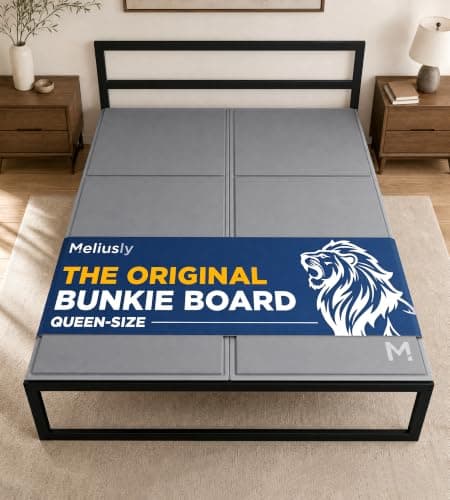 Meliusly Original Bunkie Board, Queen (60 x 80), Non-Slip Breathable The one that gets the brief right. A bunkie board should close the gaps without raising the bed, without trapping moisture under a foam mattress and without letting the mattress slide around on a new, slicker surface - and this listing states all three: anti-sag support, breathable construction, non-slip. It publishes its exact footprint too, which on this shelf is not a given. Best for: Most slatted frames - low profile, breathable, stays put | Most slatted frames - low profile, breathable, stays put | |
| 2 | 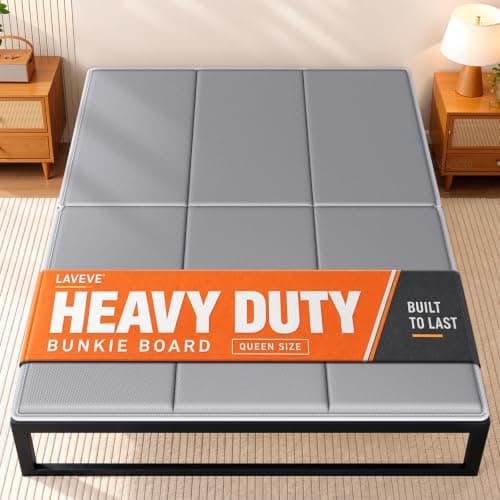 LAVEVE Heavy Duty Bunkie Board, Queen (60 x 80), Anti-Slip Bed Slat The same job for less, with one extra claim worth having: the listing names sofa beds alongside metal and slatted frames. A sofa bed deck is the worst support surface in most homes - thin, hinged and gappy - and it is a use case most bunkie board listings do not mention at all. Best for: The value pick, and sofa beds | The value pick, and sofa beds | $89.99 · View on Amazon Price as of October 19, 2026. #ad — we earn a commission. |
| 3 | 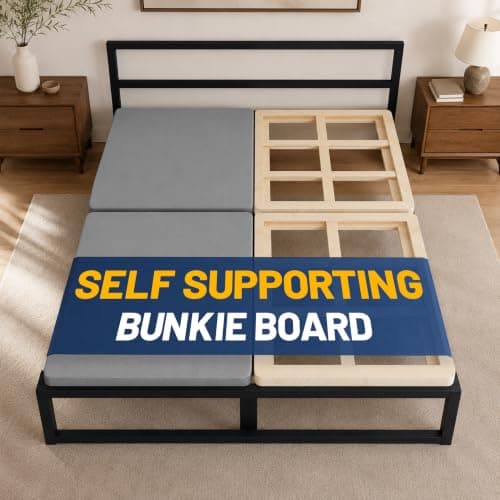 Greaton 1.5-Inch Split Wood Bunkie Board, Queen, Fully Assembled Actual timber, fully assembled, in two halves. The split is the feature: a one-piece queen board is a 60 by 80 inch rigid object, which is a thing that does not go round a stairwell turn or through a narrow doorway, and plenty of people discover that with the delivery driver still outside. Two halves solve it and butt together under the mattress. Best for: Real wood, and getting it up a staircase | Real wood, and getting it up a staircase | $119.99 · View on Amazon Price as of October 19, 2026. #ad — we earn a commission. |
| 4 | 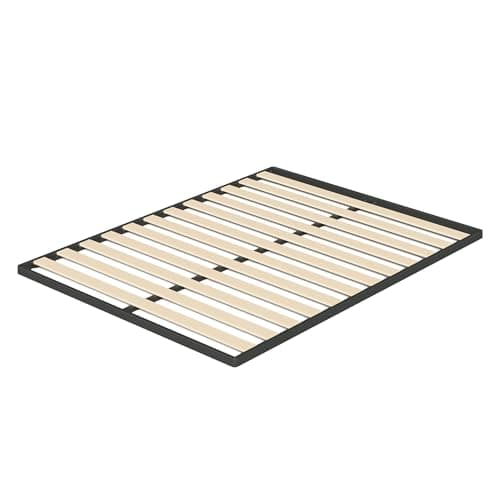 Zinus 1.6 Inch Deepak Easy Assembly Wood Slat Bunkie Board, Full Different construction from everything above: a metal frame with wood slats across it, rather than a covered board. That makes it the most airflow-friendly option here by a distance, and the most likely to survive years of a heavy mattress without bowing - the steel is doing the spanning, not the fabric. Best for: A brand-name slat replacement with a metal frame behind it | A brand-name slat replacement with a metal frame behind it | $135.13 · View on Amazon Price as of October 19, 2026. #ad — we earn a commission. |
| 5 | 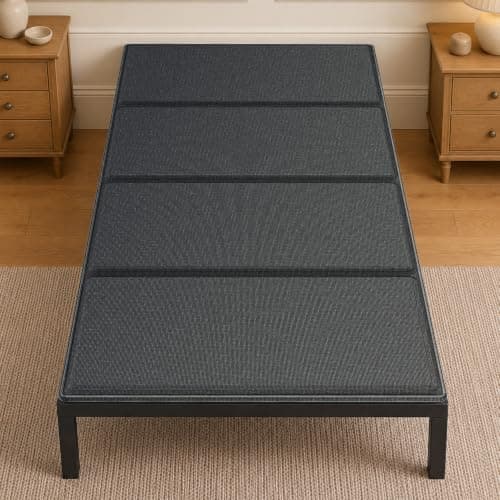 Wolive Bunkie Board, Twin (38 x 75), 10mm Low Profile The original use case, at the original price. Bunk beds and trundles are where bunkie boards came from - there is no room for a box spring under a top bunk - and this is a 10mm board that publishes its footprint, states breathability and costs less than everything above. For a child's bed with wide slats, it is the whole fix. Best for: Bunk beds, trundles and kids' rooms | Bunk beds, trundles and kids' rooms |
First, check you are fixing the right thing
A bunkie board fixes a base. It does nothing for a mattress. That distinction is the difference between a hundred dollars well spent and a hundred dollars spent on the wrong half of the bed, and it takes two minutes to settle.
Pull the mattress off the frame and lay it flat on the floor. Look along it at eye level.
- Flat on the floor, sagging on the frame? The base is the problem. A bunkie board is exactly the right purchase.
- Still dipped on the floor? The mattress has failed internally. A rigid board underneath will not lift a collapsed comfort layer — the sagging mattress guide covers what is recoverable and what is not, and the honest answer is usually not much.
If you are not sure what the product is or whether your frame needs one at all, start with our guide to what a bunkie board actually is. This page assumes you have decided and is about choosing one.
Measure the frame, not the mattress
Bunkie boards are sold by mattress size. What has to fit is the inside of the frame — the opening between the rails — and those two numbers are not always the same, particularly on older frames, imported frames and anything built around a box spring.
A board an inch too wide does not squeeze in. It sits up on the rails, lifts the mattress off level, and creates a worse problem than the one it was bought for. A board slightly under the opening is fine: it still spans the slats, which is the only job.
So take a tape to the inside length and the inside width, write both down, and buy from a listing that publishes inches. Three of the five picks here do. If you fall between two standard sizes, size down.
Solid, covered, or slatted?
Three constructions share this shelf and they are not interchangeable.
A fabric-covered support board — the Meliusly and the LAVEVE — is the modern default. Low profile, light, breathable, and continuous enough that a mattress cannot feel what is underneath. This is the right answer for most slatted frames.
Solid wood under a cover — the Greaton — is the rigid option. It spans the widest gaps with the least flex and it will not bow over time, at the cost of weight. The split-in-two design is the practical detail: a one-piece queen panel is a 60 by 80 inch rigid object, and rigid objects that size do not turn corners on staircases.
A metal frame with wood slats — the Zinus — is structurally the strongest and the most breathable, because steel is carrying the load and air moves freely between the slats. The catch is in the name: it is still slatted. If the reason you want a bunkie board is a continuous surface under a latex or shredded-foam mattress that telegraphs every gap, this is not that product.
Breathability is the spec people skip
You sleep on top of a mattress and the mattress gets rid of overnight moisture through every surface it has, including the bottom one. Put a sealed, non-breathing panel under a foam mattress and that route closes. In a humid room, over a season, the result is mildew on the face of the mattress you never look at.
This is the main argument against the cheapest possible version of this fix — a sheet of plywood cut to size. Plywood works mechanically. It is also the least ventilated thing you can put under a bed, which is why anybody doing it should drill holes in it. Four of the five picks here state breathable construction, and on a foam or hybrid mattress that is not a marketing word, it is the reason to buy a made product instead of a cut sheet.
Profile: every inch is an inch
Bunkie boards run from about 10mm to around two inches, and the thickness is a genuine trade rather than a quality ladder.
- Thin (10mm to half an inch). Adds almost nothing to bed height. Correct for bunk beds, where board thickness eats into headroom and guard-rail margin, and for close-slatted frames that just need a continuous surface.
- Standard (1 to 2 inches). More rigid, spans wider gaps without flexing, holds its shape over years. The default for a main bed.
Check the arithmetic on your own bed before ordering: board thickness plus mattress depth is what your fitted sheet has to clear, and a deep mattress plus a two-inch board is how people discover that their sheets no longer reach.
How the five compare, from the listings
| Pick | Size listed | Profile | Construction | Non-slip |
|---|---|---|---|---|
| Meliusly Original | Queen, 60 x 80 | Low, not stated | Covered board | Yes |
| LAVEVE | Queen, 60 x 80 | Not stated | Covered board | Yes |
| Greaton split wood | Queen | 1.5 in | Solid wood, split | Not stated |
| Zinus Deepak | Full | 1.6 in | Metal frame + slats | Yes |
| Wolive | Twin, 38 x 75 | 10mm | Covered board | Not stated |
The ranking follows the columns that are filled in. A board that publishes its footprint, its profile and its surface behavior is a board you can buy without guessing — and on a product whose entire job is fitting an opening you measured, that is most of the decision.
Bunk beds, trundles and the original use case
The name is not an accident. Bunkie boards exist because there is no room for a box spring under a top bunk or inside a trundle, and a thin rigid panel was the way to give a mattress proper support in a few inches of height. That is still the cleanest application of the product.
On a bunk, thickness is the constraint that outranks everything: whatever you add to the deck comes straight off the clearance between the mattress surface and the guard rail. Measure that gap before buying, and prefer the thinnest board that will span your slats — which is why the twin pick here leads with 10mm rather than with strength.
What to do if the mattress starts sliding
Expect it, and it is the most common complaint after fitting one of these. Bare slats have friction and edges. A smooth covered board does not, and a mattress that sat still for years can start creeping down the bed an inch at a time.
Buy a non-slip board if you can — three of the picks here state it. If it happens anyway, a rubberized gripper pad between board and mattress supplies the friction the two surfaces lack, and it is a few dollars against a problem that otherwise never goes away. The full set of fixes is here.
Bunkie board, box spring or new frame?
If the frame is sound and only the support surface is wrong, a bunkie board is the cheapest correct answer, and for a foam or hybrid mattress it is usually the better one — those mattresses want rigidity, not the flex a box spring was built to give an innerspring.
If you also want the height back, a box spring or a foundation is the purchase instead — swapping one for a board drops the bed by most of a foot, which is a bigger change to a room than people expect. And if the slats are breaking rather than merely wide, the frame itself is the thing to replace; a board over a failing frame is a splint.
About the prices on this page
We do not type prices into pages. Each button carries a figure read from the live listing by our own price check, stamped with the date it last ran. This shelf prices steeply by size on the same listing — a twin and a king can be double — so check the size selected on the listing matches the one you measured for.
What we will not tell you
We have not load-tested these, we have no lab, and nobody writing an affiliate page has put a dial gauge under a bunkie board. The ranking is built on what each listing publishes — exact dimensions, stated profile, construction, breathability, non-slip surface — and on what those properties do: a thin board flexes into a wide gap, a sealed board traps moisture, a one-piece queen panel does not turn a stair corner, and a smooth surface lets a mattress walk. Our full method is here. Where a listing leaves a spec out, this page says so instead of filling it in.
The picks, in full
1. Best for Most slatted frames - low profile, breathable, stays put
Meliusly Original Bunkie Board, Queen (60 x 80), Non-Slip Breathable
The one that gets the brief right. A bunkie board should close the gaps without raising the bed, without trapping moisture under a foam mattress and without letting the mattress slide around on a new, slicker surface - and this listing states all three: anti-sag support, breathable construction, non-slip. It publishes its exact footprint too, which on this shelf is not a given.
Key specs
- Queen, 60 x 80 inches (as listed)
- Non-slip surface (as listed)
- Breathable construction (as listed)
- Anti-sag, noise minimizing (as listed)
- Moisture resistant (as listed)
What's good
- Breathability is the specification people skip and then regret - a solid, sealed board under a foam mattress blocks the airflow that lets overnight moisture out of the underside
- Non-slip matters more than it sounds: a new rigid surface is usually slicker than the slats it replaced, and a mattress that walks an inch a night is a worse problem than the sag you fixed
- Published exact inches, so you can measure the inside of your frame and know before it ships whether it drops in
What's not
- Not a solid wood panel - this is a fabric-covered support board, and anyone who wanted a plank of timber will find it feels lighter than expected even though the span is what matters
- Sold by mattress size, which is not the same as your frame's internal dimensions - a queen board and a queen frame can still disagree by an inch
- Mid-priced for a product whose cheapest honest alternative is a cut sheet of plywood
Skip this one if
You specifically want solid timber under the mattress. The Greaton is the real-wood pick.
2. Best for The value pick, and sofa beds
LAVEVE Heavy Duty Bunkie Board, Queen (60 x 80), Anti-Slip Bed Slat
The same job for less, with one extra claim worth having: the listing names sofa beds alongside metal and slatted frames. A sofa bed deck is the worst support surface in most homes - thin, hinged and gappy - and it is a use case most bunkie board listings do not mention at all.
Price as of October 19, 2026. #ad — we earn a commission.
Key specs
- Queen, 60 x 80 inches (as listed)
- Heavy duty, anti-slip (as listed)
- Noise reducing (as listed)
- Breathable (as listed)
- Fits metal frames, slatted frames and sofa beds (as listed)
What's good
- The cheapest queen board here that still states breathability and anti-slip, which are the two specs that separate a bunkie board from a plank
- Explicitly listed for sofa beds, which is the hardest base in the house to fix and the one most buyers of this product are actually trying to rescue
- Noise reduction is a real benefit on a metal frame, where the sound of a mattress shifting against bare steel slats is half the complaint
What's not
- Heavy duty is the seller's own adjective with no load figure behind it, so there is nothing to compare against the boards that publish one
- No stated thickness on the listing, which matters if you are counting total bed height or working with a fitted sheet already at its limit
- Fabric-covered construction again, so this is support and gap-spanning, not a rigid platform
Skip this one if
You need to know the exact profile before buying. Two picks here publish a thickness and this one does not.
3. Best for Real wood, and getting it up a staircase
Greaton 1.5-Inch Split Wood Bunkie Board, Queen, Fully Assembled
Actual timber, fully assembled, in two halves. The split is the feature: a one-piece queen board is a 60 by 80 inch rigid object, which is a thing that does not go round a stairwell turn or through a narrow doorway, and plenty of people discover that with the delivery driver still outside. Two halves solve it and butt together under the mattress.
Price as of October 19, 2026. #ad — we earn a commission.
Key specs
- 1.5 inches thick (as listed)
- Queen, split two-piece design (as listed)
- Solid wood construction (as listed)
- Fully assembled (as listed)
- Breathable fabric cover; replaces bed slats or box spring (as listed)
What's good
- Split construction is the quiet practicality on this shelf - it is the difference between a board that reaches the bedroom and one that lives in the hallway
- Fully assembled means no hardware, no instructions and no evening lost to it
- Real wood under a breathable cover gives you the rigidity of a plank without the bare-timber downsides of one
What's not
- A split board has a seam down the middle, and on a very soft mattress a seam is a thing you can eventually feel - a solid board does not have one
- 1.5 inches of wood is the heaviest option here to lift into place, and you are doing it twice
- Fits bed frames and bunk beds per the listing, but it is a rigid panel - it will not conform to a hinged or curved sofa bed deck
Skip this one if
Your bedroom is on the ground floor with a wide door and you would rather have one unbroken surface.
4. Best for A brand-name slat replacement with a metal frame behind it
Zinus 1.6 Inch Deepak Easy Assembly Wood Slat Bunkie Board, Full
Different construction from everything above: a metal frame with wood slats across it, rather than a covered board. That makes it the most airflow-friendly option here by a distance, and the most likely to survive years of a heavy mattress without bowing - the steel is doing the spanning, not the fabric.
Price as of October 19, 2026. #ad — we earn a commission.
Key specs
- 1.6 inches thick (as listed)
- Full size (as listed)
- Metal frame with wood slats (as listed)
- Easy assembly (as listed)
- Noise-free, non-slip construction (as listed)
What's good
- A steel frame carrying the load is structurally the most honest answer to a sagging base, and it is the construction least likely to develop a bow in the middle
- Open slats over a metal frame means air moves freely under the mattress, which is the one thing a solid board compromises
- Zinus is a brand with a long bed-frame catalog behind it, so sizing and replacement parts are predictable
What's not
- It is slatted, which means it has gaps - narrower than the ones you are fixing, but if you bought a bunkie board specifically to get a continuous surface for a latex or shredded-foam mattress, this is not that
- Easy assembly is still assembly, unlike the two fully assembled picks above
- The most expensive pick here despite being a full rather than a queen, so compare on your own size before you read that as a premium product
Skip this one if
You want an unbroken surface under a mattress that telegraphs gaps. Buy the solid wood or the covered boards.
5. Best for Bunk beds, trundles and kids' rooms
Wolive Bunkie Board, Twin (38 x 75), 10mm Low Profile
The original use case, at the original price. Bunk beds and trundles are where bunkie boards came from - there is no room for a box spring under a top bunk - and this is a 10mm board that publishes its footprint, states breathability and costs less than everything above. For a child's bed with wide slats, it is the whole fix.
Key specs
- Twin, 38 x 75 inches (as listed)
- 10mm profile (as listed)
- Breathable, moisture resistant (as listed)
- Noise minimizing (as listed)
- For platform and slatted frames (as listed)
What's good
- 10mm is as close to adding no height as this product gets, which is exactly what a top bunk needs - every inch of board is an inch less headroom and guard-rail margin
- Cheapest pick here by a wide margin, and a twin bunkie board is a genuinely small purchase next to replacing a frame
- Publishes exact inches, which matters more on a bunk than anywhere else because bunk decks are often non-standard
What's not
- 10mm is thin, and a thin board spans a wide gap less confidently than a thick one - this is a close-slat fixer, not a rescue for a frame with six-inch gaps
- Twin only, so this is not the pick for a main bed
- A newer seller name with less of a track record behind the heavy-duty claim than the branded picks
Skip this one if
The slats under it are far apart. A 10mm board will flex into a wide gap just like the mattress did.
The cheap stuff worth having
One thing worth adding if the board turns out to be slicker than the slats it replaced - which is the single most common complaint after fitting one:
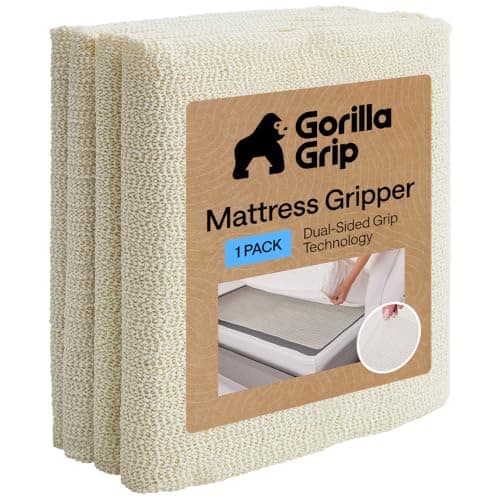
Gorilla Grip Non-Slip Mattress Gripper (54 x 72, Queen)
A rubberized pad laid between the mattress and a slick platform supplies the friction the two surfaces don't have on their own. The cheap fix for a bed that walks.
Skip it if Your mattress moves because the base is broken, or smaller than the bed sitting on it. Grip can't fix geometry — that's a frame problem.
Common questions
What size bunkie board do I need?
Measure the inside of the frame, not the mattress. Bunkie boards are sold by mattress size - twin, full, queen, king - but what has to fit is the opening between the frame rails, and that is not always the mattress dimension. Frames vary, especially older ones and anything imported, and a board an inch too wide will sit proud on the rails instead of dropping in, which raises the mattress unevenly and is worse than the sag you started with. Take a tape measure to the inside length and inside width of the frame, write both numbers down, and buy from a listing that publishes exact inches. Three of the five picks on this page do. If your frame measures between two standard sizes, buy the smaller board - a board slightly under the opening still spans the slats, while one slightly over does not fit at all.
Will a bunkie board fix my sagging mattress?
Only if the sag is in the base. This is the single most common mistake with this product and it is worth being blunt about: if the mattress has a body-shaped dip that is still there when you lift it off the frame and lay it on the floor, the mattress has failed and no board underneath it will change that. A bunkie board fixes a mattress that is sagging INTO something - gaps between wide slats, a broken slat, a worn-out box spring, a sofa bed deck. The test takes two minutes: pull the mattress onto the floor and look at it. Flat on the floor means the base was the problem and a board will fix it. Still dipped on the floor means you are shopping for a mattress, and our guide to fixing a sagging mattress covers what is and is not recoverable.
Bunkie board or plywood?
Plywood works and costs less, with two real drawbacks. The first is airflow: a solid, unventilated sheet blocks the underside of the mattress more completely than a purpose-made board does, and foam mattresses push moisture downward overnight that has to go somewhere. A sealed sheet under a foam mattress in a humid room is how people end up with mildew on a surface they never look at. The second is handling - a cut sheet of plywood is heavy, awkward, and has edges and splinters where a covered board does not. If you go the plywood route, drill ventilation holes, sand the edges, and cover it so the sheet is not abrading the mattress fabric. Our bunkie board guide covers the same comparison in more detail.
How thick should a bunkie board be?
Between about half an inch and two inches, and the right answer depends on what it has to span rather than on any ideal number. A thin board - the 10mm pick here - is correct where the slats are already close together and you just want a continuous surface without raising the bed. A thicker board, one and a half inches or so, is more rigid and resists bowing over wide gaps and over years. The trade is height. Every inch of board is an inch of extra bed height, which matters on a bunk bed with a guard rail, on a platform bed designed around a specific total height, and for anyone whose fitted sheets are already stretched to their limit over a deep mattress.
Can I use a bunkie board instead of a box spring?
Usually, and for a foam or hybrid mattress it is often the better choice. A box spring is tall and has some give in it because it was designed for old innerspring mattresses that wanted a bit of flex underneath. Foam and hybrid mattresses want the opposite - a rigid, even surface - which is why bunkie boards have quietly become the more sensible match for what is actually sold today. The one thing a bunkie board does not replace is the height a box spring adds: swap one for the other and your bed drops most of a foot, which changes how it looks in the room and how easy it is to get out of. Our box spring guide and the foundation versus box spring comparison both cover when the height is worth keeping.
Does a bunkie board affect the mattress warranty?
It can help, and occasionally it is the point. Mattress manufacturers commonly specify what counts as adequate support - typically a maximum spacing between slats, and sometimes a center support leg on a queen or larger - and sagging on an inadequate base is one of the standard grounds for declining a warranty claim. A bunkie board is a cheap way to bring a frame into line with that requirement. What it is not is a universal fix: read your own warranty, because the requirement is set by the manufacturer and varies, and some specify a solid foundation rather than any added board. Our mattress warranty guide covers what these documents usually require and what usually voids them.
Why does my mattress slide after fitting a bunkie board?
Because you replaced a grippy surface with a smoother one. Bare wooden slats have friction and edges; a fabric-covered board is a continuous, often slicker plane, and a mattress that never moved on slats can start walking an inch a night on a new board. Three of the picks here state a non-slip surface for exactly this reason, and it is worth prioritizing. If it happens anyway, the fix is a rubberized gripper pad laid between the board and the mattress, which supplies the friction the two surfaces do not have - it is a few dollars and it solves the problem completely. What does not work is pushing the mattress back every morning and hoping.
Sources
Where the facts on this page come from. We cite other people's testing because we don't do our own — here's what that means.
Read next
- What Is a Bunkie Board?What a bunkie board actually is, how it compares to a box spring and a sheet of plywood, and the slat-spacing test that tells you whether you need one.
- Do You Need a Box Spring?A plain-English answer on box springs: what they were built for, why most modern mattresses don't want one, and the slat-spacing rule that decides whether your base voids the warranty.
- Foundation vs. Box Spring: What's the Difference?Box spring vs. foundation, compared honestly: one flexes and was built for innerspring beds, the other stays rigid for foam and hybrids. How to match the base to your mattress, plus the height, noise, and warranty differences.
- How to Fix a Sagging MattressThe honest triage for a sagging mattress: check the base first, the fixes that actually help, the myths that don't, and when a warranty — and a topper — stop being able to save it.
- The Best Box Springs, and the Honest Case for Not Buying OneSix box springs and foundations ranked on the things that actually decide it - height, deck rigidity, published weight capacity, noise and whether it fits up your stairs - with the warranty trap spelled out and an honest skip note on every pick.
- The Best Bed Frames (No Box Spring Required)Six platform bed frames that replace the box spring, chosen on slat spacing, noise, storage and whether a headboard's included — with honest cons on every pick.
- What Is a Platform Bed?What a platform bed actually is, how it compares to a frame-and-box-spring, a foundation, and a bunkie board, the slat-spacing rule that protects your warranty, and the honest downsides.