The Best Air Purifiers for a Bedroom
Buy the Levoit Core 300-P. It is AHAM Verifide, it is quiet enough to sleep next to, and it is sized for a bedroom rather than for a marketing claim about a house. Four more below for a long-haul machine with a real sensor, a larger room, a budget unit that still measures something, and the cheapest one worth plugging in.
We earn a commission if you buy through our links. It doesn't affect our picks — and we never take free products. How this site is funded.
Quick picks
| # | Product | Best for | Price |
|---|---|---|---|
| 1 | 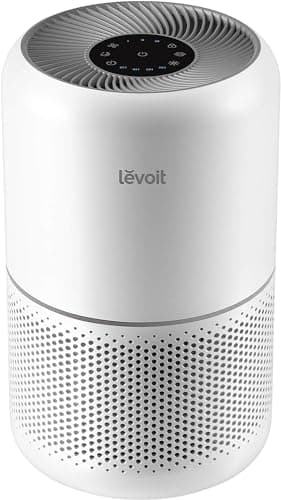 Levoit Core 300-P Air Purifier, HEPA Sleep Mode, up to 1073 sq ft The one to buy if you are buying one. It is AHAM Verifide, which means its clean air delivery rate was measured by someone other than the seller - and on this shelf that single fact separates about five products from about five hundred. The cylinder is small enough to sit on a nightstand, the sleep mode is genuinely quiet, and the 3-in-1 filter handles particles and odor in one cartridge. Best for: Most bedrooms - the right size, quiet, and independently rated | Most bedrooms - the right size, quiet, and independently rated | |
| 2 | 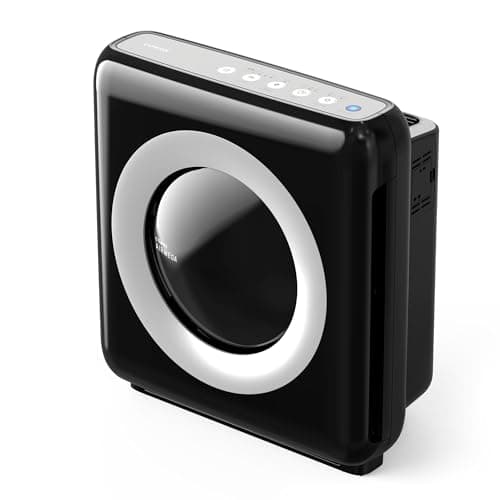 Coway Airmega Mighty AP-1512HH Air Purifier with Air Quality Monitor The machine that has been the enthusiast answer for years, and the specs explain why rather than the reputation. A real particle sensor driving a real auto mode, an eco mode, a filter indicator so you replace on condition instead of on guesswork, and a three-year warranty on a category where one year is normal. If you want to buy once, buy this. Best for: The long haul - a sensor, auto mode and a three-year warranty | The long haul - a sensor, auto mode and a three-year warranty | |
| 3 | 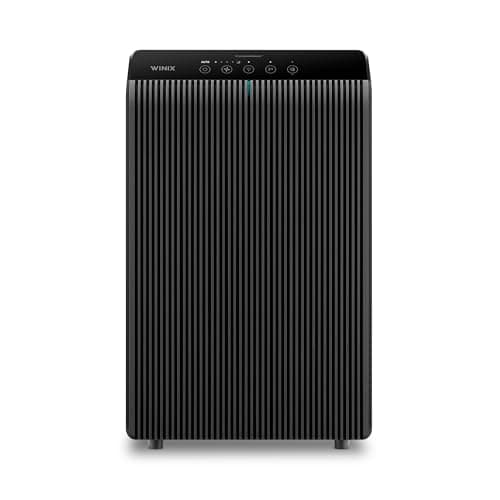 WINIX 5510 Air Purifier, True HEPA with Carbon Filter and Auto Mode The pick for the room that is too big for a nightstand cylinder. True HEPA plus a high-deodorization carbon filter, auto mode, app support, and a stated coverage figure well past anything else here. Read the con about PlasmaWave before you buy it - the feature is switchable, and we would switch it off. Best for: A large bedroom, or one that opens onto the rest of the house | A large bedroom, or one that opens onto the rest of the house | $179.99 · View on Amazon Price as of October 19, 2026. #ad — we earn a commission. |
| 4 | 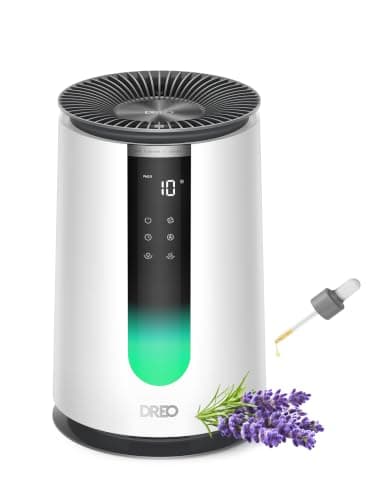 DREO DR-HAP008 Air Purifier with PM2.5 Monitor and Auto Mode The cheapest machine here that still measures the air instead of guessing at it. A PM2.5 readout, auto and turbo modes, four speeds, a HEPA sleep mode and AHAM Verifide on the listing - that is a specification sheet from one tier up, at a price much closer to the budget end. Best for: A sensor and auto mode without the long-haul price | A sensor and auto mode without the long-haul price | |
| 5 | 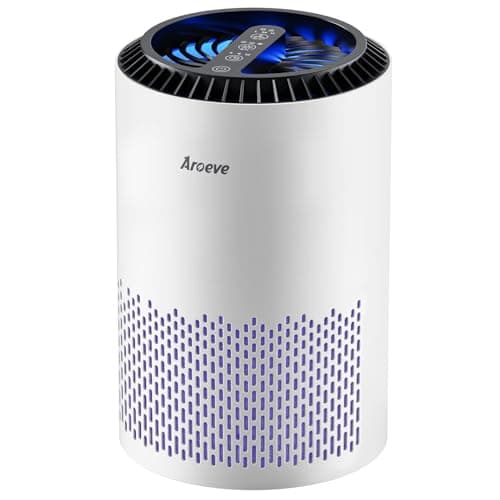 AROEVE MK01A Air Purifier for Bedroom with Sleep Mode, 22 dB Honest about what it is: a small, very quiet filter for one small room, at a price where buying two for two bedrooms is realistic. The 22 dB claim on the lowest speed is the specification that matters most in a bedroom, and this is the only pick here that leads with it. Best for: The cheapest unit worth plugging in, and second bedrooms | The cheapest unit worth plugging in, and second bedrooms |
Three numbers, and everything else is noise
Air purifier listings are among the worst on Amazon: coverage claims with no methodology, percentages with no particle size, and a wall of acronyms that mostly describe the same pleated filter. Almost all of it can be ignored. For a bedroom there are three numbers that decide the purchase.
- CADR, against your actual room.Clean air delivery rate is how much filtered air the machine produces. EPA's estimation chart — at an 8-foot ceiling — puts the minimum at 65 cfm for 100 square feet, 130 for 200, 195 for 300, 260 for 400, 325 for 500 and 390 for 600. Higher ceilings need more.
- Noise on the lowest speed. Not the average, not the one in the marketing copy. A bedroom purifier runs on its quietest setting all night or it gets switched off in week two, and the quietest setting is also the one producing the least clean air.
- The annual filter bill. Every machine here uses proprietary filters. The unit price is the smaller half of what this costs you over three years, and on the cheapest pick the filters cost a large fraction of the machine every year.
Why CADR is quietly worse than it looks
EPA notes that the CADR rating is typically measured at the air cleaner's highest speed. Read that next to the first criterion and the problem is obvious: the number that sizes the machine was measured on a setting you will never use in a bedroom at night.
That is the single most useful thing on this page. Size up. Take EPA's chart figure for your room, then buy a machine rated comfortably above it, so that its low and medium speeds — the ones you will actually run — still move enough air. A unit matched exactly to the room on paper is a unit you will run at full speed and still not sleep next to.
One further note on the coverage claims in square feet: those are generally derived from the same top-speed CADR, sometimes at a low number of air changes per hour. "Up to 1,073 square feet" does not describe a machine for an 1,000 square foot room. It describes a machine for a bedroom, measured generously.
AHAM Verifide is the only third-party number here
A seller can print any coverage figure it likes. AHAM Verifide means the clean air delivery rate was measured independently to a standard test, and it is the one mark on these listings that was not written by the marketing department. Three of the five picks on this page carry it; the cheapest does not, and that is the main thing separating it from the rest.
It is not a quality score and it says nothing about build, noise or filter cost. It is simply the difference between a measured number and a claimed one.
HEPA, carbon, and the ionizer question
HEPA is the particle stage, and it is what EPA is referring to when it notes that portable air cleaners often achieve a high CADR by using a high-efficiency particulate air filter. Dust, pollen, dander, smoke particles. This is the part that works.
Activated carbon is the gas and odor stage, and EPA is blunt that gas-removal performance has no widely used rating system and that carbon filters work best when there is a lot of material present. A thin carbon-impregnated sheet bundled into a combination filter is doing something; it is not doing much. If odor is your reason for buying, weight of carbon matters more than any other spec.
Ionizers, plasma and UV are the part to be careful about. EPA advises avoiding portable air cleaners that intentionally produce ozone, identifies ozone as a lung irritant, and lists electrostatic precipitators, ionizers, UV lights without adequate lamp coatings and plasma cleaners among devices that may emit it. No federal agency has approved ozone generators sold as air cleaners for occupied spaces. In a bedroom — a small, closed room you spend eight hours in — this is the one feature worth switching off, and the Winix pick on this page carries exactly such a feature with a switch for it.
How the five compare, from the listings
| Pick | AHAM Verifide | Sensor / auto | Stated coverage | Watch for |
|---|---|---|---|---|
| Levoit Core 300-P | Yes | No | Up to 1073 sq ft | No auto mode |
| Coway Mighty | Not stated | Yes, plus eco mode | Up to 1748 sq ft | Front light at night |
| Winix 5510 | Not stated | Yes | Up to 1881 sq ft | PlasmaWave — switch it off |
| Dreo DR-HAP008 | Yes | Yes, PM2.5 readout | Bedroom sized | Scent pad — leave it out |
| AROEVE MK01A | No | No | Small room | 22 dB stated on low |
The ranking follows that table almost exactly. Independently measured beats claimed; a sensor beats no sensor once the measurement is there; and a published low-speed decibel figure is what keeps the cheapest pick on the page at all.
What a purifier does not do
It does not fix dust mites. They live in the mattress, the pillow and the bedding, not in the air, and the things that reach them are hot washes, a zippered encasement and lower humidity.
It does not fix mold. EPA states that portable air cleaners and HVAC filters do not address the cause of mold and musty odors, and that the moisture must be removed and the mold cleaned up. If the room smells damp, the purifier is the wrong appliance — look at the room's temperature and humidity first, and note that a humidifier makes a damp room worse, not better.
And it does not replace ventilation. EPA's position is that no air cleaner will eliminate all of the air pollutants in a home and that filtration does not replace the need to control pollutants and ventilate. Source control, then ventilation, then filtration — in that order, with the purifier doing the overnight work when the window has to stay shut.
Noise, and the thing nobody tells you about white noise
A purifier on low is a broadband hum, and a lot of people find that pleasant — it is, functionally, a white noise machine that also filters. If that is part of the appeal, buy for it deliberately: a unit that is silent on low and loud on medium gives you neither, and a published decibel figure on the lowest speed is the spec to look for.
If the opposite is true and you need the room quiet, the order of operations is a quiet machine first and earplugs second, not a loud purifier plus earplugs — the earplugs cut the noise you want gone along with the noise you are paying for.
About the prices on this page
We do not type prices into pages. Each button carries a figure read from the live listing by our own price check, stamped with the date it last ran. This category discounts hard and often, and several of these models exist in near-identical smart and non-smart variants at different prices, so check the model code on the listing matches the one named in the pick.
What we will not tell you
We have not run these in a sealed chamber with a particle counter, and nobody writing an affiliate page has. The ranking is built on what is independently measured — AHAM Verifide where it exists — on what each listing publishes, and on EPA's published guidance about what this class of appliance can and cannot do. Our full method is here. Health claims on this page are EPA's and are quoted as such, including the inconvenient one about the benefits being small.
The picks, in full
1. Best for Most bedrooms - the right size, quiet, and independently rated
Levoit Core 300-P Air Purifier, HEPA Sleep Mode, up to 1073 sq ft
The one to buy if you are buying one. It is AHAM Verifide, which means its clean air delivery rate was measured by someone other than the seller - and on this shelf that single fact separates about five products from about five hundred. The cylinder is small enough to sit on a nightstand, the sleep mode is genuinely quiet, and the 3-in-1 filter handles particles and odor in one cartridge.
Key specs
- AHAM VERIFIDE (as listed)
- 3-in-1 filter with HEPA layer (as listed)
- Quiet HEPA sleep mode (as listed)
- Coverage stated up to 1073 sq ft (as listed)
- 360-degree cylindrical intake (as listed)
What's good
- AHAM Verifide is the whole reason this is the top pick - an independently measured CADR is the only number on an air purifier listing that is not the seller's own marketing
- Small enough to live on a nightstand, which matters because a purifier two rooms away is a purifier doing nothing for the air you are breathing
- One cartridge covers the HEPA and carbon layers, so the annual maintenance is a single part and a single price
What's not
- The 1073 sq ft coverage figure is a best-case number at the highest fan speed, and the highest fan speed is not a setting you will use in a bedroom at night - size it to the room, not to the headline
- Proprietary filters, which is the business model on this entire shelf: the unit is cheap, the replacements are not, and a year of filters is a meaningful fraction of the purchase price
- No air quality sensor, so there is no auto mode and no way to know what it is doing - you pick a speed and trust it
Skip this one if
You want the machine to decide. Without a sensor there is no auto mode, and two picks below have one.
2. Best for The long haul - a sensor, auto mode and a three-year warranty
Coway Airmega Mighty AP-1512HH Air Purifier with Air Quality Monitor
The machine that has been the enthusiast answer for years, and the specs explain why rather than the reputation. A real particle sensor driving a real auto mode, an eco mode, a filter indicator so you replace on condition instead of on guesswork, and a three-year warranty on a category where one year is normal. If you want to buy once, buy this.
Key specs
- Air quality monitor with auto mode (as listed)
- Eco mode (as listed)
- True HEPA filter plus odor filter (as listed)
- Coverage stated up to 1748 sq ft (as listed)
- Filter indicator, 3-year warranty (as listed)
What's good
- A particle sensor turns the purifier from an appliance you forget to run into one that runs when it is needed, which is the difference between owning one and benefiting from one
- A three-year warranty is the longest here by two years, and it is the clearest signal a manufacturer can send about expected service life
- The filter indicator ends the main failure mode of this product category - a purifier running happily on a filter that stopped working months ago
What's not
- Bigger and squarer than the cylinder picks, and it wants floor space with clear air around it rather than a nightstand corner
- The air quality light glows on the front and changes color through the night - a strip of tape is the standard fix, which should not be necessary at this price
- Eco mode stops the fan entirely when the air is clean, which some owners read as the unit having failed; it has not, but it is an unsettling behavior in a dark room
Skip this one if
The bedroom is small and the nightstand is the only free surface. This is a floor machine.
3. Best for A large bedroom, or one that opens onto the rest of the house
WINIX 5510 Air Purifier, True HEPA with Carbon Filter and Auto Mode
The pick for the room that is too big for a nightstand cylinder. True HEPA plus a high-deodorization carbon filter, auto mode, app support, and a stated coverage figure well past anything else here. Read the con about PlasmaWave before you buy it - the feature is switchable, and we would switch it off.
Price as of October 19, 2026. #ad — we earn a commission.
Key specs
- True HEPA filter (as listed)
- High-deodorization activated carbon filter (as listed)
- Auto mode (as listed)
- Coverage stated up to 1881 sq ft in 1 hour (as listed)
- App support; new generation of the 5500-2 (as listed)
What's good
- The largest stated coverage on this page, and the only pick that will keep up with a big bedroom or an open-plan sleeping area
- A heavy carbon stage rather than a token one, which is what actually addresses odor - EPA notes that activated carbon works best when there is a lot of material present
- Replaces the long-running 5500-2, so filters and spares are widely stocked and will stay that way
What's not
- PlasmaWave is an ionizing feature, and EPA's guidance is to avoid air cleaners that intentionally produce ozone, naming ionizers and plasma cleaners among the devices that may emit it. The feature can be turned off and we would leave it off - the HEPA and carbon stages are what you bought
- Physically large and not quiet at the speeds that justify the coverage number, so in a small room you are buying capacity you will never switch on
- Two-part filter system means two consumables to track rather than one cartridge
Skip this one if
The bedroom is normal-sized and closed. You are paying for air changes you do not need, in a bigger box.
4. Best for A sensor and auto mode without the long-haul price
DREO DR-HAP008 Air Purifier with PM2.5 Monitor and Auto Mode
The cheapest machine here that still measures the air instead of guessing at it. A PM2.5 readout, auto and turbo modes, four speeds, a HEPA sleep mode and AHAM Verifide on the listing - that is a specification sheet from one tier up, at a price much closer to the budget end.
Key specs
- PM2.5 air quality monitor (as listed)
- Auto and turbo modes, 4 speeds (as listed)
- HEPA sleep mode (as listed)
- AHAM VERIFIDE (as listed)
- Scent diffuser pad included (as listed)
What's good
- A PM2.5 number on the front is the honest version of an air purifier - you can see the reading climb when you vacuum and fall again afterward, which is the only feedback this product category ever gives you
- AHAM Verifide at this price is unusual, and it is the same independent measurement that puts the Levoit at the top of the page
- Four speeds rather than three gives you a usable step between silent and audible, which is exactly where a bedroom unit lives
What's not
- It ships with a scent diffuser pad, which is a strange feature on a machine whose job is removing things from the air - adding fragrance to filtered air is working against yourself, and we would leave the pad in the box
- Sized for a bedroom and not much more, so this is not the unit for an open-plan space
- A newer name on a shelf where the long-warranty incumbents have a decade of filter availability behind them
Skip this one if
You want a machine you will still be buying filters for in eight years. Coway has the track record; this does not yet.
5. Best for The cheapest unit worth plugging in, and second bedrooms
AROEVE MK01A Air Purifier for Bedroom with Sleep Mode, 22 dB
Honest about what it is: a small, very quiet filter for one small room, at a price where buying two for two bedrooms is realistic. The 22 dB claim on the lowest speed is the specification that matters most in a bedroom, and this is the only pick here that leads with it.
Key specs
- 22 dB stated noise level on low (as listed)
- Sleep mode with speed control (as listed)
- 360-degree air inlets (as listed)
- Filters smoke, pet dander and dust (as listed)
- Aromatherapy function (as listed)
What's good
- A published decibel figure on the lowest speed, which is the only speed a bedroom purifier runs at and the number most sellers quietly omit
- Cheap enough to put one in a child's room and one in yours, and a purifier in the room beats a better purifier down the hall
- The 360-degree intake means it works without clearance on three sides, which is what a cluttered bedroom actually offers
What's not
- No AHAM Verifide rating, so there is no independently measured CADR - you are trusting the seller's coverage claim, which is precisely what we tell you not to do everywhere else on this page
- Small capacity: this is a one-small-room machine and it will not keep up with a large bedroom or a smoky one
- Replacement filters cost a substantial fraction of the unit price, so the cheap purchase is not a cheap year
Skip this one if
The bedroom is large, or this is your only purifier. Buy one unit that is properly sized instead of one that is cheap.
Common questions
What CADR do I need for my bedroom?
Measure the room and use EPA's chart. EPA's estimation table, which assumes an 8-foot ceiling, lists a minimum CADR of 65 cfm for 100 square feet, 130 cfm for 200, 195 cfm for 300, 260 cfm for 400, 325 cfm for 500 and 390 cfm for 600. Higher ceilings need more. Two things make that less generous than it sounds. First, EPA notes CADR is typically measured at the air cleaner's highest speed - and in a bedroom you will run the lowest, so a unit sized exactly to the room on paper is undersized in practice. Second, the square-footage claims on listings are usually derived from that same top-speed number. Buy a size up from the chart if you intend to sleep next to it on its quietest setting.
Do air purifiers actually help you sleep better?
Indirectly, if your sleep is being disrupted by airborne particles, and not at all if it is not. EPA's summary of the research is worth quoting plainly: studies of portable HEPA air cleaners have found small cardiovascular and respiratory health benefits, typically small and not always noticeable to the individual, and some studies found improvements in allergy or asthma symptoms but not always major ones and not in every symptom. So if you wake up congested in pollen season or you share a bedroom with a cat, a purifier is a reasonable thing to try. If you are sleeping badly for any of the dozen other reasons people sleep badly, it will not help, and the honest alternatives are cheaper. A purifier is not a treatment for snoring, apnea or insomnia.
Are ionizers and PlasmaWave safe?
EPA's guidance is direct: avoid portable air cleaners that intentionally produce ozone, and it identifies ozone as a lung irritant. It names electrostatic precipitators, ionizers, UV lights without adequate lamp coatings, and plasma cleaners among the devices that may emit ozone, and notes that no federal agency has approved ozone generators sold as air cleaners for use in occupied spaces. The practical reading for a bedroom: buy the machine for its HEPA and carbon filtration, and if it has an ionizing feature, turn that feature off. One pick on this page - the Winix, with PlasmaWave - has exactly this feature, it is switchable, and our con on that pick says to switch it off. EPA also points to the California Air Resources Board and AHAM lists of cleaners that emit little or no ozone.
How much do the filters actually cost per year?
More than people expect, and it is the number that should decide between two otherwise similar machines. Every pick on this page uses proprietary filters, typically replaced every six to twelve months depending on run hours and how dirty the air is - which means the real cost of ownership is the unit price plus two to three filter purchases over the first couple of years. On the cheapest pick here, a year of filters is a large fraction of what the machine cost. Before you buy, look up the replacement filter for the specific model and multiply. A filter indicator, like the one on the Coway, is genuinely useful here: it replaces a guess with a prompt, and a purifier running on a saturated filter is just a fan.
Where should the purifier go in the bedroom?
In the room, first of all - a better machine in the hallway loses to a smaller one beside the bed. Give it clear air on the intake side; most cylinder units pull in through 360 degrees and want a few inches all round rather than being wedged against a nightstand and a wall. Avoid pointing the outlet directly at your face, both because a draft on your head is a good way to wake up with a stiff neck and because it tells you nothing about the rest of the room's air. And keep the door shut while it runs: a purifier sized for a bedroom is not sized for a bedroom plus a hallway plus a landing, and an open door quietly turns the first into the third.
Will an air purifier help with dust mites or mold?
Not in the way people hope, and this is where the money is usually misspent. Dust mites live in the mattress, the pillow and the bedding rather than in the air, so filtering the air does not reach them - that is a job for hot washes, a zippered encasement and lower bedroom humidity, which we cover on its own page. Mold is worse: EPA states that portable air cleaners and HVAC filters do not address the cause of mold and musty odors, and that the moisture has to be removed and the mold cleaned up. A purifier may catch some airborne spores, but running one against a damp wall is treating a symptom you can smell while the cause keeps growing.
Does a purifier replace opening the window?
No, and EPA says so plainly: no air cleaner or filter will eliminate all of the air pollutants in your home, and filtration does not replace the need to control pollutants and ventilate. The order of operations for a bedroom is the unglamorous one - stop the source if you can, ventilate when outdoor air is good, then filter what is left. The honest place for a purifier is as the third step, for the particles you cannot ventilate away or when opening a window makes things worse, which in wildfire smoke or high pollen is exactly the situation. It is also the step that runs all night while the window stays shut, which is why a quiet one is worth paying for.
Sources
Where the facts on this page come from. We cite other people's testing because we don't do our own — here's what that means.
Read next
- The Best Humidifiers for a BedroomA bedroom humidifier is judged on three things nobody puts in the headline: how loud it is, how long it runs on one fill, and how easy it is to clean. Five ranked on all three, plus the humidity range to aim for.
- The Best White Noise MachinesSix white noise machines split by the only thing that matters - a mechanical fan versus a digital loop - across a bedside classic, a travel unit and budget all-rounders.
- How to Get Rid of Dust Mites in Your BedYou cannot get rid of dust mites completely - but you can cut their numbers and allergen load. The habits that genuinely work, ranked, minus the hype.
- The Best Mattress EncasementsAn encasement is not a protector with a zipper - it is a sealed box around the whole mattress, and it is bought for containment rather than for spills. Five ranked on stated depth range, zipper design and what each one can honestly claim to stop.
- The Best Pillow ProtectorsA pillow protector is the cheapest thing in the bedroom and the most mislabeled. Five picks sorted by the only question that matters - barrier or breathable - plus what the allergy research actually says a cover can do.
- The Best Temperature for Sleep (and How Your Bedding Gets You There)The bedroom temperature commonly recommended for sleep is around 65-68 F (about 18-20 C), because your body lowers its core temperature to fall and stay asleep and a warm room fights that. This guide covers why, plus the bedding levers that get you there — breathable sheets, a mattress that ventilates, a cooler pillow, seasonal comforter weight, and simple airflow.
- The Best Blackout Curtains for SleepSix blackout curtains split by the one thing that matters - room-darkening versus a true liner-backed 100% blackout - across a value default, a shift-worker pick, a no-drill renter option and a budget pair.