The Best Blackout Curtains for Sleep
The label "blackout" hides one real decision - a room-darkening panel, or a true 100% blackout curtain with a bonded liner. Get that right and the rest is fit. Six picks, sorted by that divide, each with an honest note on who should skip it.
We earn a commission if you buy through our links. It doesn't affect our picks — and we never take free products. How this site is funded.
Quick picks
| # | Product | Best for | Price |
|---|---|---|---|
| 1 | 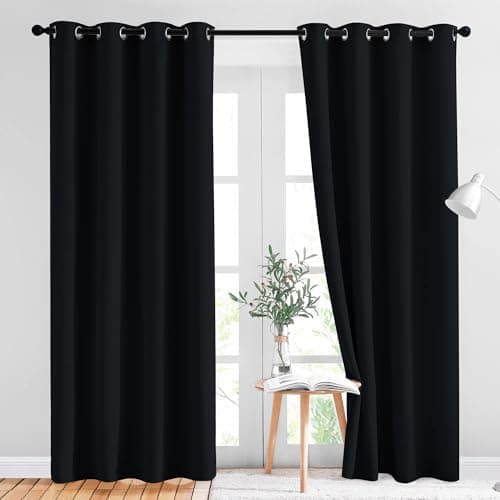 NICETOWN Grommet Blackout Curtains The Amazon default, and for most bedrooms the right call. A dense triple-weave grommet panel that kills the great majority of the light for very little money - just know it is room-darkening, not a liner-backed 100% blackout. Best for: The one to buy if you buy one | The one to buy if you buy one | $14.58 · View on Amazon Price as of September 17, 2026. #ad — we earn a commission. |
| 2 | 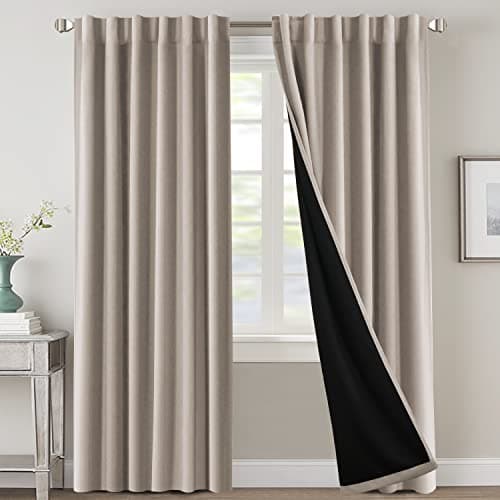 H.VERSAILTEX 100% Blackout Curtains (Lined) The pick when the room has to be dark at noon. A bonded black liner behind the face fabric makes the panel genuinely opaque, and the back-tab header hangs flatter to the wall than grommets do. Best for: Total darkness for day sleepers | Total darkness for day sleepers | $25.95 · View on Amazon Price as of September 17, 2026. #ad — we earn a commission. |
| 3 | 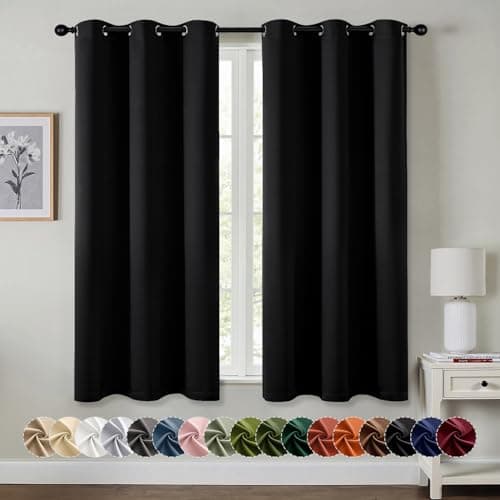 MIULEE Blackout Curtains (Budget 2-Pack) The lowest price here that still darkens a room properly. A plain black room-darkening pair for a spare room, a first apartment or a window you just need to shut the streetlight out of - as long as you measure before you buy. Best for: The cheapest honest option | The cheapest honest option | $10.98 · View on Amazon Price as of September 17, 2026. #ad — we earn a commission. |
| 4 | 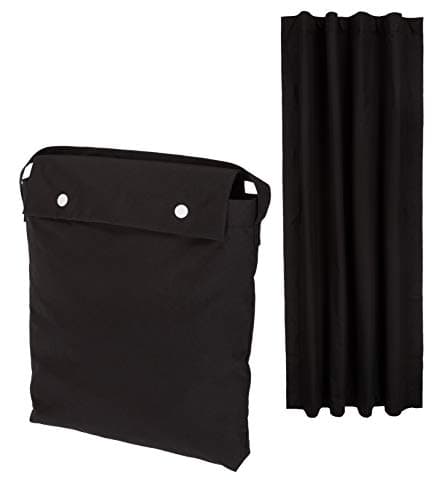 Amazon Basics Portable Blackout Shade No rod, no drill, no holes. It suction-cups straight to the window and sits flush against the glass, which is both the renter-friendly install and, quietly, a better seal against edge light than a hung panel. Best for: Renters, dorms and travel | Renters, dorms and travel | $24.14 · View on Amazon Price as of September 17, 2026. #ad — we earn a commission. |
| 5 | 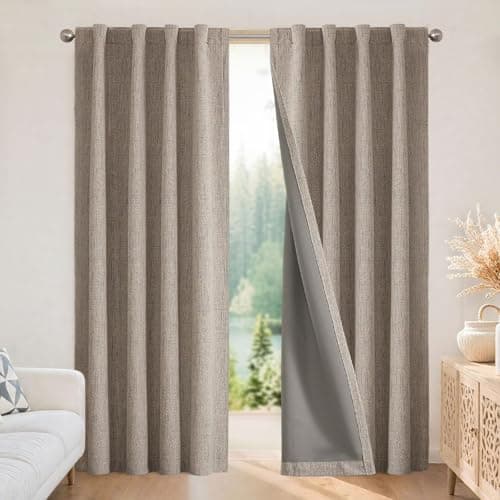 Joydeco 100% Blackout Linen-Look Curtains For the bedroom you actually decorate. A 100% blackout panel woven to read like natural linen, so the room gets the darkness without looking like it's wearing a utility blackout on the window. Best for: A blackout you want to look at | A blackout you want to look at | |
| 6 | 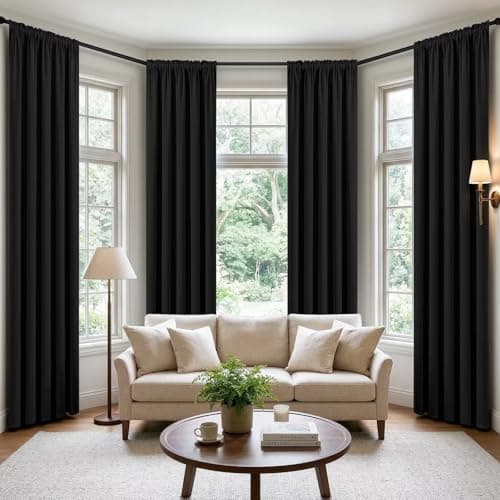 CUCRAF Thermal Rod-Pocket Blackout Curtains The pick when the window is a temperature problem as much as a light one. Rod-pocket panels that lead with the insulated thermal layer, and gather tight to the rod so less light spills over the top. Best for: Drafty or hot windows | Drafty or hot windows | $18.96 · View on Amazon Price as of September 17, 2026. #ad — we earn a commission. |
What "blackout" actually means on the box
"Blackout" is a marketing word before it is a specification, and the gap between the two is where people waste money. Curtains sold as blackout fall into two genuinely different tiers, and the label alone won't tell you which one you're holding. Get the tier right for how you sleep and the rest of the decision - color, header, price - is just fit and taste. Get it wrong and you either overpay for a lined panel you didn't need or, far more common, buy a thin one and lie awake watching a bright rectangle glow at 5 a.m.
Light matters here more than for almost any other bedroom purchase because it is the master signal your body clock reads. A dark room tells your body it is night; even a dimly lit one keeps nudging it awake and holding back the melatonin that keeps you asleep. That is the whole reason day sleepers, night-shift workers and anyone facing an early summer sunrise care about this at all - and it is why a curtain that gets a room almost dark is not the same product as one that gets it dark.
The one decision that matters: room-darkening, or a true lined 100%
Every panel on this page sits on one side of a single line. On one side are room-darkening curtains: dense, usually single-layer fabric that blocks most of the light and leaves a room dim. The NICETOWN grommet pick and the budget MIULEE pair are this tier. For most people, on a normal night, dim is all you need - the streetlight is gone, the room is shadowed, you sleep.
On the other side are true blackoutcurtains, which add a second opaque layer - typically a bonded black liner - so the fabric itself passes essentially no light. The H.VERSAILTEX lined panel and the Joydeco 100% linen sit here. This is the tier you actually need if you sleep during the day, work nights, or your window faces a sunrise you want to ignore. The honest shopping rule is short: read for the liner. "100% blackout with liner" or "double layer" is the real thing; a lone "room-darkening" or "light-reducing" panel is the cheaper, dimmer tier, and the words get used interchangeably by sellers who are counting on you not to notice.
Why even a 100% fabric still leaks - and how to beat it
Here is the part almost no listing tells you: the fabric is rarely the problem. You can buy the most opaque, liner-backed 100% blackout panel on the market and still wake up to a room rimmed with light, because a curtain is a flat sheet hung in front of a window and light does not politely travel only straight ahead. It wraps around the sides, spills over the top through the gap in the header, and glows up off the windowsill. The blackout rating describes the cloth. The room's darkness is decided at the edges.
Which means the biggest upgrade to your darkness is not a pricier curtain - it is how you hang the one you buy. Three moves do most of the work:
- Go wide. Mount the rod several inches past the frame on each side and buy enough panel width - roughly two to two-and-a-half times the window - so the fabric overlaps the wall and the two panels overlap each other in the middle. A curtain sized to the glass leaks a halo on every side.
- Go high. Hang the rod close to the ceiling, not just above the frame, so there is no strip of bright wall glowing above the curtain.
- Go long. Choose a drop that reaches the floor or past the sill and let it break or puddle slightly, rather than stopping short and leaving a lit gap at the bottom.
Do those three and a mid-price room-darkening panel can out-dark an expensive blackout one that's been hung too small and too low. Skip them and no fabric on earth saves you. If you rent and can't mount a wide, high rod, that is exactly the case for the suction-cup shade, which sidesteps the edge problem by pressing flat to the glass.
Grommet, rod pocket, or back tab - the header is a light gap
The top of the curtain - the header - is both how it hangs and where it leaks, so it is worth a moment. Grommet tops (metal-ringed holes the rod threads through, like the NICETOWN pick) glide open and shut the easiest, which is the right choice if you actually open your curtains every day - but the scalloped waves between the rings leave small gaps that light finds first. Rod-pocket tops (the rod slides through a sewn channel, like the CUCRAF) gather tight and spill less light over the top, but they drag when you try to draw them, so they suit curtains you mostly leave shut. Back-tab tops (hidden loops behind the panel, offered on the H.VERSAILTEX and Joydeco) hang the flattest against the wall - the best of the three at the top gap - at the cost of being a little more effort to slide. There is no best header, only the right trade between how dark you need the top and how often you open the curtain.
Thermal, noise, and the features that are real
Blackout panels are sold with a wall of secondary claims, and a couple are genuinely useful. The thermalor "insulated" layer is real: a dense, lined panel does slow heat moving through a window, which takes the edge off a room that bakes behind afternoon glass or chills beside a single pane - and a steady, cooler room is its own sleep upgrade, which is why this pairs with getting the bedroom to a good sleeping temperature. The noise-reducing claim is milder than it sounds: a heavy curtain muffles a little high-frequency sound and softens echo, but it is not soundproofing, and if noise is your real problem a sound machine or earplugs will do far more than fabric ever will.
The features to weigh less: exact color (any dark, dense fabric blocks more than a pale one, so if darkness is the goal, lean darker), and the endless "energy saving" percentages, which are real in direction and unverifiable in magnitude. Buy for the tier and the fit; treat the rest as a tiebreaker.
Renting, or don't want to drill?
If you can't - or won't - put holes in the wall, you are not stuck with a bright room. A portable blackout shade suction-cups straight to the window frame and comes off without a trace, which is why it is the pick for renters, dorms and travel; because it sits flush to the glass it can actually beat a hung panel at sealing the edges, at the cost of covering only the pane rather than the whole wall. A tension rod wedged inside the window recess is the other no-drill route and lets you hang a normal lightweight panel, though it holds less weight and leaks more at the sides than a wide, high, wall-mounted rod. Between the two, if pitch-black is the goal, the shade pressed to the glass usually wins.
Color, and keeping them working
Two small things decide whether the curtain you like still darkens the room and still does it in three years. First, color matters less than people assume. A dark fabric blocks marginally more stray light than a pale one, but on a properly lined panel it is the liner, not the face color, that does the blocking - which is why the sand-colored H.VERSAILTEX and the natural Joydeco can still be full blackout with the working layer hidden on the window side. Don't rule out a light, room-friendly color just because you want it dark; on a 100% lined panel you can have both.
Second, care is where blackout curtains quietly die. Most are machine washable cold on a gentle cycle, but the thing that kills the blackout is heat: a hot dryer or a hot iron can crack, melt or peel the very coating or bonded liner that does the darkening, and once that layer is damaged the panel is just a decorative curtain. Wash cold, tumble low or line dry, and iron low or not at all. Do that and a good panel holds its blackout for years; cook it once in a hot dryer and you have bought a very ordinary curtain.
Curtains, a mask, or both
One honest off-ramp before you buy. If you only need darkness for your own two eyes - you travel a lot, your partner keeps a light on, or you can't change the windows in a rental - a sleep maskblocks light at the source for a fraction of the price and packs in a bag. Curtains win when you want the whole room dark: for a partner who also sleeps there, for a child's room, or so the space simply feels like night. Plenty of day sleepers run both - blackout curtains for the room, a mask for the last stubborn sliver of light the edges never quite kill. And if your goal is the opposite problem - waking up in a room that's too dark once the curtains are doing their job - that is what a wake-up light is for.
None of these six were tested in a lab, because there isn't one behind this site. The method is to read the listings, understand how a hung panel actually blocks - and leaks - light, and sort the field by the one spec that decides whether the room gets dim or dark. That is written out in full on how we review.
The picks, in full
1. Best for The one to buy if you buy one
NICETOWN Grommet Blackout Curtains
The Amazon default, and for most bedrooms the right call. A dense triple-weave grommet panel that kills the great majority of the light for very little money - just know it is room-darkening, not a liner-backed 100% blackout.
Price as of September 17, 2026. #ad — we earn a commission.
Key specs
- Room-darkening triple-weave, single layer (as listed)
- Thermal insulated (as listed)
- Solid grommet top
- Set of 2 panels, 52" W x 84" L (as listed)
- Sold in many colors and drop lengths
What's good
- A dense, single-layer weave blocks the large majority of incoming light and dims a room hard - for most sleepers, on a normal night, that is all a blackout curtain needs to do
- The grommet top slides open and shut on the rod with one pull, which matters a lot if you actually open your curtains every morning rather than leaving them sealed
- It is the cheapest established option here and comes in a wide range of widths, drops and colors, so you can match a real window instead of settling for the one size a fancier panel offers
What's not
- It is room-darkening, not a true 100% blackout - a little daylight passes through the weave itself and more spills around the edges, so a sunrise-facing window will still glow at the margins
- A single layer, so it does less for heat and noise than the double-layer, liner-backed picks below
- The grommet header leaves small scalloped gaps at the top where the rings ride the rod - light's easiest escape route on any grommet curtain
Skip this one if
You sleep during the day or need the room genuinely black. A single room-darkening layer won't get you there - move to the H.VERSAILTEX 100% panel with the bonded liner instead.
2. Best for Total darkness for day sleepers
H.VERSAILTEX 100% Blackout Curtains (Lined)
The pick when the room has to be dark at noon. A bonded black liner behind the face fabric makes the panel genuinely opaque, and the back-tab header hangs flatter to the wall than grommets do.
Price as of September 17, 2026. #ad — we earn a commission.
Key specs
- 100% blackout with bonded black liner (as listed)
- Full room darkening (as listed)
- Thermal insulated (as listed)
- Back tab or rod pocket header (as listed)
- 2 panels, 84" long, Natural Sand
What's good
- The black inner liner is the difference between 'dark' and 'dark enough to sleep past a sunrise' - it makes the fabric itself close to fully opaque instead of merely dense, which is exactly what a night-shift worker needs
- The back-tab header pulls the panel flatter against the wall than a grommet top, so there is less of the scalloped gap at the top that leaks light on cheaper curtains
- A neutral 'natural sand' face keeps the room looking normal while the working blackout layer hides on the window side - you get the darkness without the room reading like a cave
What's not
- Two bonded layers make it heavier and a touch stiffer to draw than a single panel - fine on a sturdy rod, worth noting on a tension rod
- Even a 100% fabric is not a 100% window: light still escapes at the sides and sill unless you oversize the panels and mount the rod wide and high (see the sizing section)
- The back-tab loops set how far the panel sits off the wall, so pair it with the right rod depth rather than the slimmest one you own
Skip this one if
You only want to soften a bright room, not erase the daylight - the extra layer is wasted, and the NICETOWN single panel is cheaper and easier to draw. Renters who can't mount a rod should jump to the Amazon Basics shade.
3. Best for The cheapest honest option
MIULEE Blackout Curtains (Budget 2-Pack)
The lowest price here that still darkens a room properly. A plain black room-darkening pair for a spare room, a first apartment or a window you just need to shut the streetlight out of - as long as you measure before you buy.
Price as of September 17, 2026. #ad — we earn a commission.
Key specs
- Room-darkening panels (as listed)
- 2 panels, 40" W x 63" L each (as listed)
- Black
- Machine washable fabric
What's good
- It is the cheapest pick on the page and still does the core job - solid black fabric blocks far more light than any pale or patterned curtain regardless of price
- You get two panels in the box, which is what a window actually needs for fullness and center overlap, where some 'budget' listings quietly ship a single panel
- For a guest room, a kid's room or a rental you'll leave behind, spending more is hard to justify - this is the sensible floor
What's not
- At 63 inches it is short - it suits a smaller or higher window and will look stranded on a tall one, so measure your drop before you order
- Each panel is only 40 inches wide, so you want at least two (often more) per window for the gathered fullness that actually seals the light in
- Budget fabric means room-darkening, not blackout - no liner, so expect a dim room rather than a black one
Skip this one if
Your windows are standard-height (84"+) or you need real darkness. The short drop and thin fabric are the compromise you're paying less for - size up to the NICETOWN, or step to the lined H.VERSAILTEX for true blackout.
4. Best for Renters, dorms and travel
Amazon Basics Portable Blackout Shade
No rod, no drill, no holes. It suction-cups straight to the window and sits flush against the glass, which is both the renter-friendly install and, quietly, a better seal against edge light than a hung panel.
Price as of September 17, 2026. #ad — we earn a commission.
Key specs
- Portable suction-cup shade (as listed)
- No rod or wall hardware needed
- Noise reducing and energy saving (as listed)
- 50" W x 78" L, single panel
- Packs down for travel
What's good
- It installs in minutes with suction cups and leaves no marks - the one blackout option that a deposit-conscious renter or a dorm resident can actually use, and take with them
- Because it presses flat to the glass rather than hanging off a rod, it can beat a proper curtain at the thing curtains are worst at: the light leak around the edges
- It folds up small, so the dark room you rely on can travel to a hotel or a relative's spare room instead of being left at home - the reason it's a favorite for babies who sleep away
What's not
- It is one panel sized to a window, not a wall - measure the glass, because it covers the pane, not the whole frame-and-surround a curtain would
- Suction cups can lose grip on a textured, painted or dusty frame, and any suction mount can creep over weeks and need a re-press
- It is a function-first shade, not a decorative treatment - nobody buys this because it looks good in the room
Skip this one if
You own the place and want a permanent, good-looking window treatment. Then a mounted panel is worth the drill - buy the NICETOWN or, for looks, the Joydeco linen below.
5. Best for A blackout you want to look at
Joydeco 100% Blackout Linen-Look Curtains
For the bedroom you actually decorate. A 100% blackout panel woven to read like natural linen, so the room gets the darkness without looking like it's wearing a utility blackout on the window.
Key specs
- 100% blackout, linen-look weave (as listed)
- Rod pocket and back tabs (as listed)
- Thermal insulated (as listed)
- 2 panels, 84" long
- Natural, neutral tone
What's good
- The linen-texture face and neutral color make it read as a deliberate design choice rather than a blackout hack, which is the whole reason to pay a little more than the plain black panels
- It carries the 100% blackout claim while still looking soft, and the dual rod-pocket-and-back-tab header lets you hang it flat (back tabs) or gathered (rod pocket)
- The thermal weave adds the usual side benefit of steadier room temperature next to a leaky window
What's not
- 'Linen-look' is a woven texture, not actual linen - set expectations accordingly; it's about the appearance, not a fiber upgrade
- It costs more than the utilitarian black panels for what is, functionally, a similar blackout
- Like every hung panel, it still leaks at the edges unless you oversize it and mount the rod wide and high
Skip this one if
Price is the whole point, or you don't care how it looks - the MIULEE pair does the darkening for less. If you need certified-total blackout over aesthetics, the bonded-liner H.VERSAILTEX is the more literal 100%.
6. Best for Drafty or hot windows
CUCRAF Thermal Rod-Pocket Blackout Curtains
The pick when the window is a temperature problem as much as a light one. Rod-pocket panels that lead with the insulated thermal layer, and gather tight to the rod so less light spills over the top.
Price as of September 17, 2026. #ad — we earn a commission.
Key specs
- Room-darkening, insulated thermal (as listed)
- Light blocking (as listed)
- Rod pocket top (as listed)
- 2 panels, 52" W x 84" L (as listed)
- Black
What's good
- A rod-pocket header gathers the fabric tight around the rod, so it spills less light over the top than a grommet curtain's scalloped gaps - a small, real edge on darkness
- The insulated thermal layer earns its keep on a single-pane or drafty window, holding some of summer's heat out and winter's warmth in, which pairs with getting the room to a good sleeping temperature
- Full 84-inch drop and a proper pair of panels, at a price closer to the budget end than the lined blackout picks
What's not
- A rod pocket is slower to open and close than grommets - if you draw your curtains daily, that friction gets old, and this is the wrong header for you
- It is room-darkening with a thermal layer, not a bonded-liner 100% blackout, so it dims hard but doesn't fully erase a bright sky
- Black only in this size, so it's a function pick rather than a decor one
Skip this one if
You open and close the curtains every morning - a grommet top like the NICETOWN glides where a rod pocket drags. And if the goal is pitch-black rather than warmth, the liner picks get you darker.
Common questions
Do blackout curtains actually block all the light?
The fabric can get very close; the curtain rarely does. A true blackout fabric - especially a double-layer panel with a bonded liner - stops essentially all the light that hits it. But a curtain is a flat panel hung in front of a window, and light doesn't only come straight through the cloth: it wraps around the sides, spills over the top through the header, and glows up from the sill. That edge leakage, not the fabric, is why a room with 'blackout' curtains can still be dimly lit at dawn. The fix is fit, not a fancier fabric - oversize the panels, mount the rod wide and high, and let them overlap in the middle and puddle at the floor.
What is the difference between blackout and room-darkening curtains?
It is the single most useful distinction to shop by. Room-darkening curtains are dense, usually single-layer panels that block most of the light and leave a room dim - fine for most sleepers on a normal night. True blackout curtains add a second, opaque layer (often a bonded black liner) so the fabric itself passes essentially no light, which is what you want if you sleep during the day, work nights, or live with an early summer sunrise. Marketing blurs the two words freely, so read for the liner: '100% blackout with liner' or 'double layer' is the real thing, while a single 'room-darkening' or 'light-reducing' panel is the dimmer, cheaper tier.
How wide and long should blackout curtains be?
Oversize deliberately, because the darkness is decided at the edges. For width, aim for the panels to total roughly two to two-and-a-half times the width of the window, and mount the rod several inches past the frame on each side so the fabric overlaps the wall, not just the glass. Hang the rod high - close to the ceiling - so there's no gap of bright wall above the curtain, and choose a drop that reaches the floor or past the sill rather than stopping short. A panel that just covers the glass will always leak a bright halo; one that overlaps the opening on every side is what actually gets a room dark.
Can I get blackout curtains without drilling holes?
Yes, and it's a common need for renters and dorms. The simplest route is a portable blackout shade that suction-cups straight to the window - no rod, no wall anchors, and it comes down without a trace when you move; the trade-off is that it's sized to the glass rather than the wall. A tension rod wedged inside the window recess is another no-drill option for hanging a normal panel, though it holds less weight than a mounted rod. Both sacrifice a little coverage at the edges compared with a wide, high wall-mounted rod, so if total darkness is the goal, the suction shade pressed flat to the glass usually seals better than a lightweight panel on a tension rod.
Do blackout curtains actually help you sleep?
For a light problem, yes - darkness is one of the few sleep inputs with a clear mechanism behind it. Light is the main signal your body clock reads, and even modest light in the room can nudge it toward 'awake' and suppress the melatonin that keeps you asleep. Making the room dark removes that signal, which is why blackout curtains are one of the more reliable, one-time upgrades for day sleepers, shift workers, city windows and bright summer mornings. They won't fix sleep that's disrupted by a warm room, an uncomfortable bed or a racing mind - for those, darkness is necessary but not sufficient, and pairing curtains with a cooler room does more than either alone.
Sources
Where the facts on this page come from. We cite other people's testing because we don't do our own — here's what that means.
Read next
- The Best Sleep MasksSix sleep masks that actually block light, judged on the nose gap, the eye cavity and the strap — plus an honest verdict on silk.
- The Best Wake-Up LightsSix sunrise alarm clocks that wake you with a gradual dawn instead of a jolt - spanning a budget full-screen clock, a proven Philips, and a smart Hatch system.
- The Best White Noise MachinesSix white noise machines split by the only thing that matters - a mechanical fan versus a digital loop - across a bedside classic, a travel unit and budget all-rounders.
- The Best Earplugs for SleepingSix earplugs judged for sleeping, where comfort against the pillow matters as much as the NRR on the box, from soft foam to moldable putty for side sleepers.
- The Best Temperature for Sleep (and How Your Bedding Gets You There)The bedroom temperature commonly recommended for sleep is around 65-68 F (about 18-20 C), because your body lowers its core temperature to fall and stay asleep and a warm room fights that. This guide covers why, plus the bedding levers that get you there — breathable sheets, a mattress that ventilates, a cooler pillow, seasonal comforter weight, and simple airflow.