How to Soften Linen Sheets
Wash them warm, tumble them on low, and use them. Flax softens as its fiber bundles break down mechanically, so repeated washing and agitation is the actual method - a half cup of distilled white vinegar in the rinse helps, and fabric softener makes it worse.
We earn a commission if you buy through our links. It doesn't affect our picks — and we never take free products. How this site is funded.
Linen softens mechanically, which is why there is no product for it
New linen feels stiff because of how flax is built. The fiber arrives as bundles of long cellulose strands held together by natural gums and pectins, and those bundles are what make a new sheet feel like cardboard. Softening happens when the bundles are progressively broken apart - by flexing, by agitation, by friction, by being slept on.
That single fact tells you why the internet is full of linen-softening hacks that do not work. You cannot dissolve your way to soft linen. The method is mechanical: wash it, tumble it, use it, repeat. Everything else is either removing a cause of stiffness (detergent residue) or actively working against you (softener).
The routine that works
- Wash before first use, then wash it two or three more times over the following weeks. Warm water, normal cycle, small amount of mild detergent.
- Do not overfill the drum. Linen needs room to move - the movement is the whole point, and a packed machine just creases it.
- Tumble dry on low, with a few wool dryer balls or clean tennis balls. The balls increase the flexing, which is the one genuine accelerator here.
- Take it out slightly damp and either put it straight on the bed or hang it. Linen left to bake dry in a hot drum comes out stiff and sharply creased.
- Sleep on it. Body heat, moisture and movement do as much as the machine does. A set in daily rotation softens far faster than one washed repeatedly and kept in a cupboard.
- Half a cup of distilled white vinegar in the rinse, as an occasional habit. It strips alkaline detergent residue, which is a real cause of stiffness.
- No fabric softener, no dryer sheets. Both coat the fiber and block the behavior you bought linen for.
What the household remedies actually do
| Remedy | What it really does | Verdict |
|---|---|---|
| Washing and tumbling | Mechanically breaks down the fiber bundles | The actual method |
| Dryer balls / tennis balls | Adds flexing and impact during the tumble | Genuinely helps |
| White vinegar in the rinse | Neutralizes and rinses alkaline detergent residue | Helps, modestly - use half a cup |
| Baking soda in the wash | Softens hard water so detergent leaves less behind | Mild help in hard water. Never with vinegar |
| Fabric softener | Coats the fiber with a waxy film | Counterproductive |
| Ironing | Flattens the surface; changes nothing in the fiber | Cosmetic only, and it undoes itself |
One rule from that table deserves repeating because it is the most common mistake: do not put vinegar and baking soda in the same cycle. An acid and a base neutralize each other, and you get the benefit of neither.
Buy the softening already done, if you can
The real shortcut is not a laundry trick - it is the purchase. A listing that says stone washed, pre-washed or washed and softened has had mechanical softening applied at the factory, which is the same process your washing machine performs, done industrially before the sheet ever reaches you. Both pure-flax picks below state it, which is why neither arrives feeling like cardboard.
The other spec worth reading is GSM, the fabric weight. Heavier linen takes longer to break in and drapes more substantially; lighter linen is softer sooner and cooler in summer. A listing that states a GSM is telling you something real - most do not. The best linen sheets roundup goes through the full roster on exactly these two specs.
Set your expectations honestly
Linen gets noticeably better in the first few washes, properly soft within a couple of months of real use, and continues improving for years. It will never be smooth the way cotton sateen is smooth, and it will always wrinkle - stone-washed linen is supposed to look rumpled. If what you actually want is a crisp, flat, pressed bed, flax is the wrong fiber and cotton vs linen sheets is the page that will save you the money.
Below are three sets with live prices: two pure French flax, both factory-softened, and one cotton-linen blend for anyone who wants the look without the break-in. If surface fuzz rather than stiffness is what is bothering you, that is a different mechanism - why sheets pill covers it.
Quick picks
| # | Product | Best for | Price |
|---|---|---|---|
| 1 | 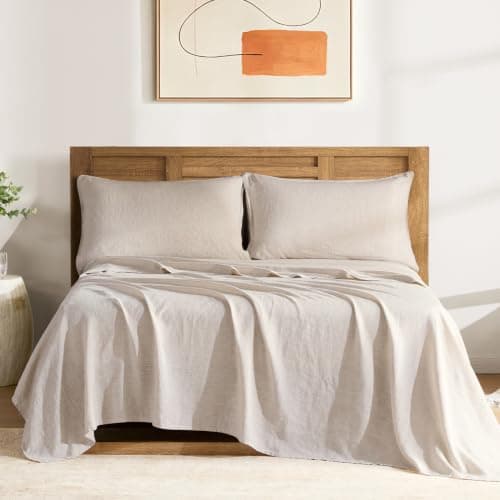 DAPU 100% Pure French Linen Sheet Set (170 GSM) 100% French flax at a stated 170 GSM, stone washed at the factory so it arrives most of the way softened. The default buy. Best for: Most people buying real linen | Most people buying real linen | |
| 2 |  JaTaCa 100% French Linen Sheet Set 100% French linen, washed and softened, with a 16-inch pocket. The cheapest way into real linen rather than a blend. Best for: The lowest price on genuine flax | The lowest price on genuine flax | $84.99 · View on Amazon Price as of October 17, 2026. #ad — we earn a commission. |
| 3 | 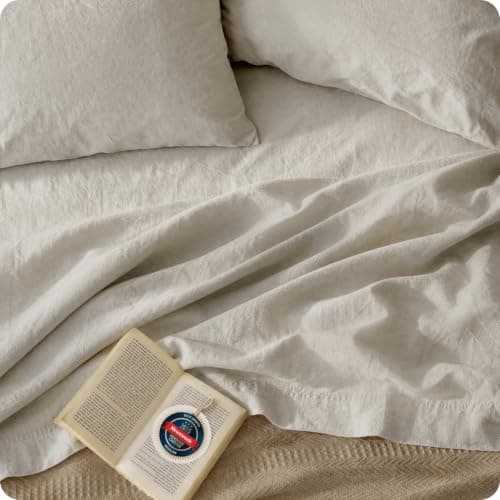 Bedsure Cotton-Linen Blend Sheet Set A cotton-linen blend that is soft on arrival and states anti-pilling. The pick if you want the look without the break-in. Best for: Soft immediately, with less of the linen | Soft immediately, with less of the linen |
The picks, in full
1. Best for Most people buying real linen
DAPU 100% Pure French Linen Sheet Set (170 GSM)
100% French flax at a stated 170 GSM, stone washed at the factory so it arrives most of the way softened. The default buy.
Key specs
- 100% French linen from Normandy (as listed)
- 170 GSM (as listed)
- Stone/pre-washed for softness (as listed)
- 4-piece queen set
What's good
- It states a GSM, which is the number that tells you how heavy the linen is - and weight is what decides how long the break-in takes and how the sheet drapes
- Stone washing is factory-applied mechanical softening: the work of the first thirty home washes has already been done for you
- 100% flax with a named growing region, rather than a blend hiding behind the word linen
What's not
- At 170 GSM this is a substantial linen, so it still takes real time to reach its softest state
- Linen wrinkles by nature and stone-washed linen looks rumpled by design - that is the aesthetic, not a fault
- It is a high price next to the blend
Skip this one if
You want a smooth, crisp, pressed-looking bed. Linen is the opposite of that by definition - a cotton percale is the crisp option.
2. Best for The lowest price on genuine flax
JaTaCa 100% French Linen Sheet Set
100% French linen, washed and softened, with a 16-inch pocket. The cheapest way into real linen rather than a blend.
Price as of October 17, 2026. #ad — we earn a commission.
Key specs
- 100% French linen (as listed)
- Washed / softened (as listed)
- 16 in deep pocket (as listed)
- 4-piece queen set
What's good
- 100% flax at the lowest price here, so you get linen's actual behavior - the breathability and the moisture handling - rather than a cotton blend imitating its look
- Listed as washed and softened, so it has had factory mechanical treatment before it reaches you
- A stated 16-inch pocket, which is more fit information than most linen listings give
What's not
- No GSM is stated, so you cannot tell how heavy the fabric is before it arrives
- Cheaper flax tends to be shorter-fibered, which can mean more surface fuzz early on
- Linen at any price is slow to dry and heavy when wet
Skip this one if
You want to know exactly what weight you are buying. Without a stated GSM you are trusting the photograph - the DAPU set publishes its 170 GSM.
3. Best for Soft immediately, with less of the linen
Bedsure Cotton-Linen Blend Sheet Set
A cotton-linen blend that is soft on arrival and states anti-pilling. The pick if you want the look without the break-in.
Key specs
- Cotton-linen blend (as listed)
- Anti-pilling (as listed)
- 16 in deep pocket (as listed)
- 4-piece queen set
What's good
- Blending cotton in gives you softness from the first night, which is the honest shortcut if the break-in period is the thing putting you off
- Anti-pilling is stated, and blends are where surface fuzz usually shows up first
- Cheaper and lighter to launder than pure flax, and far faster to dry
What's not
- The listing does not state the blend ratio, so how much linen you are getting is unknown - and that ratio is the whole product
- A blend does not deliver flax's full breathability or its decades-long lifespan
- It will not develop the characteristic softening curve that makes pure linen worth the wait
Skip this one if
You want linen for its longevity. A pure-flax sheet softens for years and lasts decades; a blend behaves like good cotton. Buy the DAPU or JaTaCa if the fiber is the point.
Common questions
How do you soften linen sheets quickly?
Wash them two or three times in a row on a warm, normal cycle with a small amount of mild detergent, tumble dry on low each time, and then sleep on them. Flax softens mechanically - the stiff bundles of fiber that make new linen feel board-like are broken down by flexing, agitation and friction, not dissolved by a product. That is why washing and tumbling, which flex every fiber thousands of times, is the fastest legitimate route. Adding a few clean tennis balls or wool dryer balls to the tumble increases the mechanical action and genuinely helps.
Does vinegar soften linen sheets?
It helps, modestly, and for a specific reason. Distilled white vinegar is mildly acidic, so it neutralizes and rinses away the alkaline detergent residue that builds up on fibers and makes fabric feel stiff and chalky. Half a cup in the rinse, no more, with no detergent in the same part of the cycle. What it does not do is change the flax itself - the fiber softening is still mechanical. So vinegar is a useful maintenance habit that removes a cause of stiffness, not a softening treatment.
Does baking soda work on linen?
Mildly, and by a different route than vinegar. Baking soda is alkaline and acts as a water softener, so in hard water it helps detergent work with less residue left behind - which indirectly keeps fabric feeling better. Half a cup in the wash drum alongside your detergent is harmless. What you should not do is combine it with vinegar in the same cycle: they neutralize each other, and you end up with salty water and no benefit from either. Pick one - baking soda in the wash, or vinegar in the rinse.
Why does fabric softener make linen worse?
Because it coats rather than softens. Softener deposits a waxy film on the fiber surface, which gives an immediate slippery feel while blocking the two things linen is bought for - its breathability and its ability to absorb and release moisture. It also sits on top of the fiber instead of letting it flex freely, so it slows down the real mechanical softening you are waiting for. Over several washes the residue accumulates and the sheets start to feel greasy and hold odor. Dryer sheets have the same effect.
How long does it take for linen sheets to get soft?
Noticeably softer within the first few washes, genuinely soft within a couple of months of regular use, and still improving for years. A stone-washed or pre-washed set starts much further along because the factory has already done mechanical softening for you - which is why both pure-flax picks here state it. The curve never really ends: well-kept linen is still getting better a decade in, which is the actual reason people put up with the first month.
Can you iron linen sheets to soften them?
Ironing flattens linen; it does not soften it. Pressing a damp linen sheet on a hot setting will give you a smooth, crisp surface for a day, and crisp is not the same as soft - the fiber bundles are unchanged, and you have added heat exposure for a cosmetic result that one night of sleep undoes. If you want linen to look pressed you are fighting the fabric's nature. The better approach is to take it out of the dryer slightly damp and smooth it onto the bed by hand, which removes the worst creases without the heat.
Sources
Where the facts on this page come from. We cite other people's testing because we don't do our own — here's what that means.
Read next
- The Best Linen SheetsSix linen sheet sets — pure French flax and softer cotton-linen blends — chosen on fiber honesty and value, with the price-and-wrinkle trade stated plainly on each.
- Cotton vs Linen SheetsTwo fibers, one decision: cotton's soft, affordable, low-maintenance comfort now, versus linen's breathability, longevity and lived-in look for buyers who will pay and embrace the wrinkles.
- Linen vs Bamboo SheetsLinen's airflow, longevity and lived-in look versus bamboo-rayon's silky, drapey, cool-to-the-touch feel — plus the labeling truth almost no bamboo listing says out loud.
- How to Wash Bed Sheets (by Fabric)A wash-and-dry method for every kind of sheet — cotton and percale, sateen, linen, bamboo viscose, flannel and microfiber — plus how often to wash, how to handle new sheets, and why sheets pill and how to slow it down.
- Why Do Sheets Pill?Pilling is mechanical, not a defect. Why short fibers and strong polyester are the worst combination, which weaves resist it, what slows it down - and why you cannot reverse it.
- The Best Organic SheetsSix organic sheet sets ranked on the standard each listing names - GOTS grade, certificate number, OEKO-TEX - plus weave, pocket and elastic, with honest cons on every pick and a plain account of what "organic" does not buy you.
- How Often Should You Wash Your Sheets?About once a week for most people - but sweat, pets, allergies, and skin can push it higher. Here is how to set an honest sheet-washing schedule.