The Best Mattress Encasements
Buy the SureGuard six-sided encasement. It is the one here that publishes a depth range rather than a single number, which is what decides whether the zipper closes on your mattress at all. Four more below for a cheaper seal, an active bed bug problem, a softer surface, and a cooler one.
We earn a commission if you buy through our links. It doesn't affect our picks — and we never take free products. How this site is funded.
Quick picks
| # | Product | Best for | Price |
|---|---|---|---|
| 1 | 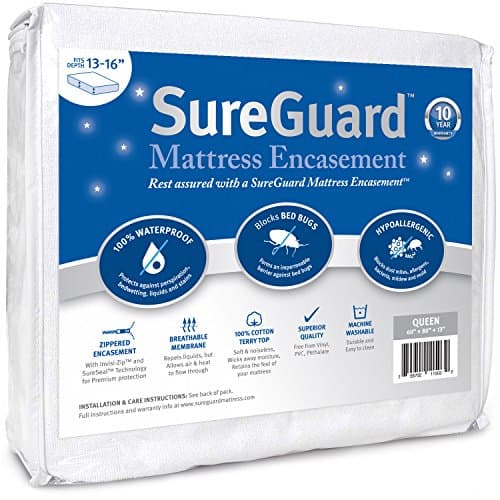 SureGuard Mattress Encasement, Queen 13-16 in Deep, Six-Sided The pick that gets the fit right. SureGuard sells this in four separate depth bands - 6-8, 9-12, 13-16 and 17-20 inches - instead of one size that stretches to cover everything, and that is the difference between a zipper that closes cleanly and one that strains for two years before it splits. Stated 100% waterproof, bed bug proof and hypoallergenic. Best for: Most people - the only pick stating a depth range | Most people - the only pick stating a depth range | $64.97 · View on Amazon Price as of October 18, 2026. #ad — we earn a commission. |
| 2 | 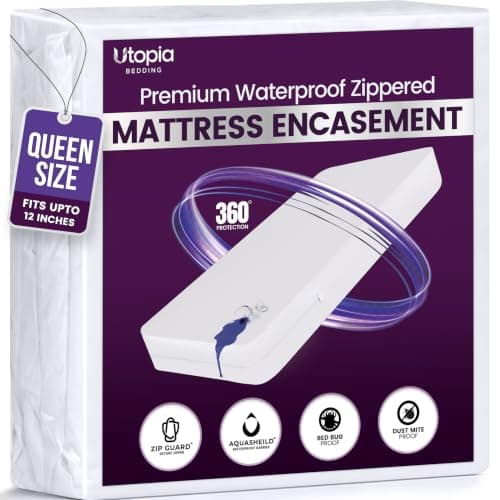 Utopia Bedding Premium 6-Sided Mattress Encasement, 12 in Pocket The value answer, and the right call if you are encasing a spare bed or buying several at once. Utopia states six-sided construction, waterproofing, a bed bug proof and dust mite proof claim, and a 12-inch pocket - the standard mattress depth - at roughly a third of the price of the specialist brands. Best for: The cheapest honest six-sided seal | The cheapest honest six-sided seal | |
| 3 | 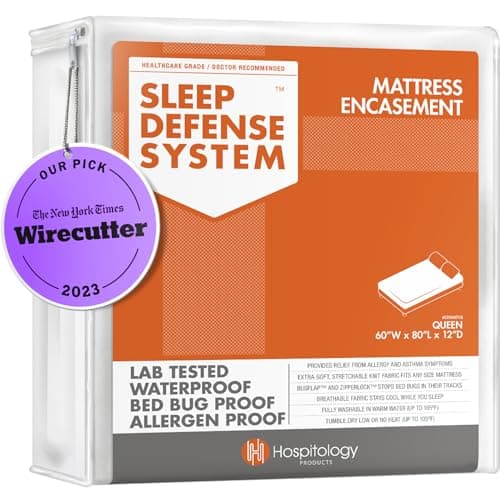 HOSPITOLOGY Sleep Defense System Mattress Encasement, 12 in Depth The one built for the actual emergency. Hospitology sells into the institutional market, and this is the design language of that world: a stated zippered bed bug and dust mite proof system with published dimensions - 60 by 80 inches, 12-inch depth - rather than a range of soft claims. If pest control has told you to encase the mattress and leave it sealed, buy this kind of product. Best for: An active bed bug problem, and long sealed treatment | An active bed bug problem, and long sealed treatment | $44.00 · View on Amazon Price as of October 18, 2026. #ad — we earn a commission. |
| 4 | 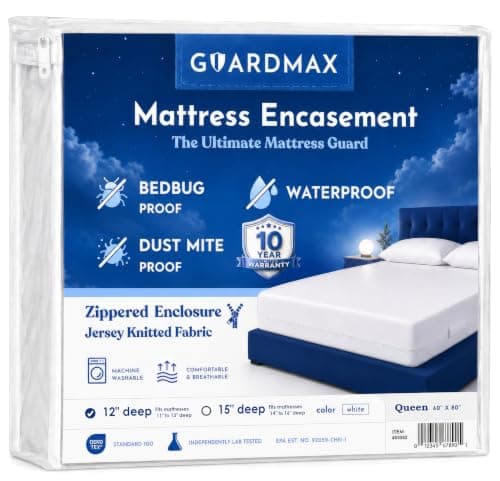 Guardmax Zippered Mattress Encasement, Jersey Knit, OEKO-TEX Certified The pick for the thing people hate about encasements. A soft jersey knit face over the membrane is quieter under a sheet and does not have the plastic hand of a cheap vinyl-faced cover - and Guardmax states OEKO-TEX certification plus a usable depth limit of 13 inches. The containment is the same; living with it is better. Best for: A surface that feels like a sheet rather than a liner | A surface that feels like a sheet rather than a liner | |
| 5 | 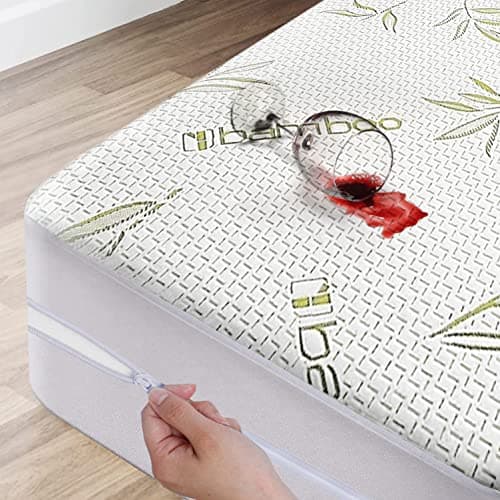 Bamboo Zippered Mattress Encasement, Jacquard Face, Queen The cooling-oriented option, with the usual caveat about what bamboo means on a bedding listing. The face fabric is a rayon-from-bamboo jacquard, which is genuinely better at moving moisture than a plain polyester face, and the listing states waterproof, breathable and noiseless. The membrane underneath is still a membrane. Best for: Hot sleepers who still need a full seal | Hot sleepers who still need a full seal | $38.99 · View on Amazon Price as of October 18, 2026. #ad — we earn a commission. |
Six sides and a zipper, or it is a protector
These two products get sold interchangeably and they do different jobs. A mattress protector is a fitted cover: top surface, down the sides, open underneath. That is everything you need to stop a spilled drink, night sweat or an accident reaching the mattress, and because it is open at the bottom it breathes reasonably well.
An encasement seals the mattress completely — all six faces, closed with a zipper, no opening anywhere. That total seal exists for two reasons and no others: to trap or exclude bed bugs, and to put a continuous barrier between you and the dust mite allergen that accumulates in a mattress core. If neither applies to you, buy the protector. It is cheaper, cooler and easier to live with, and we would rather say so here than sell you a zipper you do not need.
Depth is the spec that fails
On a fitted protector, getting the depth slightly wrong means a loose fit. On an encasement it means a zipper that will not close, or — worse — one that closes under strain and splits at the seam in year two. This is the specification to get right before anything else.
Measure the mattress at the side, top seam to bottom seam, with nothing on it. Then look for a cover that publishes either a depth band containing your number or a stated maximum you are comfortably under. One pick above sells four separate bands; one publishes a ceiling of 13 inches; one publishes nothing at all, and is ranked last for it.
Then: zipper, face fabric, noise
- The zipper and its flap. On a bed bug cover the zipper is the only route in, so the design detail that matters is whether there is a fabric flap or a zip-end guard over the slider. A bare zipper on a cover sold for pest containment is a weak point you can see from the photograph.
- Face fabric. Every encasement has a polyurethane membrane; what varies is what is laminated to it. A soft jersey knit or a woven jacquard moves moisture sideways and muffles sound. A thin, smooth, film-faced cover is the one that crinkles every time you roll over and ends up in a cupboard within a week.
- Heat. A sealed membrane on six sides traps heat that would otherwise go into the mattress. Face fabric softens this; nothing eliminates it. If you sleep hot and have no pest or allergy reason to encase, this is where the trade-offs between the thin-layer products sit.
How the five compare, from the listings
| Pick | Depth stated | Sides | Face | Bed bug claim |
|---|---|---|---|---|
| SureGuard | 13-16 in band | 6 | Not stated | Yes |
| Utopia Bedding | 12 in pocket | 6 | Not stated | Yes |
| Hospitology | 12 in, 60 x 80 in | 6 | Stretchable | Yes, system |
| Guardmax | Up to 13 in | 6 | Jersey knit | Yes |
| Bamboo jacquard | Not stated | Zippered | Bamboo jacquard | Not stated |
Four of the five make a bed bug claim, and all four of those claims are the seller's own — none of these listings cites third-party entomological testing. We have ranked on fit and construction because those we can read, and treated the claims as claims.
An encasement is one part of a bed bug plan
If this is why you are here: encasing the mattress alone accomplishes little. Bed bugs live in the frame, the headboard, the box spring and the room, and the EPA's own guidance treats encasements as one component of an integrated approach rather than a fix. The usual shape of the plan is to encase both the mattress and the box spring, leave them sealed for a long stretch — a year or more is commonly advised — and treat the room itself, with professional help if the infestation is established.
If you are here for allergies instead, the same product does real work for a different reason, and the full dust mite routine — pillow protectors, hot washes, lower humidity — matters more than which cover you choose.
About the prices on this page
We do not type prices into pages. Each button carries a figure read from the live listing by our own price check, stamped with the date it last ran. Encasements are priced per size and per depth band on separate listings, and the price gap between a twin and a king is large — confirm the variant before you buy.
What we will not tell you
We have not slept under these five, we have no test lab, and we are certainly not going to tell you we verified that a zipper excludes insects. The ranking is built on what each listing publishes — depth band, sides sealed, face fabric, certifications — and on the physics of the construction: a membrane does not breathe, a strained zipper splits, heat laminates loose in a hot dryer, and a cover rated to 13 inches does not fit a 14-inch mattress. Our full method is here.
The picks, in full
1. Best for Most people - the only pick stating a depth range
SureGuard Mattress Encasement, Queen 13-16 in Deep, Six-Sided
The pick that gets the fit right. SureGuard sells this in four separate depth bands - 6-8, 9-12, 13-16 and 17-20 inches - instead of one size that stretches to cover everything, and that is the difference between a zipper that closes cleanly and one that strains for two years before it splits. Stated 100% waterproof, bed bug proof and hypoallergenic.
Price as of October 18, 2026. #ad — we earn a commission.
Key specs
- Six-sided zippered encasement (as listed)
- Queen, 13-16 in depth band (as listed)
- 100% waterproof (as listed)
- Bed bug proof (as listed)
- Hypoallergenic (as listed)
What's good
- Four depth bands rather than one universal size, which is the single most important spec on a zippered product - a strained zipper is the way every encasement eventually fails
- Six-sided waterproofing means the sides and underside are sealed too, not just the sleeping surface, which is the whole reason to choose an encasement over a fitted protector
- SureGuard has sold this line for years under the same model names, so what arrives matches what is described
What's not
- The most expensive pick here by a wide margin, and the premium is in fit and finish rather than in any extra function
- You have to measure your mattress before ordering and pick the right band; getting it wrong means a return rather than a slightly loose fit
- A fully waterproof membrane on all six sides traps more heat than a breathable five-sided protector, whatever the listing says about breathability
Skip this one if
All you want is to stop spills reaching the mattress. A fitted five-sided protector does that for a third of the money and sleeps cooler.
2. Best for The cheapest honest six-sided seal
Utopia Bedding Premium 6-Sided Mattress Encasement, 12 in Pocket
The value answer, and the right call if you are encasing a spare bed or buying several at once. Utopia states six-sided construction, waterproofing, a bed bug proof and dust mite proof claim, and a 12-inch pocket - the standard mattress depth - at roughly a third of the price of the specialist brands.
Key specs
- Premium 6-sided encasement (as listed)
- Waterproof, zippered (as listed)
- 12 in deep pocket (as listed)
- Bed bug proof, dust mite proof (as listed)
- Queen, machine washable (as listed)
What's good
- Sold in several stated pocket depths - 8, 10, 12 and 14 inches appear as separate listings - so you can match a mattress rather than stretching one size over it
- Cheap enough to buy for every bed in the house, which is what a bed bug situation actually requires rather than treating one mattress
- Machine washable, and at this price replacing it after a hot wash goes wrong is not a disaster
What's not
- A single pocket depth per listing rather than a range, so a mattress between sizes is a guess
- Budget waterproof membranes are the ones most likely to crinkle audibly when you move - noise is the common complaint on cheap encasements
- The bed bug proof claim is the seller's; there is no third-party entomology certification stated on the listing
Skip this one if
You are dealing with a confirmed infestation and need a cover rated to stay sealed for the full treatment period. Spend more.
3. Best for An active bed bug problem, and long sealed treatment
HOSPITOLOGY Sleep Defense System Mattress Encasement, 12 in Depth
The one built for the actual emergency. Hospitology sells into the institutional market, and this is the design language of that world: a stated zippered bed bug and dust mite proof system with published dimensions - 60 by 80 inches, 12-inch depth - rather than a range of soft claims. If pest control has told you to encase the mattress and leave it sealed, buy this kind of product.
Price as of October 18, 2026. #ad — we earn a commission.
Key specs
- Zippered encasement (as listed)
- Bed bug and dust mite proof (as listed)
- Queen, 60 in W x 80 in L (as listed)
- Standard 12 in depth (as listed)
- Waterproof, stretchable, hypoallergenic (as listed)
What's good
- Publishes exact dimensions in inches rather than a size name, which is what you need when a pest-control plan depends on a complete seal
- A hospitality and institutional supplier rather than a bedding brand, which is the right sort of seller for a containment product
- Stretchable fabric listed alongside the waterproof claim, which is how an encasement stays sealed on a mattress that is not exactly 12 inches
What's not
- Mid-to-high price for a cover with no comfort function - this is a tool, not bedding, and it does not improve your bed in any way
- One depth only, so a tall pillow-top or a mattress with a topper sewn in may not zip
- Encasing a mattress does not treat an infestation; it traps what is inside and blocks new entry, and the listing cannot do more than that
Skip this one if
You have no pest problem and no allergy driver. This is the right product for a specific situation and overkill outside it.
4. Best for A surface that feels like a sheet rather than a liner
Guardmax Zippered Mattress Encasement, Jersey Knit, OEKO-TEX Certified
The pick for the thing people hate about encasements. A soft jersey knit face over the membrane is quieter under a sheet and does not have the plastic hand of a cheap vinyl-faced cover - and Guardmax states OEKO-TEX certification plus a usable depth limit of 13 inches. The containment is the same; living with it is better.
Key specs
- Zippered, 6-sided (as listed)
- Soft jersey knit surface (as listed)
- Waterproof, dust mite proof (as listed)
- Queen 60 x 80, up to 13 in deep (as listed)
- OEKO-TEX certified, machine washable (as listed)
What's good
- A jersey knit face is the single upgrade that makes an encasement tolerable: it stretches, it is quiet, and under a fitted sheet you stop noticing it
- OEKO-TEX certification is a verifiable third-party claim about tested substances - rare on a product that is mostly polyurethane film
- States both the exact panel size and a maximum depth, so the fit question is answerable before you order
What's not
- A knit face over a membrane is warmer than a thin smooth one - the fabric that makes it feel nice also insulates
- Up to 13 inches is a ceiling, not a range: on a 14-inch mattress this is simply the wrong cover
- Jersey faces pill over time in the same places sheets do, which looks worse than it matters
Skip this one if
Your mattress is over 13 inches, or you sleep hot enough that any extra insulating layer is a problem.
5. Best for Hot sleepers who still need a full seal
Bamboo Zippered Mattress Encasement, Jacquard Face, Queen
The cooling-oriented option, with the usual caveat about what bamboo means on a bedding listing. The face fabric is a rayon-from-bamboo jacquard, which is genuinely better at moving moisture than a plain polyester face, and the listing states waterproof, breathable and noiseless. The membrane underneath is still a membrane.
Price as of October 18, 2026. #ad — we earn a commission.
Key specs
- Zippered mattress encasement (as listed)
- Bamboo jacquard surface (as listed)
- 100% waterproof (as listed)
- Queen, cooling (as listed)
- Breathable, noiseless (as listed)
What's good
- A rayon-from-bamboo jacquard face moves moisture better than the polyester knits used on most encasements, which is the difference you notice on a warm night
- Noiseless is stated explicitly, and crinkle is the complaint that makes people take an encasement off again within a week
- Jacquard is a woven texture rather than a smooth film face, so it holds a sheet in place instead of letting it slide
What's not
- Bamboo on a bedding label almost always means rayon or viscose produced from bamboo - a chemically processed fiber, and the FTC has fined sellers for implying otherwise
- No stated depth range or depth limit, which on a zippered product is the specification most likely to cause a return
- A cooling face cannot undo the waterproof layer beneath it; this is cooler than other encasements, not cool like no encasement
Skip this one if
Fit certainty matters more than feel. Two picks above publish a depth number and this one does not.
Common questions
What is the difference between a mattress encasement and a mattress protector?
The number of sides, and the zipper. A mattress protector is a fitted cover: it sits over the top and down the sides like a deep fitted sheet, leaving the underside of the mattress open. That is all you need to stop spills, sweat and stains reaching the mattress, and it is cooler and cheaper. An encasement seals all six sides and closes with a zipper, so the mattress is completely enclosed with no opening at all. That total seal is only necessary for two jobs: trapping or excluding bed bugs, and putting a continuous barrier between you and dust mite allergen in the mattress core. If neither of those is your situation, a protector is the better purchase, and we have a separate page for those.
Do mattress encasements actually stop bed bugs?
They do two useful things and one thing they cannot do. A well-made encasement with a tight zipper blocks bed bugs from entering the mattress and traps any already inside, where they eventually die because they cannot feed - the EPA lists encasements as part of an integrated control approach for exactly this reason. What an encasement cannot do is treat an infestation. Bed bugs live in the frame, the headboard, the baseboards and the box spring, not only in the mattress, so encasing the mattress alone changes very little. The standard approach is to encase both mattress and box spring, leave them sealed for a long period (a year or more is commonly advised), and treat the room itself. Buy the encasement as one part of a plan, not as the plan.
What depth encasement do I need?
Measure the mattress at the side, from the top seam to the bottom seam, and buy a cover rated for that depth or a band that contains it. This is more important on an encasement than on any other bedding product, because a zipper is unforgiving: a cover rated to 12 inches on a 14-inch mattress either will not close or closes under strain that splits the seam within a couple of years. Oversizing is a smaller problem but still a problem - a loose encasement wrinkles under the sheet and the excess fabric gathers where you lie. One pick above publishes a true range (13 to 16 inches) and sells other bands separately; that is the approach to look for.
Are mattress encasements noisy or hot?
Both, to a degree that depends on the face fabric - and this is the honest cost of a full seal. Every encasement has a waterproof membrane, usually polyurethane film, which does not breathe the way fabric does. Heat and moisture that would otherwise pass into the mattress stay on your side of the film. A soft knit or woven face over the membrane makes a real difference to both complaints: it muffles the crinkle and moves moisture sideways instead of holding it against you. A thin, smooth, film-faced budget cover is the one people take off again after a week. If you sleep hot and do not have a pest or allergy reason to encase, this is the strongest argument for buying a breathable protector instead.
Do encasements help with dust mite allergies?
Yes, with realistic expectations. Dust mites live deep in mattress and pillow fill, feeding on skin cells, and their waste is the actual allergen. A tightly woven or membrane-backed encasement puts a continuous barrier between that reservoir and your airway, and allergy guidance has recommended encasing mattresses and pillows for decades. What it does not do is reduce the mite population in your bedroom - carpet, curtains, soft furnishings and the duvet all hold allergen too, and an encasement does nothing about any of them. Pair it with pillow protectors, hot-wash bedding weekly, and keep humidity down; mites need humid air to survive.
How do you wash a mattress encasement?
Warm wash, low-heat dry, and no bleach - and check the listing, because heat is what kills these. The waterproof layer in almost every encasement is a polyurethane film laminated to the face fabric, and high dryer heat delaminates it: the cover looks fine and quietly stops being waterproof. Bleach attacks the same film. Wash it when you wash the mattress protector, every month or two, or straight away after any spill that got through a sheet. If you are using it for bed bug containment, do not wash it at all during the treatment period - unzipping is the one thing you are not meant to do.
Sources
Where the facts on this page come from. We cite other people's testing because we don't do our own — here's what that means.
- EPA - how to find bed bugs
- EPA - do-it-yourself bed bug control (where encasements fit)
- Sleep Foundation - best mattress protectors (the adjacent category)
- OEKO-TEX Standard 100 - what the certification covers
- FTC - how to avoid bamboozling your customers (bamboo fiber claims)
- FTC - Endorsement guides (why this disclosure exists)
Read next
- The Best Mattress ProtectorsSix mattress protectors that block liquid without sleeping hot or crinkling — fitted pads and zippered encasements — with an honest note on who each is wrong for.
- How to Choose a Mattress ProtectorChoosing a mattress protector is five decisions: waterproof or not, fitted or full encasement, how it feels, whether it fits the depth of your bed, and how you wash it. Here is how to pick.
- How to Get Rid of Dust Mites in Your BedYou cannot get rid of dust mites completely - but you can cut their numbers and allergen load. The habits that genuinely work, ranked, minus the hype.
- Mattress Pad vs Mattress ProtectorPad, protector, and topper are three different products people confuse. A protector is a waterproof barrier, a pad adds a little softness, a topper changes the feel — here is which one your bed needs.
- The Best Pillow ProtectorsA pillow protector is the cheapest thing in the bedroom and the most mislabeled. Five picks sorted by the only question that matters - barrier or breathable - plus what the allergy research actually says a cover can do.
- How to Clean a MattressA step-by-step method for cleaning a mattress — routine refresh, stains, sweat and smells — built around the one rule that saves it: never soak it.
- The Best Mattress PadsSix mattress pads worth buying — a thin quilted layer of softness you can machine wash — plus the plain difference between a pad, a topper, and a protector.
- The Best Bed SkirtsA bed skirt is bought on two numbers and one decision: the drop from your box spring to the floor, and whether you are willing to lift the mattress to install it. Five skirts ranked on both, plus who should not buy one at all.