How to Keep a Mattress From Sliding
A mattress that creeps across its base every time you move isn't broken — it's just missing friction. Here are the fixes, ranked from the cheapest to the most permanent.
We earn a commission if you buy through our links. It doesn't affect our picks — and we never take free products. How this site is funded.
A mattress that creeps a few inches across its base every week — until one morning you wake up half off the edge — isn't malfunctioning. It's just missing friction. Nothing about a sliding mattress means it's the wrong mattress or a bad base; it usually just means two smooth surfaces are sitting on top of each other with nothing between them to grip. The fixes are cheap, ranked roughly from least to most involved, and most people solve it with the first one they try.
Why mattresses slide in the first place
It comes down to what's directly underneath the mattress. Foam and hybrid mattresses often have a smooth woven or knit fabric on the bottom, and when that sits on an equally smooth surface — a finished wood platform, a painted metal frame, or a box spring wrapped in slick fabric — there's very little resistance holding the two together. Add ordinary movement (getting in and out of bed, two people shifting through the night) and the mattress gradually walks in whatever direction the movement pushes it, because nothing is stopping it. It's a slow process, which is why it's so easy to miss until the mattress is already several inches off center — nobody notices an eighth of an inch a night.
A few situations make it worse. A platform bed with a completely flat, finished surface has less natural grip than a slatted base with some texture, since a slatted surface at least gives the mattress a few ridges to catch on instead of one uninterrupted plane. A base that's slightly too large for the mattress gives it room to wander before it hits an edge, and a memory foam mattress — which is generally heavier and denser on the bottom layer than an all-innerspring bed — can actually feel harder to nudge back into place once it has drifted, even though it slides for the same friction reasons any mattress does. And an adjustable base changes the geometry entirely — once the head or foot inclines, gravity is pulling the mattress down the slope, not just sideways from a nudge, which is a stronger and steadier force than flat-surface sliding ever produces. A mattress that never budged on a flat platform can start creeping the moment it's on an incline for the first time.
Sheets and a fitted mattress protector make surprisingly little difference here, since the sliding happens underneath the mattress, not between the mattress and the bedding on top of it. It's worth ruling that out early so you don't spend money on the wrong layer — the fix has to go between the mattress and the base, not between the mattress and the sheets.
The fixes, cheapest first
These work by adding friction, and they stack — a rug pad plus Velcro strips is more secure than either alone. Start with the cheapest option and add more only if it's still not enough.
- A non-slip rug pad or rubber shelf liner. Cut to roughly the size of the mattress and placed between the mattress and the base, this is the cheapest fix and solves the problem for most people. The rubberized texture grips both the mattress fabric and the platform underneath, which is exactly the friction that was missing.
- Velcro strips or mattress-anchor straps.A step up in effort and security — these attach to both the base and the mattress underside and hold the two together rather than just adding surface grip. Worth it if a rug pad alone hasn't fully solved it, or if you want something more permanent.
- A fitted, non-slip mattress pad. Beyond the friction fix, a mattress pad with a grippy underside adds a layer of resistance while also doing its normal job of protecting the mattress surface — two problems solved with one purchase if you needed a pad anyway.
- Slats or a bunkie board for more surface grip. A completely smooth platform gives a mattress nothing to catch on; adding slats, or a bunkie board with a slightly textured surface, gives it more contact points and more resistance than a single flat, finished surface does.
- A proper frame with a lip, retainer bar, or headboard and footboard. The most permanent option. A raised edge around the base, or a headboard and footboard that physically box the mattress in, stops it from traveling far regardless of how slick the surface underneath is. Worth the investment in a proper bed frame if the cheaper fixes haven't held, or if a frame purchase was already on the list.
Most people never need to go past the first one or two options on this list. Start cheap, give it a couple of weeks of normal use, and only move down the list if the mattress is still creeping.
Check the base itself
Before spending money on friction fixes, make sure the base is actually the right size. A frame or platform that's noticeably larger than the mattress gives it room to drift before it even hits an edge, and no amount of grip fully compensates for a base that was never sized correctly in the first place. Measure both and confirm they match — it's a five-minute check that can save you from solving the wrong problem. This is especially common after a mattress size change, like moving from a queen to a king frame with a mattress that was never actually swapped out to match, or a hand-me-down frame that was built for a slightly different standard size.
On a slatted base, also check that there are enough slats and that they're spaced close enough together. Widely spaced slats don't just risk sagging over time — they also give a mattress fewer contact points to grip, which can make sliding worse on top of whatever else is going on. A bunkie board or an extra slat or two closes that gap and adds grip at the same time.
If you're shopping for a base rather than retrofitting one you already own, it's worth knowing whether you actually need a box spring for your mattress type — the wrong foundation can contribute to sliding as well as other problems down the line.
When it's not really a sliding problem
Sliding, sagging, and a broken base can look related, but the fixes are different, and it's worth being honest about which one you're actually dealing with. If the mattress is sliding anddeveloping a dip or a permanent low spot, that's a separate issue caused by worn-out foam or coils, not a lack of friction — our guide on fixing a sagging mattress covers that. And if the base itself is cracked, bowing, or missing a support leg, no amount of rug pad or Velcro fixes a structural problem in the frame — that needs an actual repair, not friction, and the sliding is really just a symptom of the base flexing underneath the mattress rather than sitting still.
It's also worth separating sliding from a mattress that simply feels unstable or springy at the edges. That's usually a different complaint about edge support — how firm the mattress feels when you sit or sleep near the perimeter — rather than the whole mattress traveling across the base, and no rug pad or retainer bar changes how the edge itself is built. If what you're noticing is a soft, unsupported edge rather than the entire mattress creeping over days or weeks, that's a construction question for your next mattress, not something the fixes on this page will solve.
A sliding mattress on an otherwise sound, correctly sized base, though, is one of the easiest and cheapest fixes on this whole site — most people solve it for the cost of a rug pad and never think about it again.
The cheap stuff worth having
The cheapest fix above, in the version built for the job. A non-slip rug pad or rubber shelf liner cut to size does the same work for less, and if you already own one, use that first.
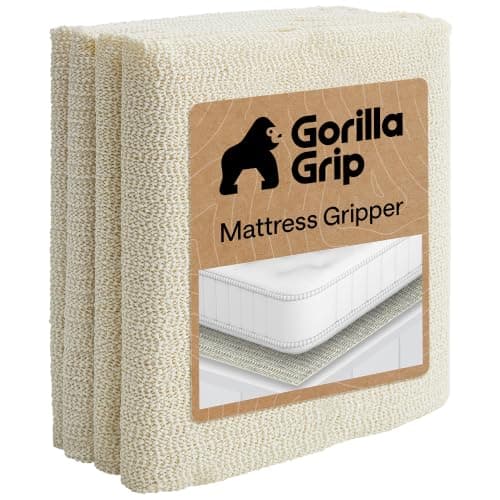
Gorilla Grip Non-Slip Mattress Gripper (54 x 72, Queen)
A rubberized pad laid between the mattress and a slick platform supplies the friction the two surfaces don't have on their own. The cheap fix for a bed that walks.
Skip it if Your mattress moves because the base is broken, or smaller than the bed sitting on it. Grip can't fix geometry — that's a frame problem.
Common questions
Why does my mattress keep sliding around?
Almost always because there's a slick surface between the mattress and whatever it's sitting on, with nothing there to create friction. A foam mattress resting on a smooth metal or wood platform, or on a box spring with a slippery fabric cover, has very little to grip — a bit of ordinary movement, or two sleepers shifting at once, is enough to walk it out of position over time. It's rarely a sign anything is wrong with the mattress itself; it's a mismatch between a smooth mattress bottom and an equally smooth surface underneath it.
Does a rug pad stop a mattress from sliding?
Yes, and it's usually the cheapest and most effective fix available. A non-slip rug pad or a purpose-made rubber shelf liner, cut to size and placed between the mattress and the base, adds real grip on both sides — the rubberized texture bites into the mattress fabric on one side and the platform or box spring on the other. It's inexpensive, takes a few minutes to place, and solves the problem for the vast majority of sliding mattresses without buying anything else.
Do Velcro strips actually work to stop a mattress from sliding?
Yes, and they're a reasonable step up from a rug pad if you want something more fixed in place. Heavy-duty Velcro strips, or purpose-built mattress-anchor straps, attach directly to the base and the underside of the mattress and hold the two together rather than just adding surface friction. They're a bit more effort to install than a rug pad, since you're committing to strip placement, but they resist movement more completely and are worth it if a rug pad alone hasn't fully solved it.
Do I need a bed frame with rails to stop sliding?
Not always, but it's the most permanent fix if the friction-based options aren't enough. A frame with a raised lip or retainer bar around the edge — or a headboard and footboard that physically box the mattress in — stops it from being able to travel far in the first place, regardless of how slick the surface underneath is. It's a bigger investment than a rug pad or Velcro strips, so it makes the most sense if you've already tried the cheaper fixes and the mattress is still creeping, or if you're buying a frame anyway.
Does an adjustable base need special anti-slide measures?
Generally yes, because an adjustable base changes the geometry that used to hold the mattress in place. Once the head or foot section inclines, gravity is actively pulling the mattress downward along the incline, not just sideways from ordinary movement, so a retainer bar at the foot of the base is essentially mandatory rather than optional. A rug pad or non-slip pad helps in addition to a retainer bar, but on an adjustable base it usually isn't enough by itself, since it's fighting gravity on an incline rather than just resisting a nudge on a flat surface.
Sources
Where the facts on this page come from. We cite other people's testing because we don't do our own — here's what that means.
Read next
- How to Keep a Mattress Topper From SlidingWhy mattress toppers slide — smooth foam on slick sheets, or a topper that is the wrong size — and the fixes that keep them put, led by a deep-pocket fitted sheet pulled over both layers, plus corner straps, grip pads, and a permanent hold.
- How to Fix a Sagging MattressThe honest triage for a sagging mattress: check the base first, the fixes that actually help, the myths that don't, and when a warranty — and a topper — stop being able to save it.
- Do You Need a Box Spring?A plain-English answer on box springs: what they were built for, why most modern mattresses don't want one, and the slat-spacing rule that decides whether your base voids the warranty.
- The Best Bed Frames (No Box Spring Required)Six platform bed frames that replace the box spring, chosen on slat spacing, noise, storage and whether a headboard's included — with honest cons on every pick.
- The Best Mattress PadsSix mattress pads worth buying — a thin quilted layer of softness you can machine wash — plus the plain difference between a pad, a topper, and a protector.
- The Best Adjustable Bed Bases (For Mattresses That Can Bend)Six adjustable bed bases chosen on the one rule that matters - your mattress has to bend on it - plus motor noise, weight capacity and which features are worth paying for. Honest cons on every pick.