What Is Waffle Weave Bedding?
Waffle is a honeycomb weave that holds pockets of still air, which makes it warmer than its weight suggests and more textured than anything else on a bed. It works beautifully as a duvet cover or a comforter. As sheets it almost does not exist, and this page explains why.
We earn a commission if you buy through our links. It doesn't affect our picks — and we never take free products. How this site is funded.
A structure, not a fabric
Waffle — also sold as honeycomb or waffle pique — is a way of weaving, not a material. Some threads are floated over several others in a repeating square grid, which pulls the cloth into raised ridges with recessed squares between them. The surface stops being flat and becomes a field of small pockets.
You already know how it feels: it is the weave of a kitchen towel and a hotel bathrobe. And because it is a structure, you can have it in any fiber — cotton, linen, microfiber, a blend — which is the first thing to check on any waffle listing, because the fiber decides as much as the weave does.
Why it is warmer than it looks
Each recess in the grid holds a pocket of still air, and still air is a good insulator. So a waffle fabric insulates better than a flat weave of the same weight — which is why a waffle blanket feels substantial without being heavy.
At the same time the structure is open rather than dense, so moisture still moves through it. That combination — traps warmth, still breathes — is exactly what a bathrobe needs, and it is what makes cotton waffle a good three-season weight on a bed rather than a winter-only fabric. In a heavier fabric weight it becomes genuinely warm; which is why a published GSM is worth looking for.
What to look for before you buy
- Fiber content, stated as a percentage.Cotton waffle breathes and gets softer with washing. Microfiber waffle has the look with none of the moisture path, which turns the trapped warmth clammy. Watch for listings where "linen" describes the colorway or the look rather than the material.
- Fabric weight in GSM. The spec that separates a waffle that drapes softly from one that stands up like upholstery, and the best available proxy for both warmth and snag resistance. One listing below publishes 320 GSM; most publish nothing.
- Snag resistance, realistically. The floated threads that make the texture are loops available to catch on rings, clasps, zippers and claws — and in a regular grid, one pulled loop distorts a visible patch. Heavier weights resist it better. Nothing eliminates it.
- Exact dimensions if you are buying a duvet cover for an insert you already own. Cotton waffle shrinks on heat like any cotton, and a few percent on a cover is the difference between fitting and not fitting.
The honest answer about waffle sheets
A lot of people arrive at this topic looking for waffle sheets, so here is what we found when we checked live listings for this page: that market barely exists. Waffle on the main retail shelf is duvet covers, comforters and blankets. We could verify exactly one waffle fitted-sheet product family — unbranded, a handful of sizes and colors, thin stock — and no established brand making waffle sheet sets at all.
That is probably not an oversight. A raised, open weave is the wrong structure for a fitted sheet in two specific ways: it snags far more than a flat weave in the layer that gets dragged across a mattress every night, and it is the one piece of bedding in constant contact with bare skin, where a geometric texture divides opinion sharply.
So the sensible way to get the waffle look is to put it on top — a duvet cover over an insert you choose, or a waffle comforter — and keep a smooth percale or cotton sheet underneath. You get the texture where you see it and no texture where you sleep. The one live waffle fitted sheet is included in the picks below for the people who specifically want it, ranked last and with the caveats attached.
Where waffle belongs on a bed
Three places, in order of how well it works:
- A duvet cover. The best use by a clear margin. The texture adds visual depth and a little loft, the warmth is a bonus because the insert is doing the actual insulating, and nothing is rubbing against it except the air. The wider duvet cover category has the non-waffle alternatives.
- A comforter or a blanket. Also excellent, and the cheapest route in — a waffle comforter replaces both the insert and the cover in one purchase, at the cost of being a single fixed warmth level. That trade-off in full, and a cotton waffle blanket is already on our blankets page.
- Sheets. See above. Possible, barely available, and the weave is working against itself.
Living with it
Cold or warm wash, gentle cycle, low dryer heat, and out of the drum while still slightly damp. The last part matters more on waffle than on any flat weave: the texture sets creases, and a cotton waffle cover left to tumble until bone dry comes out with wrinkles pressed into the grid that will not shake loose. Wash it without zippers, and preferably without anything abrasive at all — the open structure is the vulnerable part.
Then take your rings off at night, and if you have cats, buy a different weave. We would rather tell you that now than have you discover it with a pulled loop across the middle of a new duvet cover.
Quick picks
| # | Product | Best for | Price |
|---|---|---|---|
| 1 | 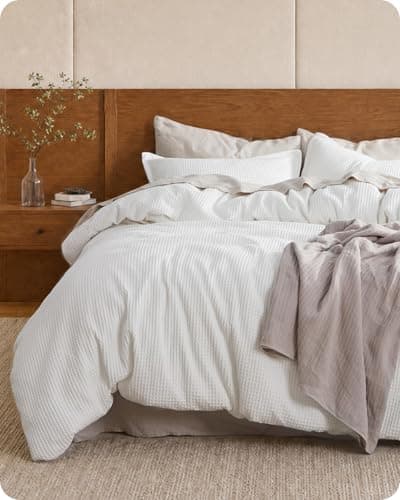 Bedsure PureWoven 100% Cotton Waffle Duvet Cover Set, 3 Piece This is where waffle belongs. A duvet cover is the one place the texture is purely an advantage: the pockets add visual depth and a little loft to the top of the bed, and because the insulation is coming from the insert underneath, the weave's warmth is a bonus rather than a variable. Stated 100% cotton, three pieces, and it carries a Good Housekeeping Seal. Best for: The best use of a waffle weave - a cotton duvet cover | The best use of a waffle weave - a cotton duvet cover | |
| 2 | 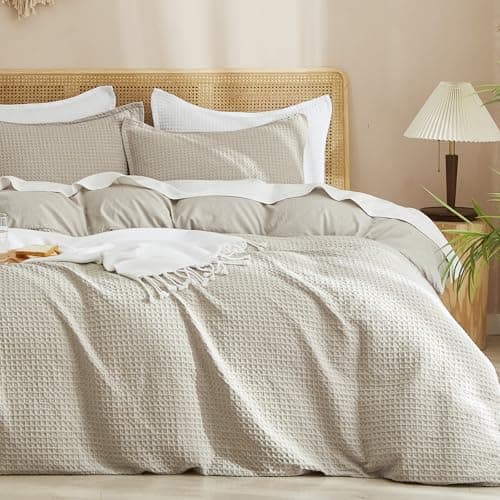 PHF Waffle Duvet Cover Set, 320 GSM, 90 x 90 in, 3 Piece The pick with a number on it. PHF publishes 320 GSM and exact dimensions - 90 by 90 inches - which is rare on this shelf and genuinely useful, because fabric weight is what separates a waffle that drapes from one that stands up like upholstery. It is also described as no-snagging, which is the right thing for a waffle seller to be thinking about. Best for: A published fabric weight, and a linen look | A published fabric weight, and a linen look | $46.99 · View on Amazon Price as of October 18, 2026. #ad — we earn a commission. |
| 3 | 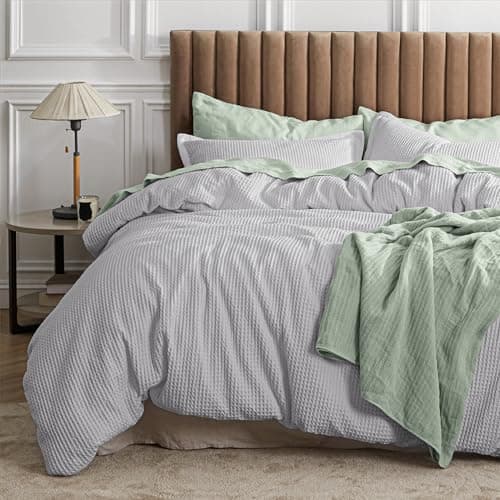 Bedsure Waffle Comforter Set, 100% Cotton Shell, OEKO-TEX Certified The all-in-one. A waffle comforter set skips the insert-and-cover arrangement entirely: cotton waffle shell, filled, ready to put on the bed, with an OEKO-TEX certification and a very low price. The compromise is the usual comforter compromise - you cannot change the warmth or wash just the cover - but as a complete lightweight top layer it is hard to argue with. Best for: One purchase instead of insert plus cover | One purchase instead of insert plus cover | |
| 4 | 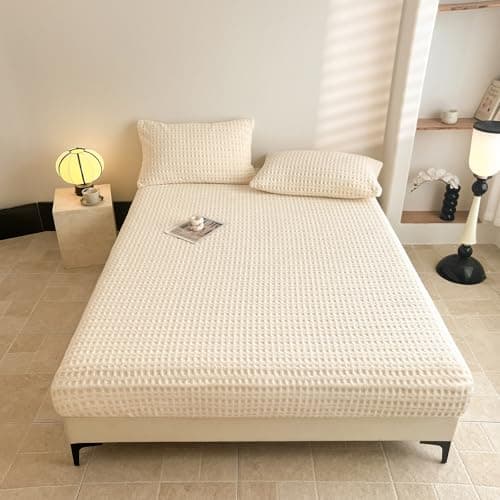 Waffle Weave Fitted Sheet, 15 in Deep Pocket, Elastic All Around Included because it is the one live product that actually answers the query, and listed last because of what it is: an unbranded fitted sheet sold in a handful of sizes and colors with thin stock levels. It has the two specs that matter - a 15-inch deep pocket and elastic all around - and if you specifically want a textured bottom sheet, this is currently it. Best for: The only real answer to "waffle sheets" - with caveats | The only real answer to "waffle sheets" - with caveats | $29.99 · View on Amazon Price as of October 18, 2026. #ad — we earn a commission. |
The picks, in full
1. Best for The best use of a waffle weave - a cotton duvet cover
Bedsure PureWoven 100% Cotton Waffle Duvet Cover Set, 3 Piece
This is where waffle belongs. A duvet cover is the one place the texture is purely an advantage: the pockets add visual depth and a little loft to the top of the bed, and because the insulation is coming from the insert underneath, the weave's warmth is a bonus rather than a variable. Stated 100% cotton, three pieces, and it carries a Good Housekeeping Seal.
Key specs
- 100% cotton (as listed)
- Waffle weave texture (as listed)
- 3 pieces, Queen (as listed)
- All-season, machine washable (as listed)
- Good Housekeeping Seal (as listed)
What's good
- 100% cotton rather than a microfiber waffle, which is the difference between a texture that breathes and one that holds heat with no moisture path
- On a duvet cover the weave does the job it is best at: visual texture and a little extra loft, with the actual warmth coming from the insert
- A stated 3-piece set, so the shams match - a waffle cover with plain shams reads as a mismatch rather than a choice
What's not
- A raised open weave catches on rings, watch clasps and claws, and a pulled loop on a waffle is far more visible than a snag on a flat weave
- Cotton waffle creases hard in the dryer and the texture holds the creases - it needs taking out damp or it looks slept-in from the start
- Price is at the upper end for a cotton duvet cover set, and the texture is most of what you are paying for
Skip this one if
You have cats, or anyone in the bed wears rings at night. Snagging is the honest weakness of every waffle weave and no brand has solved it.
2. Best for A published fabric weight, and a linen look
PHF Waffle Duvet Cover Set, 320 GSM, 90 x 90 in, 3 Piece
The pick with a number on it. PHF publishes 320 GSM and exact dimensions - 90 by 90 inches - which is rare on this shelf and genuinely useful, because fabric weight is what separates a waffle that drapes from one that stands up like upholstery. It is also described as no-snagging, which is the right thing for a waffle seller to be thinking about.
Price as of October 18, 2026. #ad — we earn a commission.
Key specs
- 320 GSM fabric (as listed)
- 90 x 90 in, Queen (as listed)
- Textured honeycomb, linen look (as listed)
- 3 pieces (as listed)
- Listed as no snagging (as listed)
What's good
- A published GSM is the single most useful spec on a textured weave, and almost nobody on this shelf gives you one
- Exact dimensions in inches rather than a size name, so you can check it against the insert you already own
- Cheaper than the cotton pick while publishing more specification, which is an unusual combination
What's not
- The listing does not state a fiber content - linen here describes the look and the colorway, not the material, and that distinction matters
- No-snagging is a seller claim about a structural property of the weave; treat it as an intention rather than a guarantee
- A heavier 320 GSM waffle is warmer, which on a summer bed with a warm insert is more than you may want
Skip this one if
You need to know what the fabric is made of. The cotton pick above states its fiber and this one does not.
3. Best for One purchase instead of insert plus cover
Bedsure Waffle Comforter Set, 100% Cotton Shell, OEKO-TEX Certified
The all-in-one. A waffle comforter set skips the insert-and-cover arrangement entirely: cotton waffle shell, filled, ready to put on the bed, with an OEKO-TEX certification and a very low price. The compromise is the usual comforter compromise - you cannot change the warmth or wash just the cover - but as a complete lightweight top layer it is hard to argue with.
Key specs
- 100% cotton shell (as listed)
- Soft waffle weave (as listed)
- Queen, 3 piece (as listed)
- Lightweight, all-season (as listed)
- OEKO-TEX certified, machine washable (as listed)
What's good
- Cheapest pick here by a wide margin and it replaces two purchases - no insert needed, no cover needed
- A stated 100% cotton shell with OEKO-TEX certification, which is more paperwork than most comforters at any price
- Lightweight is the right call for a waffle: the weave already adds warmth, so a light fill keeps it usable past March
What's not
- A comforter is one fixed warmth level - you cannot swap the fill for summer the way you can change an insert inside a cover
- The whole thing goes in the machine, which means a bulky wash rather than laundering a cover and leaving the insert alone
- The fill type is not stated on the listing, only the shell, so what provides the warmth is unspecified
Skip this one if
You already own a duvet insert you like. Buy a waffle cover for it instead and keep the ability to change the warmth.
4. Best for The only real answer to "waffle sheets" - with caveats
Waffle Weave Fitted Sheet, 15 in Deep Pocket, Elastic All Around
Included because it is the one live product that actually answers the query, and listed last because of what it is: an unbranded fitted sheet sold in a handful of sizes and colors with thin stock levels. It has the two specs that matter - a 15-inch deep pocket and elastic all around - and if you specifically want a textured bottom sheet, this is currently it.
Price as of October 18, 2026. #ad — we earn a commission.
Key specs
- Waffle weave fitted sheet (as listed)
- 15 in deep pocket (as listed)
- Elastic all around (as listed)
- Queen, Ivory White (as listed)
What's good
- A 15-inch deep pocket with all-around elastic is a genuinely good fit specification, better than many branded flat-weave sheets
- The only waffle fitted sheet we could verify as live, so it is the actual answer to a question a lot of people are asking
- A textured bottom sheet does grip a duvet and a sleeper more than a slick sateen does, which some people specifically want
What's not
- No stated fiber content and no brand with a trading history behind it - the thinnest paperwork of anything on this page
- Stock is thin and variant-dependent; listings like this disappear, and if it does there is currently no obvious replacement
- A raised weave against bare skin is a texture you either like or find scratchy, and a fitted sheet is the one piece of bedding you cannot avoid touching
Skip this one if
You want a waffle look without sleeping directly on the texture. Put the waffle on top as a duvet cover and keep a smooth sheet underneath.
Common questions
What is waffle weave?
A weave structure, not a fabric. Waffle - also sold as honeycomb or waffle pique - is made by floating some warp and weft threads over several others in a repeating square grid, which pulls the surface into a pattern of raised ridges and recessed squares. The result is three-dimensional cloth: each little square is a pocket. Because it is a weave rather than a fiber, you can get waffle in cotton, in linen, in microfiber and in blends, and the fiber matters as much as the structure does. It is the same weave you already own in a kitchen towel or a hotel bathrobe, which is a useful reference point for what it feels like.
Is waffle weave warm?
Warmer than a flat weave of the same weight, and that surprises people. The mechanism is still air: each recessed square in the grid holds a pocket of air, and trapped air is a good insulator, so the fabric insulates better than its weight alone would suggest. That is why a waffle blanket feels substantial without being heavy. It is also breathable at the same time, because the structure is open rather than dense - the pockets hold air but moisture can still move through the weave, which is exactly what a bathrobe needs to do. In bedding that combination makes waffle a good three-season choice in cotton, and a warm one in a heavier GSM.
Are there waffle weave sheets?
Barely, and this is worth saying plainly. When we checked live listings for this page, the waffle market on the main retail shelf was duvet covers, comforters and blankets - we could verify exactly one waffle fitted-sheet product family, unbranded, in a few sizes and colors with low stock. There is no established brand making waffle sheet sets. There are two likely reasons. A raised, open weave is the wrong structure for a fitted sheet mechanically: it snags more, it has less stretch recovery at the corners, and it is the one layer of bedding in constant contact with skin, where a texture divides opinion sharply. So if you want the waffle look, the sensible move is to put it on top - a duvet cover or a comforter - and keep a smooth percale or cotton sheet underneath.
Does waffle weave snag?
Yes, more than any flat weave, and it is the honest weakness of the fabric. The threads that create the texture are floated over others rather than locked into a tight grid, so there are raised loops available to catch on rings, watch clasps, zippers, rough fingernails and cat claws - and because the pattern is regular, one pulled loop distorts a visible area rather than disappearing into the cloth. A heavier GSM waffle is more resistant than a light open one, which is one practical reason to look for a published fabric weight. Beyond that: wash it on its own or with other soft items, never with zippers, and take rings off at night. If you have cats, this is not the weave for you.
How do you wash waffle weave bedding?
Cold or warm, gentle cycle, low dryer heat, and take it out while it is still slightly damp. Two things make waffle different from a flat weave in the laundry. First, the texture holds creases: if you let a cotton waffle cover tumble dry completely it comes out with set wrinkles in the grid that do not shake out, which is why damp removal matters more here than on percale. Second, the open structure is vulnerable to abrasion, so a crowded drum with a zipper in it does real damage. Cotton waffle also shrinks on heat like any cotton, and on a duvet cover a few percent of shrinkage is the difference between fitting your insert and not.
Waffle or linen for a textured bed?
They give you texture in opposite ways and suit different rooms. Linen's texture is irregular - slubs and variation in the thread itself, with a relaxed, rumpled drape that gets softer every wash. Waffle's texture is geometric: a regular grid that reads as deliberate and structured rather than casual, and it holds its shape rather than draping. Linen is cooler and more expensive; waffle is warmer and cheaper. In practice the choice is aesthetic. If you want the bed to look relaxed and lived-in, linen. If you want it to look made and architectural, waffle. We have a full page on linen sheets if that is the direction you are leaning.
Sources
Where the facts on this page come from. We cite other people's testing because we don't do our own — here's what that means.
Read next
- What Is GSM in Bed Sheets?Grams per square meter, explained. Why GSM beats thread count on flannel and linen, what the common numbers feel like in a real bed, and why most listings refuse to print it.
- The Best BlanketsSix blankets worth buying — cotton waffle, fleece, sherpa, cooling and wool — plus the fiber-and-weave logic that decides which one belongs on your bed, and who each pick is wrong for.
- The Best Duvet CoversSix duvet covers worth buying, plus the one word on the label that separates cotton from polyester, why corner ties matter more than thread count, and how to size a cover to your insert.
- The Best Duvet InsertsSix duvet inserts worth buying, plus the two numbers sellers conflate, why baffle-box construction beats box stitching, and how to pick warmth for your room.
- Percale vs Sateen SheetsTwo weaves, one decision: crisp and breathable, or silky and warm. Plus why thread count is mostly a marketing number.
- The Best Linen SheetsSix linen sheet sets — pure French flax and softer cotton-linen blends — chosen on fiber honesty and value, with the price-and-wrinkle trade stated plainly on each.
- Duvet vs ComforterA comforter is a single finished bedspread you use as-is; a duvet is an insert that goes inside a washable cover. How they differ on laundering, styling, warmth, and cost — and a clear verdict for which to buy.
- The Best Jersey SheetsJersey sheets are knitted like a T-shirt, which means thread count is meaningless and stretch does the fitting. Five sets ranked on fiber content, stated pocket depth and what the knit will do after a year of washing.