The Best Air Mattresses
An air mattress is a temporary bed, and the good ones are honest about that. Six worth owning — the guest-room default, the one that re-inflates itself while you sleep, the cheap one that isn't a mistake — plus the reason almost every air bed feels softer at 6am than it did at midnight, which usually isn't a puncture.
We earn a commission if you buy through our links. It doesn't affect our picks — and we never take free products. How this site is funded.
Quick picks
| # | Product | Best for | Price |
|---|---|---|---|
| 1 | 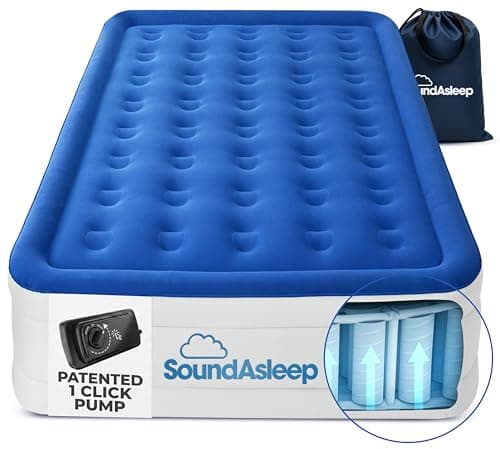 SoundAsleep Dream Series Air Mattress, Queen The guest-room default, and still the one I would buy without thinking about it — nineteen inches tall, forty internal coils, and a pump that gets there on one button. Best for: Most people | Most people | $149.95 · View on Amazon Price as of September 7, 2026. #ad — we earn a commission. |
| 2 | 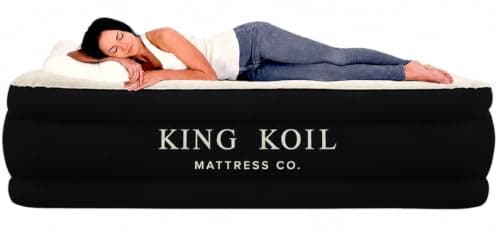 King Koil 20" Queen Air Mattress The tallest pick here, with a built-in pillow — two structural decisions that do more for the this-feels-like-a-bed impression than any material on the spec sheet. Best for: Feeling closest to a real bed | Feeling closest to a real bed | |
| 3 | 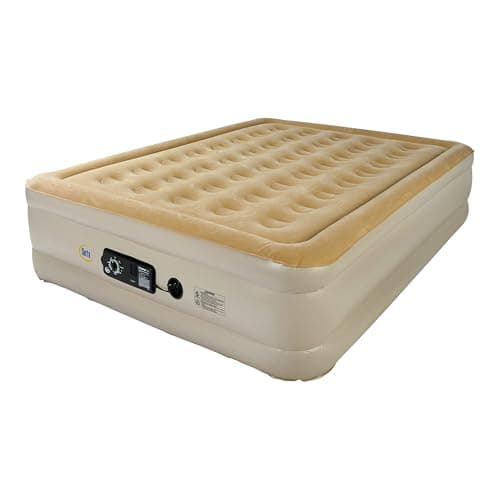 Serta Raised Air Mattress with Never Flat Pump, Queen 18" A second, quiet pump that tops the bed back up through the night — the only pick here that actually addresses the thing everybody complains about. Best for: Waking up as firm as you went to sleep | Waking up as firm as you went to sleep | $158.96 · View on Amazon Price as of September 7, 2026. #ad — we earn a commission. |
| 4 | 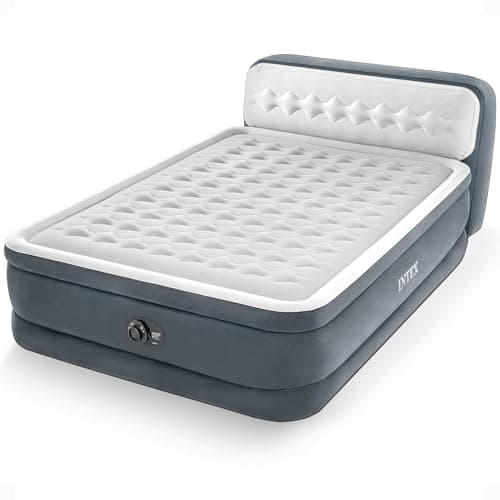 Intex Dura-Beam Deluxe Ultra Plush Headboard Airbed, Queen An inflatable headboard reads as a gimmick right up until the third morning your guest's pillow is on the floor again. Best for: Stays longer than a weekend | Stays longer than a weekend | $85.49 · View on Amazon Price as of September 7, 2026. #ad — we earn a commission. |
| 5 | 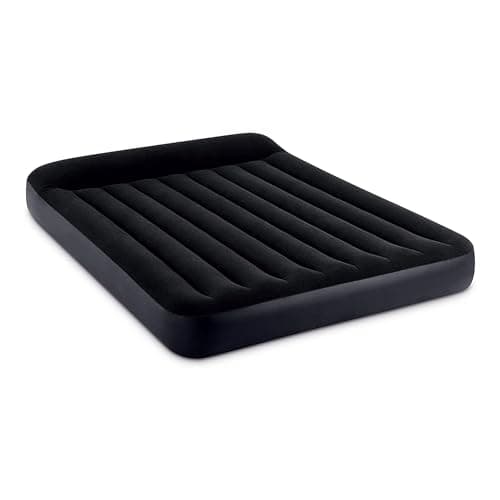 Intex Dura-Beam Standard Pillow Rest Airbed, Queen The cheapest bed here that isn't a mistake — low, plain, and completely adequate for the two nights a year it will actually be used. Best for: The once-a-year spare | The once-a-year spare | |
| 6 | 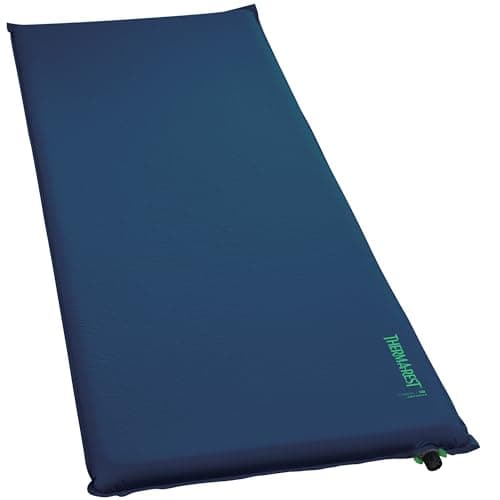 Therm-a-Rest BaseCamp Self-Inflating Sleeping Pad, Large Not an air mattress, and that is the point. On cold ground an air bed is the wrong tool, and this is the right one. Best for: Camping — instead of an air bed | Camping — instead of an air bed |
What an air mattress is for, and what it isn't
An air mattress is a bed you own so that you don't have to own a spare room. That is the entire brief. It gets inflated for a sister who is staying two nights, a child's sleepover, a house move, a floor during a renovation, or a tent. It spends the other three hundred and sixty days flat in a cupboard, which is precisely the point and precisely why it exists.
Almost every bad review in this category is written by somebody who bought one for a different job. If you are sleeping on an air mattress every night because your bed is broken, no product on this page will fix that, and the manufacturers agree — SoundAsleep's own FAQ states that daily use for extended periods voids the warranty. That is a company telling you, in the one document where it is legally accountable, that this is not a bed. Take it at its word. If you need something to sleep on nightly, a compressed foam mattress is a far better use of the money: our bed-in-a-box picks start not far above what the best air bed on this page costs, and every one of them is designed to be slept on every night.
What I actually looked for
Five criteria, in this order. The first one eliminates more bad purchases than the other four combined.
- Height. The single spec that decides whether anyone complains. Eighteen to twenty inches puts the sleeping surface at roughly the height of a real bed frame, so getting in and out uses ordinary movements rather than a controlled fall. Ten inches is a floor bed with loft. Everything else on the spec sheet is a detail by comparison.
- What's inside the bladder.An unsupported bag of air behaves like a hammock — it bows toward whoever is heaviest and rolls two people into the middle. Internal coils or fiber beams tie the top surface to the bottom one at hundreds or thousands of points, which is what keeps the surface flat. Published coil counts and named construction beat unexplained "premium comfort" every time.
- Whether the pump is any good, and where it needs to be. Every mains pump on this page inflates a queen in about two minutes, which is fine. What varies is deflation — getting the air back out is what decides whether the bed goes back in the bag or lives in a heap — and whether the design assumes a socket. A built-in AC pump makes a bed useless at any campsite without hookups, and no listing says so.
- Is the top flocked, and are the sides? A fitted sheet slides straight off bare PVC, and waking up on naked vinyl at 3am is the defining air mattress experience. Flocking is the fuzzy layer that holds a sheet in place. Most beds flock the top; the good ones flock the sides too, because the side is where a knee lands.
- The warranty, read as a durability statement.Nobody in this category publishes an expected lifespan, so the warranty is the only number a manufacturer is accountable for. In air mattresses it is one year, essentially without exception — including on the most expensive picks here. Hold that up against the limited lifetime warranty on the camping pad at the bottom of this page and you have the industry's own view of what it sells.
What I did not do is score them, because we have no lab and have not slept on any of these. Here is exactly how we work, including what we refuse to claim.
Your air bed is probably not leaking
This is the complaint that defines the category, and most of the time it is a misdiagnosis. Intex — which sells more air mattresses than anyone — states both of the ordinary causes in its own owner's manual, and neither is damage.
The first is the vinyl itself. "Stretching is a natural characteristic of new vinyl. During initial use, the airbed may become soft and require additional inflation to maintain desired firmness." A new bed relaxes under load over its first few nights. It happens once, it is finished after a handful of uses, and it is the reason a bed that seemed defective in week one is fine in week three.
The second happens every single night, to every air bed ever made. "The ambient temperatures of air have an effect on the airbed internal pressure. At low ambient temperature the air will contract within the airbed and the airbed will feel softer." Bedrooms cool overnight. The air inside a sealed mattress cools with them, and cooling air exerts less pressure. Firmness in an inflatable is nothing but pressure, so the bed you inflated at eleven at a comfortable room temperature is measurably softer at six when the heating has been off for hours. Nothing has escaped. The same manual notes the reverse in heat — air expands, the bed goes hard, and an over-filled mattress left in a hot tent can actually burst.
The useful diagnostic follows directly. Inflate the bed, leave it empty in a room at steady temperature, and come back in eight hours. If it is still firm, you do not have a leak — you have thermodynamics and a new bed, and the answer is to top it up before you get in, or buy the Serta with the second pump that does it for you. If it softens with nobody on it in a stable room, then go looking for the puncture.
Why they sleep cold, and the number nobody prints
The other universal complaint is temperature, and this one is real physics rather than a misreading. A foam or fiber mattress traps warmth where your body puts it. An air mattress is one big open bladder, so the air inside circulates freely, carries your body heat down to the floor, and gives it away. On a cold floor — or worse, cold ground — you are being cooled from below all night, and no amount of blankets on top addresses it, because the heat is not leaving upward.
The camping industry measures exactly this and prints it on the packet as an R-value: higher means better insulated. The pad at the bottom of this page publishes an R-value of 6. Not one air mattress on this page publishes an R-value at all, and that silence is the answer. If a big inflatable bladder scored well on insulation, somebody's marketing department would have put the number on the box a decade ago.
Indoors the fix is free: put a blanket or a folded quilt underneath the sleeper, between body and vinyl, rather than adding another one on top. Outdoors, the fix is not to bring an air mattress. That is why pick six is not one.
Height is the spec that decides everything
If you take one thing from this page, take this. Air mattresses are sold on coil counts, PVC thickness, pump speed and flocking, and none of those is what a guest actually notices. What they notice is how far down they have to go to get into it, and how much effort it takes to get out in the morning.
A twenty-inch bed sits at about the height of a low bed frame. An eighteen-inch bed is close enough. A ten-inch bed is a floor bed, and for anyone with a bad back, stiff knees, or thirty years on you, it is a genuinely unpleasant thing to be given. The height difference costs roughly the price of a takeaway, and it is the difference between a guest who mentions the bed and one who doesn't.
The trade is storage. Twenty inches of queen-size vinyl folds into a much larger bundle than ten, and the taller beds are noticeably harder to get back into their bags. If the mattress has to live on a shelf in a hall cupboard rather than in a loft, that is a real constraint and the low Intex is the honest answer. Everyone else: buy the height. And if you are buying for a child's room rather than for guests, a low air bed is the wrong shape of solution entirely — a real kids' mattress costs about the same and lasts years.
The one thing we will not soften
Everything else on this page is a preference. This is not. The US Consumer Product Safety Commission publishes a safety alert called Air Mattresses Are Not For Infants, and its instruction is unambiguous: never place infants to sleep on air mattresses or other soft surfaces such as water beds and adult beds, which are not designed or safe for infant use.
CPSC says it has received reports of deaths — mostly of infants younger than eight months — of babies placed to sleep on air mattresses who either suffocated face down or died after falling into a gap between the mattress and a bed frame, a wall, or adjacent furniture. Its stated reason is that even a properly inflated air mattress is usually too soft for an infant to maintain a clear airway, and that air leaks and under-inflation make it worse.
We are quoting a federal regulator rather than offering medical advice, because there is no medical advisor on this site. But a queen air bed on a guest room floor is exactly the setup where a visiting family puts the baby down for a nap, and the warning deserves to be somewhere people actually read it rather than only in a PDF.
What the money buys
The spread in this category is wide and, unusually, it maps onto something real. At the bottom of the range — where a queen costs less than a set of decent sheets — you get ten inches of height, a built-in pump, and a published weight capacity that is the same as the expensive beds. Nothing is wrong with it. It is a floor bed for occasional use and it is priced as one.
The middle of the range, roughly double that, buys height: eighteen inches, a headboard, a better finish. The top of the range, three to four times the cheapest, buys height plus one genuine engineering answer — forty internal coils, or a second pump that maintains pressure all night. Beyond that the money stops buying anything. There is no premium tier in air mattresses in the way there is in real mattresses, because the ceiling on the technology is low and every manufacturer has hit it.
One thing worth knowing before you shop by size: air mattress "queen" is not always a standard queen. Inflated dimensions vary by an inch or two between brands and the bed changes shape slightly under load, so a fitted sheet that fits your bed at home may or may not fit this. Buy sheets after the bed arrives, not before, and if you are unsure what the standard sizes even are, we have the actual numbers.
What I'd buy
For a guest bed that gets used a few times a year: the SoundAsleep Dream Series. Nineteen inches, forty coils, a thick flocked top, and a decade of being the answer to this question. It is not cheap for what it is, and it is still what I would put in a spare room.
If somebody is staying for weeks rather than nights, the Serta with the Never Flat pump is the one that stops the conversation about the bed going soft, because it is the only one that actually does something about it. Accept the cable across the floor, or don't buy it — unplugged it is an ordinary bed at a premium price.
If you host once a year and have a small cupboard, buy the ten-inch Intex and a patch kit and stop thinking about it. And if the bed is for camping, buy the pad instead. An air mattress in a tent is a cold night with extra steps, and the reason is printed on one of these two products and missing from the other.
The picks, in full
1. Best for Most people
SoundAsleep Dream Series Air Mattress, Queen
The guest-room default, and still the one I would buy without thinking about it — nineteen inches tall, forty internal coils, and a pump that gets there on one button.
Price as of September 7, 2026. #ad — we earn a commission.
Key specs
- 80" x 60" x 19" inflated, queen
- 40 internal air coils (ComfortCoil)
- 600 lb weight capacity
- Built-in 1-click pump
- Extra-thick waterproof flocked top, puncture-resistant PVC
- SureGrip bottom
- 1-year limited warranty
What's good
- Nineteen inches is the height at which a guest bed stops feeling like a floor. Standing up from a raised air bed uses the same motion as standing up from a real one, and that single dimension accounts for more guest complaints than every material claim in this category combined
- Forty internal coils is the highest published count of anything here. Coils are what stop an air bladder behaving like a hammock — they tie the top sheet of vinyl to the bottom one at forty points instead of letting the whole surface bow toward whoever is heaviest
- The flocked top is not a decorative detail. A fitted sheet slides straight off bare PVC, and half the misery of a cheap air bed is waking up on naked vinyl at 3am. SoundAsleep flocks it thickly and the sheet stays put
What's not
- A one-year limited warranty — and SoundAsleep's own FAQ says using the mattress every day for extended periods voids it. That is an unusually honest admission of what the product is, but it is still the shortest guarantee of anything we recommend on this site
- It sits at the top of the price range for an Amazon air mattress and it is still an air mattress. Height and coil count do not change the fact that you are sleeping on a sealed bag of air with no insulation in it
- The pump is mains-powered and built in, so this is useless anywhere without a socket. The listing mentions camping; that only applies to campsites with hookups, and nobody says so out loud
Skip this one if
Somebody is going to sleep on it every night. This is a spare bed by design and by warranty — for a nightly bed at a similar price, buy a real one.
2. Best for Feeling closest to a real bed
King Koil 20" Queen Air Mattress
The tallest pick here, with a built-in pillow — two structural decisions that do more for the this-feels-like-a-bed impression than any material on the spec sheet.
Key specs
- 80" x 60" x 20" inflated, queen
- 600 lb weight capacity
- Built-in raised pillow
- Built-in high-speed pump, 120V / 210W
- Full inflate or deflate in 90 seconds (manufacturer)
- Flocked top and sides, puncture-resistant PVC
- 1-year warranty
What's good
- Twenty inches puts the sleeping surface at roughly the height of a low bed frame, which is the whole trick. Nobody has ever described an air bed as luxurious while climbing down onto it, and this is the one on this page you climb into
- It flocks the sides as well as the top. Most beds flock only the surface, and the side is exactly where a knee lands when you get in — a small manufacturing decision that you notice every single time
- The pump has separate inflation and deflation valves and King Koil publishes its wattage, which is more disclosure than most of this category offers. Deflation matters more than people expect: getting the air out is what decides whether the thing goes back in its bag
What's not
- The built-in pillow is fixed and it is not very tall. If you are a side sleeper who needs real loft you will put your own pillow on top of it, which raises your head another few inches above a surface that is already high — some people find that combination genuinely awkward
- King Koil's own site says 90 seconds to inflate; the Amazon title says under two minutes. Neither is a problem and the bed is fast either way, but a manufacturer contradicting itself on the one number it chose to advertise is a fair calibration of how much weight to give marketing figures here
- One-year warranty, like everything else in the category. At twenty inches this is also the bulkiest pick to fold, and it does not go back in its bag as easily as it came out
Skip this one if
You are buying for camping or for a small storage cupboard. Twenty inches of bed is a lot of vinyl to wrestle flat, and this is the least portable pick here.
3. Best for Waking up as firm as you went to sleep
Serta Raised Air Mattress with Never Flat Pump, Queen 18"
A second, quiet pump that tops the bed back up through the night — the only pick here that actually addresses the thing everybody complains about.
Price as of September 7, 2026. #ad — we earn a commission.
Key specs
- 18" raised, queen
- AC-powered dual pump: primary inflates and deflates, secondary maintains pressure (as listed)
- Three firmness settings — plush, medium, firm (as listed)
- Secondary pump runs overnight and adds air when it senses a pressure drop (as listed)
What's good
- It is the only design here that solves the real problem rather than denying it exists. Air beds soften overnight for two reasons that have nothing to do with damage — new vinyl stretches, and cooling air loses pressure — and a pump that quietly tops the bed back up handles both without waking anyone
- The three firmness settings are not a gimmick on an air bed the way they are on a foam one. Firmness in an inflatable is literally pressure, so a dial that holds a chosen pressure all night is the closest this category comes to an actual firmness control
- If a slow leak does develop, the bed stays usable until you can deal with it. On a guest bed that is the difference between a bad night for someone else and an ordinary one
What's not
- It has to stay plugged in all night to do the thing you bought it for, which usually means an extension lead across a guest room floor. That is a trip hazard in a dark, unfamiliar room, and it is the exact room this bed lives in
- A pump that hides a leak is still a pump that hides a leak. The bed keeps working, you never go looking for the puncture, and the failure arrives later and all at once — at a campsite, or the week the pump gives up
- The most expensive pick on this page, and the premium buys one feature. Without power it is an ordinary eighteen-inch air bed that cost more than the eighteen-inch air beds
Skip this one if
You are camping, or the bed lives anywhere you would rather not run a mains cable all night. Unplugged, you have paid a premium for nothing.
4. Best for Stays longer than a weekend
Intex Dura-Beam Deluxe Ultra Plush Headboard Airbed, Queen
An inflatable headboard reads as a gimmick right up until the third morning your guest's pillow is on the floor again.
Price as of September 7, 2026. #ad — we earn a commission.
Key specs
- 18" bed height, queen (as listed)
- Inflatable ultra-plush headboard (as listed)
- Fiber-Tech internal beam construction (as listed)
- 600 lb weight capacity (as listed)
- Built-in electric pump (as listed)
- Carry bag included (as listed)
What's good
- The headboard is doing a real job. Pillows migrate off an inflated surface because there is nothing at the top to stop them, and a raised lip solves that permanently. Over one night it is a novelty; over a fortnight it is the difference between a guest room and a camp
- Fiber-Tech uses thousands of high-strength polyester fibers inside the bed rather than a smaller number of air coils, which is Intex's approach to keeping the surface flat under load. Whatever you make of the branding, more anchor points is the right direction for an air bladder
- Intex is the volume manufacturer in this category by a wide margin, which has one very practical consequence: patches, replacement pump parts and instructions for this exact bed are trivially easy to find when you need them at 11pm
What's not
- The headboard adds close to a foot to the footprint, and the queen dimensions people plan around do not include it. In a tight box room that is the difference between the door opening and not — measure the floor with the headboard, not the mattress
- Fiber-Tech is Intex's own trade name for its internal construction and Intex is the only party describing what it does. Treat it as a construction method that the manufacturer has named, not as an independently verified benefit
- Intex does not publish a PVC thickness the way King Koil does, so on durability you are trusting the brand's scale and reputation rather than a number. At this price that is a reasonable trade, but it is a trade
Skip this one if
The room is tight or oddly shaped. This is the largest floor footprint on the page and the headboard is not detachable.
5. Best for The once-a-year spare
Intex Dura-Beam Standard Pillow Rest Airbed, Queen
The cheapest bed here that isn't a mistake — low, plain, and completely adequate for the two nights a year it will actually be used.
Key specs
- 10" bed height, queen (as listed)
- Integrated pillow rest (as listed)
- Fiber-Tech internal beam construction (as listed)
- 600 lb weight capacity (as listed)
- Built-in electric pump (as listed)
What's good
- It carries the same published 600 lb capacity as the beds costing three and four times as much. What you give up moving down this page is height, finish and pump sophistication — not load rating
- Ten inches packs down far smaller than eighteen or twenty. A queen bed that genuinely fits on a shelf in a hall cupboard is a different proposition from one that needs its own corner of the loft
- It is priced honestly for what it is. Nobody is pretending this replaces a bed, and for the household that hosts once or twice a year, everything above this is money spent on nights that never happen
What's not
- Ten inches is low, and low is the spec that hurts. It is harder to get off, it is nearer the cold floor, and it is the version of an air bed that guests remember badly
- The integrated pillow rest is a raised lip of vinyl, not a pillow. It stops your own pillow sliding away and that is the whole of its contribution
- At this price the bed is a consumable. Expect a few years of occasional use rather than a decade, and buy a patch kit with it rather than treating the first pinhole as a failure
Skip this one if
Anyone using it has a bad back, bad knees or any difficulty getting up off the floor. Pay for height — it is the single spec that matters most, and it is the one this pick gives up.
6. Best for Camping — instead of an air bed
Therm-a-Rest BaseCamp Self-Inflating Sleeping Pad, Large
Not an air mattress, and that is the point. On cold ground an air bed is the wrong tool, and this is the right one.
Key specs
- R-value 6
- 2" thick
- 25" x 77" (Large)
- 3 lb 6 oz (Large)
- Self-inflating foam core, WingLock valve
- Stuff sack included
- Limited lifetime warranty
What's good
- R-value is the number that decides whether you are warm on the ground, and this pad publishes one: 6, which is a genuine cold-weather figure. Not one air mattress on this page publishes an R-value at all, and that absence is the honest answer to why people are cold in tents
- Self-inflating means no pump, no socket and no batteries. You open the valve, the compressed foam expands and pulls air in on its own, and you top it off by mouth. Nothing in the system can fail in a way that leaves you on bare ground
- A limited lifetime warranty against the one-year warranty on every air bed above it. That gap is not marketing — it is two different manufacturers telling you honestly how long they expect their product to last
What's not
- Two inches thick, sleeps one, and costs roughly what a queen air bed costs. On a per-person, per-inch basis the numbers look terrible, and for indoor guests this is simply the wrong purchase
- Self-inflating is not instant. It wants to be unrolled and left for several minutes before it is anywhere near full, and the last few breaths still go in by mouth
- Foam this thick does not pack down the way an air mattress does. It is a rolled bundle roughly the size of a small holdall, not a folded sheet of vinyl in a carry bag
Skip this one if
You are buying a guest bed for indoors. This will feel like sleeping on the floor with excellent insulation, because that is exactly what it is.
Common questions
Why does my air mattress go flat overnight?
Usually it isn't leaking. Intex's own owner's manual names both of the ordinary causes in writing. The first is new vinyl: "Stretching is a natural characteristic of new vinyl. During initial use, the airbed may become soft and require additional inflation to maintain desired firmness." That is a one-off, over the first few uses, and it is not a defect. The second is temperature: "The ambient temperatures of air have an effect on the airbed internal pressure. At low ambient temperature the air will contract within the airbed and the airbed will feel softer." Bedrooms get colder overnight, so this happens every night, to every air bed, forever. The practical test for a real leak is whether the bed also softens while nobody is on it in a room at steady temperature — if it holds firm empty and soft only in the morning, you have physics, not a puncture.
How long does an air mattress last?
Nobody publishes a figure, and we are not going to invent one. What you can read instead is the warranty, and in this category it is almost universally one year — including on the most expensive picks on this page. Compare that with the limited lifetime warranty on the camping pad we recommend and you have the manufacturers' own view of durability, stated in the only place they are legally accountable for it. Treat an air mattress as a several-year product used occasionally, buy a patch kit alongside it, store it loosely folded rather than crammed, and keep it away from anything that can put a pinhole in vinyl.
Are air mattresses safe for babies?
No, and this is the one place on this page where the answer isn't a preference. The US Consumer Product Safety Commission publishes a safety alert titled "Air Mattresses Are Not For Infants", which states: "Never place infants to sleep on air mattresses or other soft surfaces (such as water beds and adult beds), which are not specifically designed or safe for infant use." CPSC says it has received reports of deaths, mostly of infants younger than eight months, who were placed to sleep on air mattresses and either suffocated face down or died after falling into gaps between the mattress and a bed frame, wall or adjacent furniture. Its stated reason is that even a properly inflated air mattress is usually too soft for an infant to maintain a clear airway. This is a regulator quoting itself, not medical advice from us.
Why do air mattresses feel so cold?
Because there is nothing in them but air, and air moves. A mattress made of foam or fiber traps warmth in place; a mattress made of a single large bladder lets the air inside circulate, carrying your body heat down to whatever the bed is standing on and dumping it there. On a cold floor or cold ground you are effectively being air-conditioned from below all night. The camping industry measures exactly this and prints it as an R-value; the air mattress industry does not print one at all, which tells you what the number would look like. The indoor fix is simple and cheap: a blanket or a quilt underneath you, between your body and the vinyl, not just on top.
What height air mattress should I buy?
Height is the spec that decides whether your guest says anything about the bed, so buy the tallest one your budget and storage allow. Eighteen to twenty inches puts the surface at about the height of a real bed frame, which means getting in and out uses ordinary movements — it also puts more air between the sleeper and a cold floor. Ten to thirteen inches is a floor bed with a bit of loft: fine for a fit adult once or twice a year, noticeably harder for anyone with a bad back or knees, and much easier to store. If the bed is going to be used more than a few nights a year, pay for the height.
Can you sleep on an air mattress every night?
You can, and we would not advise building a life around it. The clearest signal comes from the manufacturers: SoundAsleep's own FAQ says that using the mattress every day for extended periods voids the warranty. That is the company that makes the best air bed on this page telling you what it is designed for. An air mattress supports you with pressure, not with structure, so it loses firmness as the room cools and offers nothing a spinal-support argument can be built on. If you need a bed for every night, a compressed foam mattress arrives in a box for similar money and is built for the job.
Sources
Where the facts on this page come from. We cite other people's testing because we don't do our own — here's what that means.
- CPSC Safety Alert — "Air Mattresses Are Not For Infants" (Publication 5222)
- Intex owner's manual — new-vinyl stretch and ambient temperature effects on airbed pressure
- SoundAsleep — Dream Series queen published specifications
- SoundAsleep FAQ — 1-year limited warranty and daily-use exclusion
- King Koil Airbeds — luxury air mattress dimensions, capacity, pump and warranty
- Kohl's — Serta 18" raised air mattress with internal Never Flat pump, dual-pump description
- Therm-a-Rest — BaseCamp self-inflating pad R-value, thickness, weight and warranty
Read next
- The Best Mattresses for a Guest RoomWhy a spare bed changes the maths — value and a broadly-agreeable medium feel over long-haul durability — plus six mattresses for adult guests, kids' rooms and the no-spare-room case, with an honest note on who each is wrong for.
- The Best Mattresses in a BoxHow the boxed-mattress format really works — compression, off-gassing, expansion — plus six picks and who each one is wrong for.
- The Best MattressesSix mattresses worth buying, from a budget hybrid to a deep-foam premium bed — with a plain note on who each one is wrong for.
- The Best Mattresses for KidsSix twin mattresses for children, judged on durability and cleanability — with an honest note on who each one is wrong for.
- Mattress Sizes: Every US Dimension, in InchesEvery standard US mattress size in inches, and how to choose between them without measuring twice.
- The Best Mattress ToppersSix mattress toppers worth buying, and the simple test that tells you whether a topper will fix your bed or waste your money.