The Best Lumbar Pillows for Bed
Buy the vamorry memory foam lumbar pillow. It is sized and shaped for lying down rather than for an office chair, which is the distinction most of this shelf ignores. Four more below for a dense version, the clinical-standard roll, the cheapest one worth buying, and one that works in a recliner too.
We earn a commission if you buy through our links. It doesn't affect our picks — and we never take free products. How this site is funded.
Quick picks
| # | Product | Best for | Price |
|---|---|---|---|
| 1 | 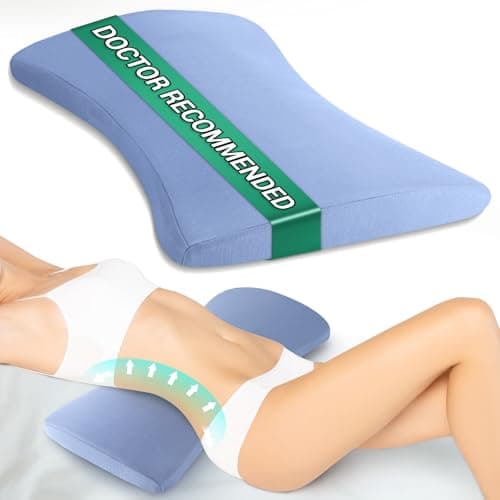 vamorry Lumbar Pillow for Sleeping, Memory Foam Lower Back Support The sensible default, and it earns the spot mostly by being the right product. The listing is written for sleeping rather than for sitting: memory foam, a shape intended to fill the gap under your lumbar curve while you lie on your back or side, and a washable cover. That sounds obvious until you look at the rest of this shelf. Best for: Most people - a lumbar pillow actually sold for a bed | Most people - a lumbar pillow actually sold for a bed | |
| 2 | 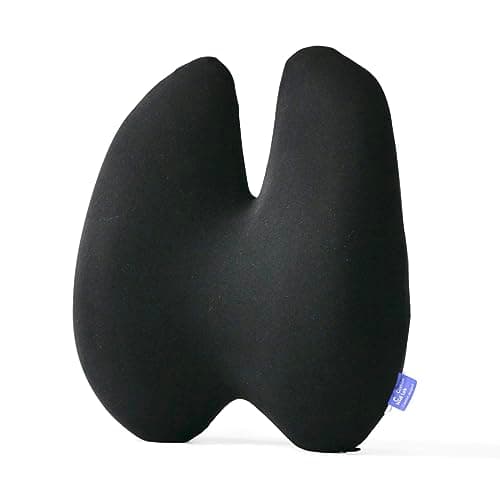 Cushion Lab Extra Dense Lumbar Pillow, Multi-Region Firm Support The dense option, and the honest caveat first: this is sold primarily for an office chair, car and sofa, not for a bed. What it has that the bed-specific picks do not is extra-dense foam that keeps its height under a heavy load, which is the common failure of a soft lumbar cushion under anyone above average weight. Used in bed it works; it is just not what the listing is aimed at. Best for: Heavier frames, and support that does not bottom out | Heavier frames, and support that does not bottom out | $66.99 · View on Amazon Price as of October 18, 2026. #ad — we earn a commission. |
| 3 | 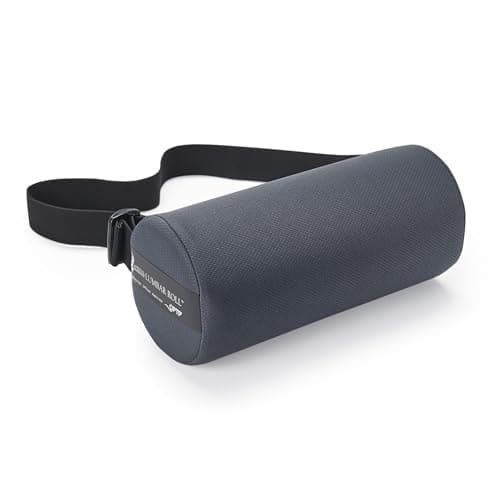 OPTP The Original McKenzie Lumbar Roll, Standard Density The clinical standard, and the only product here with a decades-old professional track record. It is a plain firm cylinder with a strap: no contours, no gel, no marketing. If a physiotherapist has told you to support your lumbar curve, this is very likely the object they meant, and the standard-density version is the one to start with. Best for: A firm, narrow roll - the version physical therapists use | A firm, narrow roll - the version physical therapists use | $27.95 · View on Amazon Price as of October 18, 2026. #ad — we earn a commission. |
| 4 | 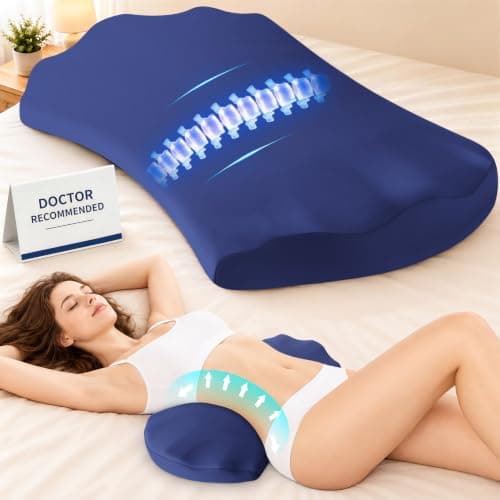 Fledano Lumbar Support Pillow for Bed, Memory Foam, Cooling Cover The low-risk way to find out whether lumbar support in bed helps you at all. It is bed-specific, memory foam, ergonomically shaped, with a washable cooling cover, at a price where a failed experiment costs less than lunch for two. The paperwork is thin but the intent of the product is right. Best for: The cheapest bed-specific lumbar pillow worth trying | The cheapest bed-specific lumbar pillow worth trying | |
| 5 | 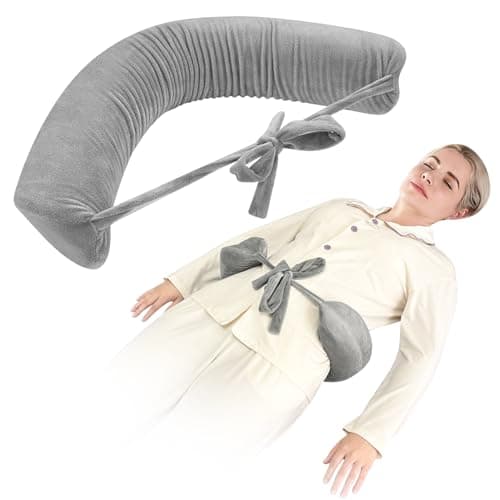 KAVIL Lower Back Support Pillow for Bed and Recliner, Adjustable The one for people who do not do all their resting in a bed. A lot of back pain is managed in a recliner - after surgery, during a flare, or simply because lying flat hurts - and this is listed for both, with adjustability so the same cushion suits a near-vertical chair and a flat mattress. Narrower use case, correct product for it. Best for: Sleeping in a recliner, or moving between bed and chair | Sleeping in a recliner, or moving between bed and chair | $25.99 · View on Amazon Price as of October 18, 2026. #ad — we earn a commission. |
What this page is, and the two pages it is not
This shelf is a mess of overlapping products sold under the same words, so the boundaries first:
- A lumbar pillow — this page — is a small cushion that supports the inward curve of your lower back while you lie down. Back sleepers put it under the curve; side sleepers put it in the hollow at the waist.
- A reading pillow is a large vertical backrest with arms for sitting up awake in bed. Separate page.
- A knee pillow sits between or under the knees and works on hip and leg alignment rather than the lumbar curve. Also separate — and often the better answer, as below.
There is a fourth complication: most products that rank for "lumbar pillow" are office-chair cushions. A chair cushion is shaped around a vertical spine under compression; a bed pillow is shaped around a horizontal one. Two of the picks above are chair-first products chosen for specific reasons, and the entries say so plainly rather than pretending otherwise.
Why the gap exists in the first place
Lie flat on your back and your lumbar spine does not touch the mattress — it curves away from it. On a mattress with the right support profile, your hips sink just enough that the surface comes up to meet that curve. On a mattress that is too firm, they do not sink and the gap stays open all night, with the surrounding muscles holding the load instead.
Which means a lumbar pillow is really a diagnostic tool as well as a product. If filling the gap fixes your mornings, you have learned that your mattress support is wrong for your body, and the durable fix is a topper or eventually a different mattress. At twenty dollars, running the test before the big purchase is simply good sense.
Height, density, and staying put
- Height is the spec, and nobody publishes it. Too low and the gap is still there; too high and your lower back is propped above the rest of your spine, which creates a new problem. Not one of the five listings on this page states a thickness in inches, which is the single most frustrating thing about this category. Start lower rather than higher.
- Density beats softness. A lumbar pillow is under steady load for hours. Soft foam compresses to nothing within minutes and does no work for the rest of the night; dense foam keeps its height. This is the reason one chair-first pick is on the list — extra-dense foam is genuinely hard to find on a bed-specific listing.
- It will probably move. Nothing holds a loose bolster under your back except your own weight, and turning over dislodges it. Denser cushions migrate less; strapped designs anchor well in a recliner and poorly on a flat mattress. If you need a posture held all night, an adjustable base is the mechanism that actually does it.
How the five compare, from the listings
| Pick | Listed for | Fill | Firmness stated | Strap |
|---|---|---|---|---|
| vamorry | Bed | Memory foam | Not stated | No |
| Cushion Lab | Chair, car, sofa | Foam | Extra dense | Yes |
| OPTP McKenzie | Chair, car | Foam roll | Standard density | Yes |
| Fledano | Bed | Memory foam | Not stated | No |
| KAVIL | Bed + recliner | Not stated | Not stated | Not stated |
Two listings state a density and two are written for a bed. None states a height. That is the shelf, and the ranking puts bed-specific design first and borrows the chair products only where they bring something — dense foam, a clinical pedigree — that the bed listings do not have.
Try the knee pillow first, honestly
Before buying anything: put a pillow under your knees tonight. It tilts the pelvis and gently reduces the lumbar arch, it costs nothing because you already own a pillow, and for a large share of back-sleepers it is the thing that works — it is one of the oldest pieces of position advice there is. If that helps and lumbar support does not, buy a knee pillow instead and save your money. If filling the lumbar gap is what helps, the picks above are the next step.
One firm rule either way: if you sleep on your stomach, do not put anything under your lower back. It increases extension in a position that already has too much of it.
About the prices on this page
We do not type prices into pages. Each button carries a figure read from the live listing by our own price check, stamped with the date it last ran. This category is full of near-identical listings at different prices from the same seller, so check that the item you land on is the one described here.
What we will not tell you
We have not slept on these five, we have no test lab, and we are not going to publish a pain-relief score for a cushion. Nothing here is medical advice: a lumbar pillow changes where your weight is supported, and that is all we are claiming for it. The ranking is built on stated intended use, stated fill, stated density, and whether there is any mechanism to keep it in place. Our full method is here.
The picks, in full
1. Best for Most people - a lumbar pillow actually sold for a bed
vamorry Lumbar Pillow for Sleeping, Memory Foam Lower Back Support
The sensible default, and it earns the spot mostly by being the right product. The listing is written for sleeping rather than for sitting: memory foam, a shape intended to fill the gap under your lumbar curve while you lie on your back or side, and a washable cover. That sounds obvious until you look at the rest of this shelf.
Key specs
- Memory foam fill (as listed)
- Lumbar support for bed (as listed)
- For side and back sleepers (as listed)
- Washable cover (as listed)
- Listed for lower back pain relief (as listed)
What's good
- Specified for sleeping rather than for a chair, which matters because a chair cushion is shaped for a vertical spine and a bed pillow for a horizontal one
- Memory foam is the right fill here: it has to hold a fixed height under steady load for hours, which fiber fill cannot do
- A removable washable cover is not a luxury on something that sits against your back all night
What's not
- No stated height or thickness in inches, and height is the spec that decides whether it fills your gap or props you up
- Memory foam warms where it is compressed, and this one is compressed between you and the mattress with no airflow
- Nothing on the listing anchors it: a free-standing bolster migrates out from under you over a night of turning
Skip this one if
You sleep on your stomach. A lumbar pillow under a stomach sleeper pushes the lower back further into extension, which is the opposite of helpful.
2. Best for Heavier frames, and support that does not bottom out
Cushion Lab Extra Dense Lumbar Pillow, Multi-Region Firm Support
The dense option, and the honest caveat first: this is sold primarily for an office chair, car and sofa, not for a bed. What it has that the bed-specific picks do not is extra-dense foam that keeps its height under a heavy load, which is the common failure of a soft lumbar cushion under anyone above average weight. Used in bed it works; it is just not what the listing is aimed at.
Price as of October 18, 2026. #ad — we earn a commission.
Key specs
- Extra dense foam (as listed)
- Patented multi-region ergonomic shape (as listed)
- Strap included (as listed)
- Listed for office chair, car, sofa, plane (as listed)
- Black (as listed)
What's good
- Extra-dense foam holds its stated shape under sustained load instead of flattening to nothing, which is what separates a support from a cushion
- A multi-region contour rather than a plain bolster, so the support is graded across the curve instead of being one hard ridge
- The included strap is the only anchoring mechanism on this page, and it is what stops a cushion wandering - on a recliner or a chair, at least
What's not
- Marketed for chairs, cars and planes rather than beds: the shape is designed around a seated spine, which is a different curve
- The most expensive pick here by a wide margin, and part of what you pay for is features a bed does not use
- Dense foam is firm foam - lying on it, some people find it holds the lumbar curve too insistently to relax into
Skip this one if
You only want it for the bed and you are of average build. A bed-specific pick at a third of the price does the same job.
3. Best for A firm, narrow roll - the version physical therapists use
OPTP The Original McKenzie Lumbar Roll, Standard Density
The clinical standard, and the only product here with a decades-old professional track record. It is a plain firm cylinder with a strap: no contours, no gel, no marketing. If a physiotherapist has told you to support your lumbar curve, this is very likely the object they meant, and the standard-density version is the one to start with.
Price as of October 18, 2026. #ad — we earn a commission.
Key specs
- Standard density foam roll (as listed)
- USA-made (as listed)
- Adjustable strap (as listed)
- Listed for office chair and car seat support (as listed)
- Described as preferred by physical therapists (as listed)
What's good
- A long-established clinical product rather than a listing invented last year, which on a back-support purchase is worth real money
- A narrow firm roll concentrates support exactly at the lumbar curve instead of spreading it over the whole lower back
- Firm closed-cell foam keeps its dimensions for years, where soft moulded cushions lose height within months
What's not
- Sold and shaped for seated use: in bed it is a hard narrow cylinder, which suits some backs and is intolerable for others
- No cover included to speak of, so it is a bare foam roll against your skin or your sheet
- Standard density is a single firmness; if it is wrong for you there is no adjustment, only a different product
Skip this one if
You want something soft and forgiving to fall asleep on. This is a firm clinical roll and makes no attempt to be comfortable in the usual sense.
4. Best for The cheapest bed-specific lumbar pillow worth trying
Fledano Lumbar Support Pillow for Bed, Memory Foam, Cooling Cover
The low-risk way to find out whether lumbar support in bed helps you at all. It is bed-specific, memory foam, ergonomically shaped, with a washable cooling cover, at a price where a failed experiment costs less than lunch for two. The paperwork is thin but the intent of the product is right.
Key specs
- Memory foam (as listed)
- Ergonomic lumbar shape for bed (as listed)
- For side and back sleepers (as listed)
- Listed for sciatica and hip pain (as listed)
- Washable cooling cover (as listed)
What's good
- Cheapest honest entry point, which matters on a product that either transforms your mornings or does nothing - and you cannot tell in advance which
- A cover described as cooling addresses the real weakness of foam pressed between your back and the mattress
- Stated for side as well as back sleeping, where a side sleeper uses it in the hollow at the waist rather than under the spine
What's not
- No stated dimensions, so there is no way to predict whether the height suits your lumbar gap before it arrives
- Sciatica and hip pain are claims about outcomes rather than specifications, and nothing on the listing substantiates them
- Light, low-density foam flattens faster, and a lumbar pillow that has lost its height is doing nothing at all
Skip this one if
You already know firm support is what helps you. Buy the dense foam or the clinical roll instead of the cheapest option.
5. Best for Sleeping in a recliner, or moving between bed and chair
KAVIL Lower Back Support Pillow for Bed and Recliner, Adjustable
The one for people who do not do all their resting in a bed. A lot of back pain is managed in a recliner - after surgery, during a flare, or simply because lying flat hurts - and this is listed for both, with adjustability so the same cushion suits a near-vertical chair and a flat mattress. Narrower use case, correct product for it.
Price as of October 18, 2026. #ad — we earn a commission.
Key specs
- Lumbar support for bed and recliner (as listed)
- Adjustable night sleep cushion (as listed)
- Listed for scoliosis and sciatica relief (as listed)
- Lower lumbar roll shape (as listed)
What's good
- Explicitly listed for both bed and recliner, which is the real pattern of use for anyone managing a painful back through the day
- Adjustability means one cushion covers two very different spine angles instead of needing two products
- A roll shape concentrates support at the curve, which is the geometry the clinical products use
What's not
- Scoliosis is a structural condition and no cushion treats it; that wording on the listing is marketing, not a medical claim we can stand behind
- No stated dimensions or density, the two specs that would let you predict fit
- A product designed to work in two places is compromised in both relative to one made for a single position
Skip this one if
You only ever need this in bed. A bed-specific pillow will fit the horizontal position better.
Common questions
What does a lumbar pillow do in bed?
It fills a gap. Your lower spine curves inward, so when you lie flat on your back on a firm-ish mattress there is an unsupported space between the small of your back and the surface - and the muscles around it spend the night holding the weight that the mattress is not taking. For some people that is exactly where the morning ache comes from. A lumbar pillow fills that space so the curve is supported and the muscles can let go. Side sleepers use it differently: the gap is at the waist, between the ribs and the hip, and a thin pillow there stops the spine sagging sideways. It is a small, cheap intervention that either helps a lot or does nothing - there is not much middle ground.
Lumbar pillow or a better mattress?
Honestly, usually the mattress - and a lumbar pillow is a good way to find out. If your lower back is unsupported, the root cause is often that the mattress is too firm for your body to sink into at the hips, or too soft and sagging so your pelvis drops. A lumbar pillow is a twenty-dollar test of that theory: if adding support under the curve fixes your mornings, you have learned something real about what your mattress is doing wrong, and the long-term fix is a mattress or topper with the right support profile. If it changes nothing, you have saved yourself a much larger purchase made on a guess. We would rather you spent twenty dollars first.
Will a lumbar pillow stay in place all night?
Not reliably, and this is the honest weakness of the whole category. A free-standing bolster tucked under your back is held there by nothing except your own weight, and the first time you turn over it starts to migrate. Most people find it either slides out from under them or ends up somewhere unhelpful by morning. Three things help: a firmer, denser cushion moves less than a soft one; a strapped design (one pick above has a strap) can be anchored, which works well in a recliner and poorly on a flat mattress; and some people get better results placing it under the knees instead, which flattens the lumbar curve rather than filling it. If you need all-night support in a fixed position, an adjustable base holds a posture in a way no loose cushion can.
Should the pillow go under my back or under my knees?
Try both - they do opposite things and different backs want different answers. A pillow under the lumbar curve supports the arch and keeps the spine in its natural shape; that suits people whose pain comes from an unsupported gap. A pillow under the knees tilts the pelvis and gently flattens the lumbar curve, which reduces the extension in the lower back; that suits people whose pain comes from too much arch, and it is one of the oldest pieces of back-pain advice there is. Many people end up using both: a thin support at the waist and a wedge or roll under the knees. Neither is more correct in general, and there is no cost to experimenting with the pillows already on your bed before buying anything.
Is a lumbar pillow the same as a reading pillow?
No, and the listings mix the words freely. A lumbar pillow is a small cushion that supports the curve of your lower back while you lie down, or while you sit in a chair with a back. A reading pillow is a large near-vertical backrest with arms that you sit up against in bed - a completely different size, shape and job. Confusing the two is how people end up with a backrest they wanted for sleeping or a small bolster they wanted for reading. A third neighbour is the knee pillow, which is about leg and hip alignment rather than the lower back. We keep all three as separate pages for exactly this reason.
Can a lumbar pillow make back pain worse?
Yes, in two specific situations, and it is worth knowing before you buy. If you sleep on your stomach, adding a pillow under your lower back pushes the spine into more extension, which is already the problem with stomach sleeping - do not do it. And if your pain comes from excessive lumbar arch rather than an unsupported one, filling the gap increases the thing that hurts; those people usually do better with support under the knees. Beyond that, a cushion that is too tall props the lower back up above the rest of the spine, which creates a new misalignment instead of fixing one. Start low, give it several nights, and stop if mornings get worse. Persistent or worsening back pain is a question for a clinician rather than a cushion.
Sources
Where the facts on this page come from. We cite other people's testing because we don't do our own — here's what that means.
Read next
- The Best Knee PillowsSeven knee pillows sorted by height and shape - between-the-knees contours for side sleepers, a half-moon bolster for back sleepers, a strapped one that stays put, and the budget entry.
- The Best Wedge PillowsFive wedge pillows sorted by incline - from a gentle reading angle to a steep reflux slope and adjustable recovery sets - with honest, non-medical notes on who each suits.
- The Best Reading PillowsA reading pillow stands or falls on three things: how far up your back it reaches, whether the fill collapses under load, and whether the cover comes off. Five backrests ranked on all three, with the wedge-pillow distinction made plain.
- The Best Mattress Toppers for Back PainSix mattress toppers that can ease back pain by matching the surface to your problem — softening a too-firm bed or firming a slightly-too-soft one — plus the honest limit that no topper fixes a sagging mattress, with cons and a skip note on every pick.
- The Best Mattresses for Lower Back PainSix mattresses judged purely on support and spinal alignment — and why medium-firm, not firm, is where the evidence points.
- Firm or Soft Mattress for Back Pain?The honest answer is neither extreme: medium-firm suits most back-pain sleepers, and the reason - keeping your spine neutral - tells you how to shop.
- How Your Sleep Position Changes the Bed You NeedEach sleep position presses a different shape into the bed. Side wants softer plus a tall pillow, back medium-firm plus medium loft, stomach firm plus flat or none.
- The Best Adjustable Bed Bases (For Mattresses That Can Bend)Six adjustable bed bases chosen on the one rule that matters - your mattress has to bend on it - plus motor noise, weight capacity and which features are worth paying for. Honest cons on every pick.