The Best Knee Pillows
The cheapest thing you can put in a bed to change how your hips sit. A knee pillow fills the gap your top leg falls into, so your pelvis stays level instead of rolling forward all night. Seven of them sorted by the two specs that actually decide the purchase - height and shape - with honest notes on what will not stay put and who should not bother.
We earn a commission if you buy through our links. It doesn't affect our picks — and we never take free products. How this site is funded.
Quick picks
| # | Product | Best for | Price |
|---|---|---|---|
| 1 |  ComfiLife Orthopedic Knee and Leg Pillow The default. A mid-height contoured foam wedge that does the one job well, in the height that suits the largest share of people, with a zippered cover you can actually wash. Best for: Most side sleepers | Most side sleepers | $24.95 · View on Amazon Price as of October 18, 2026. #ad — we earn a commission. |
| 2 | 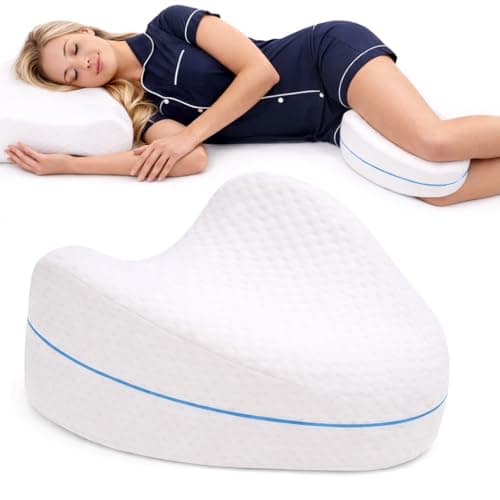 Contour Legacy Leg & Knee Foam Support Pillow The long one. Contour builds this longer than a standard knee wedge so it carries the calf and shin as well as the knees, which is the fix if a short pillow leaves your lower leg hanging. Best for: Support along the whole lower leg | Support along the whole lower leg | $32.95 · View on Amazon Price as of October 18, 2026. #ad — we earn a commission. |
| 3 | 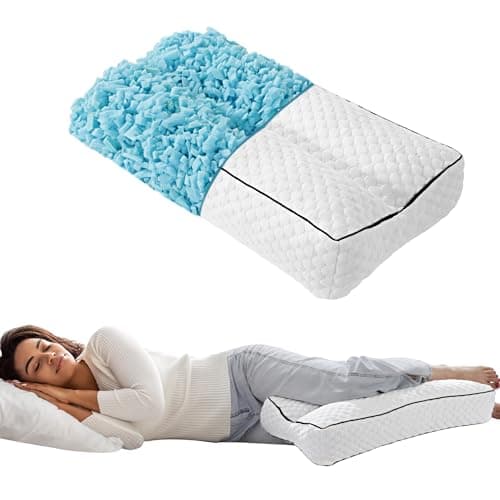 HOMBYS Shredded Memory Foam Knee Pillow, 6.5 inch The tall one, and the only shredded fill here. A 6.5-inch, 26-inch-long pillow for people whose hips are wide enough that a standard contour wedge leaves the top knee still dropping. Best for: Broader hips and taller loft | Broader hips and taller loft | $33.99 · View on Amazon Price as of October 18, 2026. #ad — we earn a commission. |
| 4 | 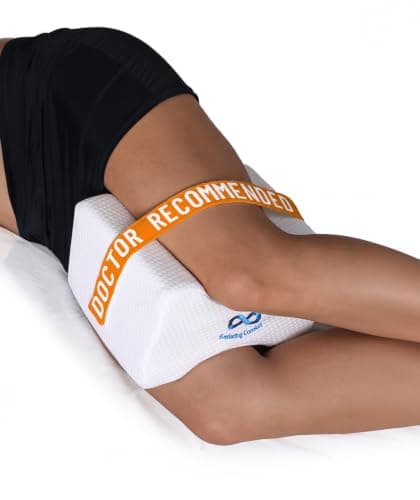 Everlasting Comfort Memory Foam Knee Pillow The one that stays put. A conventional contoured wedge with a removable adjustable strap, which is the honest answer to the single most common reason people abandon knee pillows. Best for: Sleepers who lose the pillow overnight | Sleepers who lose the pillow overnight | |
| 5 | 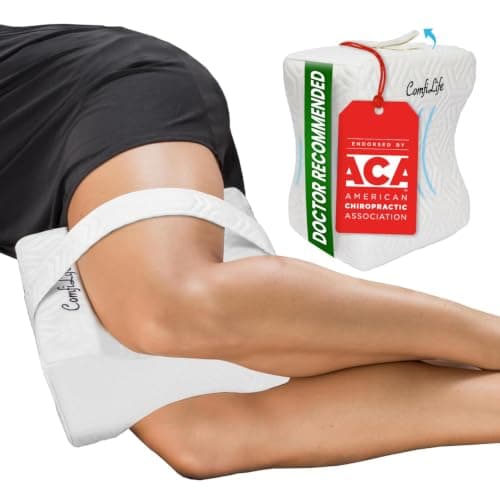 ComfiLife Cooling Knee Pillow with Strap Our overall pick's dimensions with a cooling-fabric cover and a strap added. The pick if the thing that put you off a knee pillow was the heat rather than the height. Best for: Hot sleepers | Hot sleepers | $27.95 · View on Amazon Price as of October 18, 2026. #ad — we earn a commission. |
| 6 | 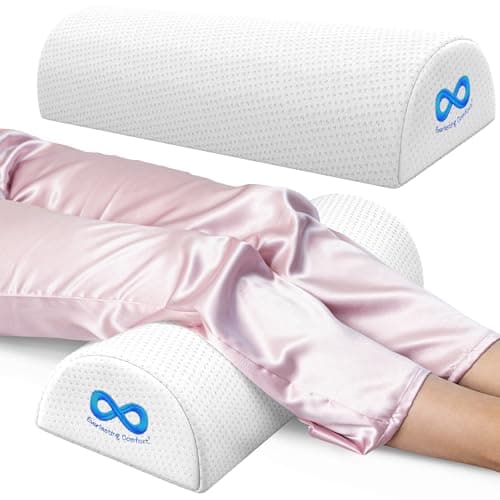 Everlasting Comfort Under Knee Bolster Pillow The different shape. A half-moon bolster that goes under the knees rather than between them - the correct tool if you sleep on your back, where a contour wedge has nothing to do. Best for: Back sleepers | Back sleepers | |
| 7 | 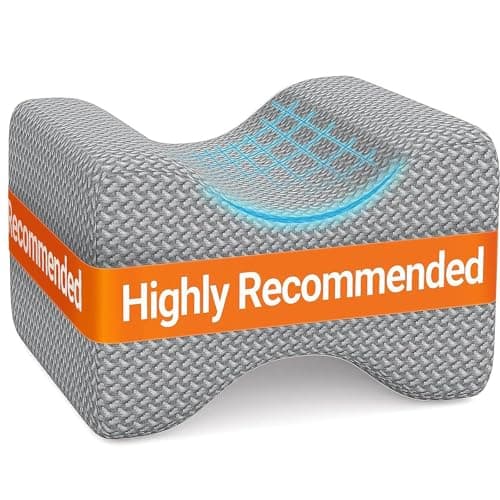 BlissTrends Memory Foam Knee & Leg Pillow, Large The cheap way in. A conventional contoured foam wedge at the lowest price here, which makes it the sensible first purchase when you do not yet know whether a knee pillow will do anything for you. Best for: Finding out cheaply whether it helps | Finding out cheaply whether it helps |
The gap your top leg falls into
Lie on your side and look at what your legs are doing. The bottom one is resting on the mattress. The top one has nothing underneath it at all, so it slides forward and downward across the bottom leg - and it takes the top hip with it. Your pelvis rotates, and a twist runs from there up through your lower back and stays for as long as you hold the position, which for most side sleepers is most of the night.
A knee pillow occupies that gap. That is the entire product. With something of roughly the right thickness between the knees, the top leg has somewhere to rest at the height it would sit if your hips were stacked, so the pelvis stays closer to level and the twist mostly goes away. It is the cheapest single change you can make to how your body is arranged in bed - cheaper than a mattress, cheaper than a head pillow, and aimed at a part of the body that most bedding shopping ignores completely.
Understanding the mechanism matters because it tells you immediately whether this product is for you. If your hips are the thing that feels wrong when you wake up, or if you notice your top knee resting on the mattress in front of you, there is a gap to fill. If you sleep on your back, the mechanism above describes a problem you do not have - and you want a different shape, which we come to below.
Height is the spec, and it is set by your hips
Everything else on a knee-pillow listing is secondary to one number: how thick the pillow is. The right thickness is roughly the size of the gap between your knees when your hips are level - and that gap is a function of how broad you are through the hips, not of your height or your weight. Two people the same size can need different pillows.
Get it wrong in either direction and you have paid for a misalignment. Too thin, and the top knee keeps dropping toward the mattress; you have reduced the twist a little rather than removed it, which is why some people conclude knee pillows "do nothing" when they have simply bought a small one. Too thick, and the top leg is lifted above level, the pelvis tips the other way, and you have swapped one rotation for its mirror image. Most of the market sits between roughly five and six and a half inches, which is not a coincidence - it is the band that is wrong for the fewest people.
The practical advice: if you have no idea, start mid-height, which is where our overall pick sits. If a standard wedge has always felt like it was not quite filling the space, go taller. If you are slim through the hips and a normal knee pillow has felt like it was propping your leg up rather than supporting it, go shorter. This is the same logic that runs through the loft question on pillows for side sleepers - the shoulder sets the head pillow, the hip sets the knee pillow, and in both cases your build decides the number.
Between the knees or under them: your position picks the shape
There are two genuinely different products sold under the same search term, and they are for opposite sleeping positions.
- The contoured wedge goes between the knees. It is hourglass-shaped so it does not slip out sideways, and it is for side sleepers. Six of our seven picks are this shape.
- The half-moon bolster goes under the knees, and it is for back sleepers. The problem it solves is different: lying flat leaves a gap under the curve of your lower back, and letting the knees bend slightly lets the lumbar spine settle toward the mattress instead of arching over that gap.
Buying the wrong one for your position is the most common way to waste money in this category, and it is easy to do because the listings all use the same words. Roll onto your side with a bolster under your knees and it does nothing whatsoever. Lie on your back with a contour wedge between your knees and it falls out. If you genuinely change position through the night, the between-the-knees shape is the more useful of the two, because it is the one you can grab and reposition as you turn - and our sleep positions guide is the better starting point if you are not sure what you actually do once you are asleep.
The real failure mode: it will not stay there
Ask around and you will find that most people who abandoned a knee pillow did not decide it was ineffective. They decided it was gone. It ends up by their ankles, wedged under a duvet, or on the floor - and after a couple of weeks of fishing for it at 3am, it lives in a cupboard.
This is worth taking seriously before you buy, because there are only three real answers to it and each has a cost. A strap fastens the pillow to one leg and genuinely solves the problem, but a meaningful number of people find a strap around the thigh more irritating than the wandering it prevents - it is a trade, not a free upgrade. A longer pillow that carries the calf as well as the knees has more contact area and tends to travel less, which is the quieter version of the same fix. Or you go up a size entirely to a body pillow, which you wrap around and therefore cannot really lose - at the cost of price, bulk and roughly half the bed if you share it.
If you are a fairly still sleeper, none of this applies and you can ignore it. If you know you turn all night, decide which of those three you are willing to live with before you pick a product, because it will decide whether you are still using it in a month.
Foam, cover and heat
The fill splits into two kinds. Cut foam - a solid molded piece - is what most of this category is, and it holds its contour under the weight of a leg, which is exactly what you need. A soft fiber cushion squashes flat within an hour and gives you nothing, which is why we have not included any. Shredded foam is the alternative: it molds around the legs rather than presenting one fixed shape, which suits people a contour wedge never quite fit, but it also compresses further under load, so a listed height is a starting point rather than a sustained one.
The cover is not a detail here. This pillow spends the whole night pressed between two thighs, which is a warm and humid place, so it needs to come off and go in a machine. Nearly every pick on this page has a zippered removable cover; the fabric varies from ordinary polyester jersey through cotton to a cooling-treated finish. Be realistic about what a cooling cover does: it is a surface effect with a fixed capacity, pleasant in the first minute and not the reason you are comfortable at 3am. If you genuinely run hot in bed, the pillow between your knees is not the biggest lever you have - a cooler comforter and cooling sheets move far more heat than a six-inch wedge ever will.
One caution on cleaning, since it follows from the above: wash the cover, never the foam. Memory foam breaks down in water and will not dry through the middle, so a foam core that has been through a washing machine is usually ruined. The exception on this page is the shredded HOMBYS, whose listing says the whole pillow is machine washable - follow the listing, and dry it low.
What we will not tell you
Every product in this category is marketed in the language of pain relief. The listings are wall-to-wall with it, and it is the reason most people arrive here. We are not going to repeat those claims, and we do not evaluate them: this site has no lab, no clinicians and no business assessing whether a piece of foam changes a medical outcome.
What can be described honestly is geometry. A pillow of the right thickness between the knees keeps the hips stacked and reduces the rotation that side sleeping puts through the pelvis and lower spine. That is a mechanical statement about position, and it is the entire basis on which this page recommends anything. Whether it changes how you feel in the morning is individual and we cannot know it. If you have persistent pain, please talk to a doctor or a physiotherapist first - that conversation is worth more than any of these purchases, and it may well change which one, if any, makes sense. The same principle governs our mattress picks for hip pressure, which discuss support and pressure distribution and nothing else.
A knee pillow and a lumbar pillow are the two halves of the same question, and they pull in opposite directions: one tilts the pelvis to reduce the lumbar arch, the other fills it. Five lumbar pillows for bed, ranked - try both before buying either.
Who should skip a knee pillow entirely
Stomach sleepers, first. Lying face-down, your legs are already flat against the mattress and there is no gap to fill; a pillow between the knees just gets in the way. If you sleep on your front and something feels wrong, the problem is almost certainly your head pillow being too tall - that is a different page.
Second, anyone whose real issue is the shoulder rather than the hip. If you wake with your top arm dead or your upper body twisted forward, a knee pillow addresses the wrong end of you; a body pillow supports both at once and is the better single purchase. And third, if you are pregnant and looking at this category for side-sleeping support, the shapes built for that job - full-length U, C and J pillows - do far more than a knee wedge, and our pregnancy pillow picks cover them properly.
None of these were tested here - there is no lab behind this site, and we say so on every page. The picks come from reading listings and manufacturer specifications, sorting the category by the two things that actually decide the purchase, and being direct about who each one is wrong for. That method is written out in full on how we review.
The picks, in full
1. Best for Most side sleepers
ComfiLife Orthopedic Knee and Leg Pillow
The default. A mid-height contoured foam wedge that does the one job well, in the height that suits the largest share of people, with a zippered cover you can actually wash.
Price as of October 18, 2026. #ad — we earn a commission.
Key specs
- 9.8 x 7.9 x 6.3 inches (manufacturer)
- Cut memory foam, listed as 100% polyurethane foam
- Breathable zippered cover, removable and machine washable (manufacturer)
- Contoured hourglass shape for between the knees
What's good
- The 6.3-inch height is the sensible middle of this category - tall enough to hold an average pair of knees apart without cranking the top hip up past level, which is the mistake an oversized pillow makes
- A zippered, removable, machine-washable cover matters more here than on most pillows, because this one spends the night pressed between two legs
- Cut foam rather than a soft fiber fill, so it holds its shape under the weight of a leg instead of squashing flat by 2am - the failure that makes people give up on knee pillows entirely
What's not
- No strap, so if you turn a lot it can end up somewhere near your ankles by morning - the strapped Everlasting Comfort below exists for exactly that person
- Solid foam sleeps warmer than an open shredded fill; between your thighs is already a warm place
- One fixed height, and 6.3 inches is genuinely short if you are broad through the hips
Skip this one if
You sleep on your back. A contoured between-the-knees wedge is the wrong shape entirely for that position - you want the half-moon bolster further down this list, which goes under the knees rather than between them.
2. Best for Support along the whole lower leg
Contour Legacy Leg & Knee Foam Support Pillow
The long one. Contour builds this longer than a standard knee wedge so it carries the calf and shin as well as the knees, which is the fix if a short pillow leaves your lower leg hanging.
Price as of October 18, 2026. #ad — we earn a commission.
Key specs
- 9.9 x 9.9 x 5.8 inches (manufacturer)
- Listed as 20% longer than traditional leg pillows (manufacturer)
- 300 thread count, 100% cotton quilted cover, removable and washable (manufacturer)
- Curved base and tapered edges; center incline to hold position (as listed)
What's good
- Extra length is not a gimmick here - a short wedge supports the knees and lets the shins and ankles collapse together, and the ankle is where a lot of people actually feel a short pillow going wrong
- A 300 thread count cotton cover instead of the usual polyester jersey - it breathes better and feels less clammy against bare legs
- The center incline and tapered edges are a real attempt at the stay-put problem without resorting to a strap around your leg
What's not
- The most expensive of the between-the-knees picks here, for a shape difference rather than a materials difference
- At 5.8 inches it is the shortest of our full-size picks in height, so broad-hipped sleepers may still find it under-lofted
- A bigger pillow is more bed real estate, which matters if you share and are already negotiating for space
Skip this one if
Your complaint is only about your knees knocking together and your lower legs feel fine. You are paying for length you do not need - the ComfiLife or the budget BlissTrends does the knee job for less.
3. Best for Broader hips and taller loft
HOMBYS Shredded Memory Foam Knee Pillow, 6.5 inch
The tall one, and the only shredded fill here. A 6.5-inch, 26-inch-long pillow for people whose hips are wide enough that a standard contour wedge leaves the top knee still dropping.
Price as of October 18, 2026. #ad — we earn a commission.
Key specs
- 6.5-inch height (as listed)
- 26 inches long, to support each leg including the knee (as listed)
- Shredded memory foam fill (as listed)
- Cover listed as 35% viscose from bamboo, 65% polyester; machine washable whole (as listed)
What's good
- Height is the spec most people get wrong, and this is the tallest pick here - if you are broad through the hips, a 5 to 6 inch wedge simply does not fill the gap and your top knee keeps falling inward
- Shredded fill molds around the knees rather than presenting one fixed contour, so it suits legs that a molded wedge shape never quite fit
- Washable as a whole unit, which is rare in this category and a genuine convenience over unzipping and reassembling a cover
What's not
- Shredded fill compresses more than cut foam under a leg, so the effective height in use is lower than the number on the listing - treat 6.5 inches as the starting point, not the sustained loft
- The extra length and bulk is a lot of pillow in a shared bed
- The listing does not describe it as adjustable, so do not buy it expecting to unzip it and remove fill the way you would with an adjustable head pillow
Skip this one if
You are slim through the hips. A tall pillow between narrow knees lifts the top leg above level and tilts the pelvis the other way, which is the same misalignment you were trying to fix - go with the mid-height ComfiLife instead.
4. Best for Sleepers who lose the pillow overnight
Everlasting Comfort Memory Foam Knee Pillow
The one that stays put. A conventional contoured wedge with a removable adjustable strap, which is the honest answer to the single most common reason people abandon knee pillows.
Key specs
- Memory foam, dual curved design for both legs (as listed)
- Removable adjustable strap (as listed)
- Zippered cover, removable and machine washable (as listed)
- Roughly 10.5 x 8 x 6 inches (as listed)
What's good
- The strap solves a real failure, not an imagined one - most people who say a knee pillow did not work for them mean it migrated out of position, and no amount of clever contouring fixes that for a restless sleeper
- It is removable, so you are not forced into the strap on nights you do not want it - you get a normal knee pillow that can become a strapped one
- Standard washable zippered cover and a conventional 6-inch-ish height, so the strap is the only thing unusual about it
What's not
- Plenty of people find any strap around the leg more irritating than the wandering pillow it prevents - it is a genuine trade, not a free upgrade
- The strap adds a step to getting into bed, which is exactly the kind of friction that gets a product abandoned in week two
- Solid foam, so the same warmth caveat as the other cut-foam picks applies
Skip this one if
You barely move at night. The strap is friction you will not benefit from - buy the unstrapped ComfiLife, which is cheaper in most weeks and one less thing to fasten.
5. Best for Hot sleepers
ComfiLife Cooling Knee Pillow with Strap
Our overall pick's dimensions with a cooling-fabric cover and a strap added. The pick if the thing that put you off a knee pillow was the heat rather than the height.
Price as of October 18, 2026. #ad — we earn a commission.
Key specs
- 9.8 x 7.9 x 6.3 inches (manufacturer)
- Cut memory foam, contour design (as listed)
- Cooling fabric cover, removable and machine washable (as listed)
- Adjustable strap included (as listed)
What's good
- Between your thighs is one of the warmest places in the bed, and a slab of memory foam parked there insulates - a cooling-fabric cover is a more sensible upgrade here than it is on most products
- Same 6.3-inch geometry as the overall pick, so you are choosing a cover and a strap rather than gambling on a different shape
- The strap comes as standard rather than as a separate model, so it covers both the heat and the migration problem at once
What's not
- A contact-cool cover is a surface effect with a fixed capacity - it feels cool when you first settle against it and stops being the reason you are comfortable a few minutes later
- It carries a premium over the plain ComfiLife for that cover, and the foam core underneath is doing the same insulating either way
- If you run hot enough that this is a real problem, the pillow is rarely the biggest lever in the bed
Skip this one if
You do not sleep hot. You are paying extra for a cover feature you will not notice - the standard ComfiLife is the identical pillow underneath. And if you are genuinely overheating, fix the layers first with a cooler comforter and cooler sheets before blaming a knee pillow.
6. Best for Back sleepers
Everlasting Comfort Under Knee Bolster Pillow
The different shape. A half-moon bolster that goes under the knees rather than between them - the correct tool if you sleep on your back, where a contour wedge has nothing to do.
Key specs
- Half-moon bolster shape, for under the knees (as listed)
- Memory foam, listed as OEKO-TEX STANDARD 100 certified (as listed)
- Air-layer fabric cover, fully removable and machine washable (as listed)
- Also usable under the lower back or neck (as listed)
What's good
- Back sleeping and side sleeping want opposite shapes, and almost every knee-pillow list ignores it - a bolster under the knees lets them bend slightly so the lower back settles toward the mattress instead of arching over a gap
- The curved shape has more than one use: under the knees at night, under the lower back or ankles when you are lying down during the day
- OEKO-TEX STANDARD 100 on the listing is a materials-safety certification with an actual standard behind it, which is more than most claims in this category carry
What's not
- Useless in the position most people who search for a knee pillow are in - roll onto your side and it does nothing at all
- Bolsters shift as your legs move, and there is no strap option to hold this one
- Costs more than a plain between-the-knees wedge for a simpler piece of foam
Skip this one if
You sleep on your side, or you change position through the night. A bolster only works while you are on your back - a combination sleeper wants a between-the-knees contour they can keep hold of as they turn.
7. Best for Finding out cheaply whether it helps
BlissTrends Memory Foam Knee & Leg Pillow, Large
The cheap way in. A conventional contoured foam wedge at the lowest price here, which makes it the sensible first purchase when you do not yet know whether a knee pillow will do anything for you.
Key specs
- 10 x 7.9 x 5.7 inches, Large (as listed)
- High-density memory foam (as listed)
- Removable washable zippered cover (as listed)
- Ergonomic contour for between the knees
What's good
- This category has an unusually high abandonment rate, so buying the cheapest competent version first is a rational way to test whether the idea works for your body before spending three times as much
- It has the two things that matter mechanically - a contoured shape and a foam that holds it - rather than being a soft fiber cushion that flattens
- A removable washable cover at this price, which budget picks in this category often drop
What's not
- At 5.7 inches it is the shortest pick here, so it is the most likely to leave a broad-hipped sleeper still dropping the top knee
- Budget foam and finishing; expect the density and the cover to match the price over a couple of years
- No strap and no cooling cover, so both of the common upgrade paths mean buying a second pillow
Skip this one if
You already know a knee pillow works for you and you know your height. Buy the one that fits properly the first time - the mid-height ComfiLife, or the tall HOMBYS if you are broad through the hips.
Common questions
What does a knee pillow actually do?
It fills a gap. When you lie on your side, your top leg has nothing under it, so it falls forward and down across the bottom leg - and it drags the top hip with it. That rotates your pelvis and puts a twist through your lower back that stays there for as long as you are in that position. A knee pillow occupies the space the top leg would otherwise fall into, so the two knees stay roughly stacked and the pelvis stays roughly level. That is the whole mechanism. It is a positioning tool, not a comfort upgrade, and if your hips are already stacked it has nothing to do.
How thick should a knee pillow be?
Roughly as thick as the gap between your knees when your hips are level - which is a function of how broad you are through the hips, not of your height or weight. Most knee pillows land between about five and six and a half inches, which suits most people. If you are narrow through the hips, a tall pillow lifts your top leg above level and tilts the pelvis the other way, which is just a different misalignment. If you are broad, a short pillow lets the top knee keep dropping and you get no benefit at all. When in doubt, start mid-height - it is the size that is wrong for the fewest people.
Should the pillow go between my knees or under them?
It depends entirely on which way you sleep, and it is the first thing to settle. Side sleepers put it between the knees, because the problem is the top leg falling across the bottom one. Back sleepers put it under the knees, because the problem is different - lying flat leaves a gap under the lumbar curve, and a slight bend in the knees lets the lower back settle toward the mattress. The two jobs need two different shapes: a contoured wedge for between, a half-moon bolster for under. Buying the wrong shape for your position is the most common way to waste money here.
Why does my knee pillow move out of position during the night?
Because nothing is holding it there, and legs move. This is by far the most common reason people give up on knee pillows - not that it did not help, but that it was down by their ankles or on the floor by morning. There are three answers. A strapped model fastens the pillow to one leg, which works but which some people find more annoying than the problem. A longer pillow that carries the calf as well as the knees has more contact and tends to travel less. And a full body pillow, which you hold rather than balance, is the version that cannot really escape - at the cost of taking up half the bed.
Is a knee pillow better than a body pillow?
Neither is better; they are different sizes of the same idea. A knee pillow does one job in one place, costs very little and takes up no space. A body pillow does the same knee-gap job and also supports the top arm and shoulder, which stops the upper body twisting the way the hips do - and because you wrap around it, it stays where you put it. The trade is bulk, price and bed space, and it is a real one if you share a bed. Start with a knee pillow if the complaint is specifically about your hips and lower back; consider a body pillow if your top shoulder rolls forward too, or if nothing you tried would stay in place.
Do knee pillows relieve pain?
We are not going to tell you that, because we are not qualified to and we have not tested it. Every listing in this category is written in the language of pain relief, and we do not evaluate those claims. What can be described plainly is the mechanics: a pillow between the knees keeps the hips stacked, which reduces the rotation through the pelvis and lower spine that side sleeping otherwise creates. Whether that changes how you feel is individual. If you have persistent pain, that is a conversation with a doctor or a physiotherapist rather than with a shopping page - and it should happen before you spend money on foam.
How do you clean a knee pillow?
Wash the cover, not the foam. Almost every pillow here has a zippered cover you remove and machine wash - which you should do more often than you might think, because this pillow spends every night pressed between two legs. The foam core itself must not go in a washing machine: water breaks memory foam down and it will never dry through the middle. Spot-clean it and let it air out instead. The exception on this page is the shredded-fill HOMBYS, which the listing says can be machine washed as a whole; follow the listing on that one and dry it at low heat.
Sources
Where the facts on this page come from. We cite other people's testing because we don't do our own — here's what that means.
- Sleep Foundation - sleeping with a pillow between your knees
- Sleep Foundation - knee pillows and spinal alignment
- ComfiLife - Orthopedic Knee Pillow published specifications
- Contour Products - Legacy Leg Pillow published specifications
- OEKO-TEX - what STANDARD 100 certification covers
- FTC - Endorsement guides (why this disclosure exists)
Read next
- The Best Pillows for Side SleepersSix pillows tall and firm enough to fill a side sleeper's shoulder gap without collapsing into it by midnight.
- The Best Body PillowsSix body pillows sorted by the thing that actually matters — shape — for side sleepers and pregnancy, with an honest note on who each is wrong for.
- The Best Wedge PillowsFive wedge pillows sorted by incline - from a gentle reading angle to a steep reflux slope and adjustable recovery sets - with honest, non-medical notes on who each suits.
- The Best Pregnancy PillowsFive pregnancy pillows sorted by shape (U, J and extra-long), covering budget, cooling and small-bed options - with honest notes on bed space and who should skip each.
- How Your Sleep Position Changes the Bed You NeedEach sleep position presses a different shape into the bed. Side wants softer plus a tall pillow, back medium-firm plus medium loft, stomach firm plus flat or none.
- The Best Mattresses for Hip PainSix mattresses judged on pressure relief and alignment for side sleepers — led by memory foam and plush hybrids, because the hip needs to sink in, not be held out.