How to Keep Fitted Sheets From Slipping
A fitted sheet that snaps off a corner at 3 a.m. is almost never defective — it is the wrong depth for your mattress, or the elastic has finally worn out. Here are the real causes, in the order they actually happen, and the fixes that make sheets stay put.
We earn a commission if you buy through our links. It doesn't affect our picks — and we never take free products. How this site is funded.
A fitted sheet that peels off a corner in the middle of the night and leaves you on bare mattress is one of the most common annoyances in a bedroom — and one of the most fixable. It almost never means the sheet is defective or badly made. In the large majority of cases it traces back to one of a small handful of causes, and the biggest by far is a pocket-depth mismatch: the sheet is simply the wrong size for the mattress it is stretched over. Work through the causes below roughly in order, and you will almost certainly find yours near the top.
The number-one cause: a pocket-depth mismatch
The pocket is the vertical wall of fabric on each side of a fitted sheet — the part that wraps down over the edge of the mattress and tucks underneath. If that pocket is too shallow for your mattress, the elastic is already stretched to its limit just to reach around the sides, with no give left in reserve. You roll over, a corner rides up over the edge, and the elastic has nothing left to pull it back down — so it lets go. By morning two corners are bare. That is not a cheap sheet; it is a sheet cut for a thinner bed than you actually sleep on, which is easy to end up with because mattresses have grown much taller over the last decade while a lot of sheets are still cut for older, slimmer beds.
The opposite mismatch causes a different but related problem. A pocket that is too deep for a thin mattress leaves inches of extra fabric with nowhere to go, so instead of pulling taut it billows, shifts, and bunches as you move — which reads as slipping even though the grip is fine. Depth is a two-way match: you want the pocket close to your mattress height, a little over, not wildly over in either direction. If you are not sure which camp you are in, our guide to what deep-pocket sheets are walks through the general ranges — standard fits up to roughly 13 to 14 inches, deep pocket around 15 to 17, extra deep beyond that — and how to read them.
The fix is a two-minute measurement. Strip the bed to the bare mattress, set a tape measure at the very top edge, and run it straight down to the bottom edge, keeping the tape flat and vertical against the side so you are capturing the true height rather than an inflated angle. Then buy a pocket depth a touch greater than that number. Do not trust the height printed in the mattress's marketing name — as our guide to mattress thickness explains, a "14-inch" model can measure differently in real life, and the box is a marketing spec, not a promise about sheet fit. Measure the bed you actually have.
When the elastic is just worn out
If a set that used to fit fine has turned unreliable, the depth did not change — the elastic gave out. Elastic ages. Every wash and every hot dryer cycle takes a little tension out of it, and after a few years the band that once snapped the sheet tight underneath the mattress no longer has the pull to hold a corner down. This is the quiet second cause behind a lot of slipping sheets, and it is worth ruling in or out before you buy anything: if the sheet is the right depth and simply stopped gripping over time, no strap or pad will fully rescue a band that has lost its stretch. To slow it down on your next set, wash in warm rather than hot water and dry on low or line-dry, since heat is what breaks elastic down fastest.
All-around elastic beats corner-only
Not all fitted sheets are elasticized the same way, and the difference decides how well they stay on. The best-behaved sheets use all-around elastic — elastic sewn into the entire hem of the opening — so it hugs the whole underside of the mattress and spreads the tension evenly. No single corner takes the full load when you shift, which is exactly why these sheets hold when a cheaper make lets go. Sheets elasticized only at the four corners rely on those small bands alone; they cost less, but they are the first to ride up and the first to wear out. When you are choosing a new set, treat the fit description as seriously as the thread count — our guide on how to choose bed sheets covers what to look for, and "all-around elastic" is one of the small phrases that predicts whether a sheet actually stays put.
Grip it from underneath: pads, straps, and suspenders
When the fit is right and the elastic is sound but a sheet still creeps, the fixes get mechanical — and most of them are cheap.
- Sheet suspenders, straps, or garters. These clip to a corner and stretch diagonally across the underside of the mattress, pulling the fabric taut and holding the corners down. They work on almost any sheet, install in a minute, and are the single most reliable fix for restless sleepers and hard-edged mattresses. Sold under several names — suspenders, straps, garters, fasteners — but they all do the same job.
- Corner-anchor bands. A variation that loops around or clips to each corner of the mattress specifically, anchoring the four points that fail first rather than pulling across the middle. Useful when it is only the corners riding up.
- A grippy, non-slip mattress pad. A textured or rubber-backed pad placed between the mattress and the fitted sheet adds friction across the whole surface, so the sheet has something to hold onto instead of sliding on smooth fabric. It also does its usual job of protecting the mattress, so it can solve two problems at once.
These stack. Suspenders plus a grippy pad is more secure than either alone, and neither one asks you to replace a sheet you otherwise like.
Tucking technique and a slippery surface
How you make the bed matters more than people expect. When you put a fitted sheet on, seat each corner fully — lift the corner of the mattress and pull the elastic hem all the way underneath, so it grips the bottom of the mattress rather than perching on the edge where it can slide off. A sheet whose corners are only half-seated is already halfway to popping off before you get in. If your sheet has extra flat length, tucking the sides deep under the mattress, hospital-corner style, gives the whole thing less room to travel.
Surface plays a part too. Very smooth, silky weaves — some sateen, satin, silk, and slick bamboo-derived sheets — feel wonderful but have less friction against the mattress and a slick protector underneath, so they slide more readily than a textured percale. You do not have to give up a fabric you love over this; a non-slip pad under the sheet or a set of corner straps offsets the slipperiness while keeping the feel.
Do not forget the topper
A mattress topper is a hidden reason sheets slip, in two ways. First, a topper adds height the fitted sheet has to cover — a 12-inch mattress under a 3-inch topper is a 15-inch sleeping surface, and a sheet sized for the bare mattress will now be stretched too shallow and pop off. Always add the topper's thickness to your mattress measurement and shop against the total. Second, the topper itself can slide against the mattress under the sheet, taking the bedding with it. If you sleep on a topper, size your sheets for the combined height and consider anchoring the topper as well, so both layers stay where they belong.
A quick order of attack
Run through it cheapest and most likely first. Measure your mattress plus any topper and confirm the sheet's pocket depth actually clears it — that alone solves most cases. If the fit is right but an old set stopped gripping, the elastic is spent and it is time to replace the set, favoring all-around elastic and corner straps this time. If a well-fitting, sound sheet still travels, add mechanical grip — sheet suspenders, corner-anchor bands, or a non-slip pad — and seat every corner fully when you make the bed. Somewhere in that list is the fix for your sheet, and none of it costs much or takes long.
The cheap stuff worth having
The two mechanical fixes named above, for when the sheet genuinely fits and still creeps. Neither one substitutes for the right pocket depth — they are what you reach for once the depth is already right.
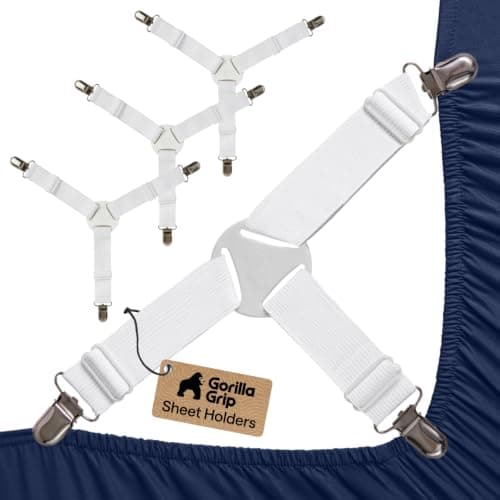
Gorilla Grip Fitted Sheet Holders (4-Pack)
Corner clips that pull the fitted sheet taut from underneath. This is the mechanical fix for a sheet that fits and still snaps off a corner at 3 a.m.
Skip it if The pocket is simply too shallow for your mattress. Straps are fighting a fit problem they can't win — buy the right pocket depth instead.
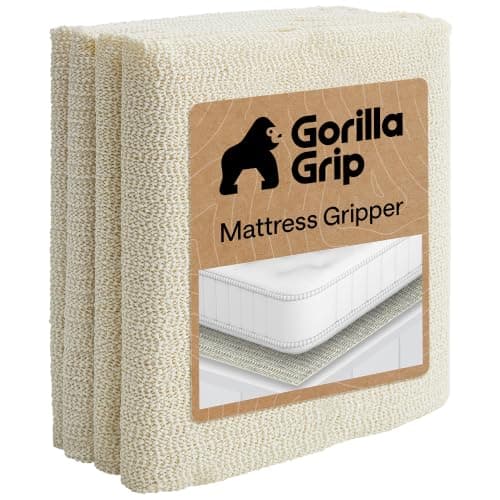
Gorilla Grip Non-Slip Mattress Gripper (54 x 72, Queen)
A rubberized pad laid between the mattress and a slick platform supplies the friction the two surfaces don't have on their own. The cheap fix for a bed that walks.
Skip it if Your mattress moves because the base is broken, or smaller than the bed sitting on it. Grip can't fix geometry — that's a frame problem.
Common questions
Why do my fitted sheets keep slipping off at night?
Almost always one of two things, and neither means the sheet is defective. The most common cause is a pocket-depth mismatch: the sheet is cut for a thinner mattress than you actually own, so the elastic is stretched to its limit and one good toss lets a corner ride up and snap off. The second is worn-out elastic that has lost its grip after years of washing and hot drying, so even a correctly sized sheet slips. Measure your mattress, match the pocket depth, and favor sheets with elastic sewn all the way around rather than only at the corners.
How do I stop a fitted sheet from coming off the corners?
Start with fit: measure your mattress height, add any topper, and buy a pocket depth a little greater than that total so the elastic is not maxed out. If the fit is already right, the next fixes are mechanical — sheet suspenders or straps that clip to each corner and stretch across the underside, corner-anchor bands, or a grippy non-slip pad between the mattress and the sheet. Seating each corner fully when you make the bed, so the elastic pulls under the mattress rather than perched on the edge, also helps more than people expect.
Do sheet suspenders and straps actually work?
Yes, and they are the most reliable mechanical fix when the sheet fits but still creeps. Sheet suspenders (also sold as sheet straps, garters, or fasteners) clip to two corners and stretch diagonally across the underside of the mattress, pulling the fabric taut and holding the corners down against normal movement. They work on nearly any sheet and are the go-to for restless sleepers, adjustable bases, or mattresses with hard, squared-off edges that a sheet tends to climb over.
Does the type of elastic in a fitted sheet matter?
It matters a lot. Sheets with all-around elastic — sewn into the entire hem of the opening — hug the whole underside of the mattress and spread the tension, so no single corner takes the full load when you move. Sheets elasticized only at the four corners rely on those small bands alone and give up far sooner. When you are shopping, treat phrases like all-around elastic and corner straps as fit features worth paying for, not marketing fluff.
Can the sheet material make a fitted sheet slip more?
It can. Very smooth, silky weaves — some sateen, satin, silk, and slick bamboo-derived sheets — have less surface friction against the mattress and against a smooth mattress protector underneath, so they slide more readily than a textured percale or cotton. Material is rarely the whole story, but if your fit and elastic are both fine and a slick set still shifts, a grippy non-slip pad under the sheet or a set of corner straps offsets the slipperiness without giving up the feel you like.
Sources
Where the facts on this page come from. We cite other people's testing because we don't do our own — here's what that means.
Read next
- How to Fold a Fitted SheetHow to fold a fitted sheet neatly: the corner-nesting method step by step, an easier roll (or 'burrito') alternative, the cardboard trick for a store-display finish, and how to fold the whole set together so your linen closet stays tidy.
- How to Make Your BedThe correct bedding layer order from protector to pillows, the hotel-bed method for a crisp finish, how to keep a fitted sheet from slipping and a duvet from bunching, plus a fast daily reset versus a full remake.
- What Are Deep-Pocket Sheets?Deep-pocket sheets have deeper side walls for thick mattresses. Standard fits up to ~13-14 in, deep pocket ~15-17 in, extra deep beyond that — the pocket must clear your mattress plus any topper.
- The Best Sheets on AmazonSix Amazon sheet sets worth buying, plus how to read a listing: why thread count lies, what Egyptian cotton isn't, and the sizing spec that causes most returns.
- The Best Cooling Sheets for Hot SleepersSix sheet sets that actually breathe, chosen on fiber and weave rather than marketing — plus who should skip each one.
- How to Choose Bed SheetsFiber is the biggest decision — cotton, linen, bamboo, microfiber or Tencel — then weave (percale vs sateen), then fit and care. Thread count matters least.
- Mattress Thickness: How Many Inches Do You Need?The typical mattress thickness ranges from 6 to 14+ inches, what each is really built for, and why total thickness matters less than comfort-layer depth and build quality.