The Best Mattress Bags for Moving and Storage
Buy the Nordic Elk. It is the reusable one with eight reinforced handles and a real zipper, which is the combination that matters on moving day - because the handles are what let two people carry a queen mattress without gripping the mattress itself. Six more below for the toughest material, the best value, the cheapest disposable, a pair for a mattress and box spring, and long-term storage.
We earn a commission if you buy through our links. It doesn't affect our picks — and we never take free products. How this site is funded.
Quick picks
| # | Product | Best for | Price |
|---|---|---|---|
| 1 | 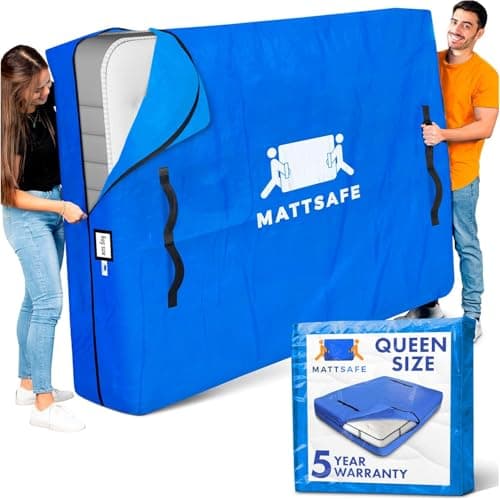 Nordic Elk Queen Size Mattress Bag for Moving and Storage, 8 Reinforced Handles The one that understands what the product is for. Eight reinforced handles and an extra-strong zipper, in a reusable bag rather than a sheet of plastic - and the handles are the whole point, because the reason a queen mattress is hard to carry is that there is nothing to grip. A plastic bag gives you a slippery surface and a prayer; this gives two people four handles each. Best for: Moving day - the handles are the feature | Moving day - the handles are the feature | |
| 2 | 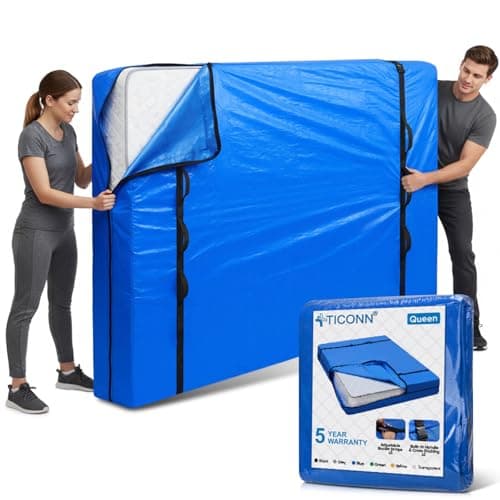 TICONN Mattress Bag for Moving, Heavy Duty Water-Resistant Tarpaulin, Queen Tarpaulin rather than woven fabric or thin plastic, which is a meaningful step up in abrasion resistance. If the mattress is going in a truck with furniture, through a doorway with a rough frame, or down an exterior staircase, this is the material that does not tear when something catches it. Carry handles and a smooth zipper too, so it loses nothing to the Nordic Elk on usability. Best for: The toughest material here | The toughest material here | $29.99 · View on Amazon Price as of November 4, 2026. #ad — we earn a commission. |
| 3 | 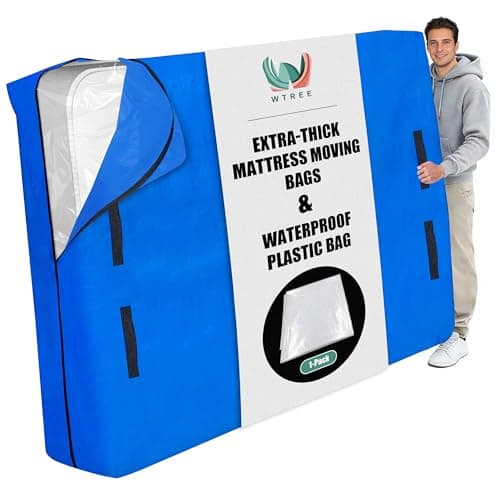 WTREE Double Shield Mattress Bag with 8 Reinforced Handles and Internal Clear Protector The clever one. It is a handled outer bag with a separate clear protector inside, which means the layer touching the mattress is a clean plastic sheet and the layer taking the abuse is the handled outer. For a move that ends in storage, that two-stage construction is genuinely the right design, and it costs about half what the single-layer reusables do. Best for: Best value - two layers for the price of one bag | Best value - two layers for the price of one bag | |
| 4 | 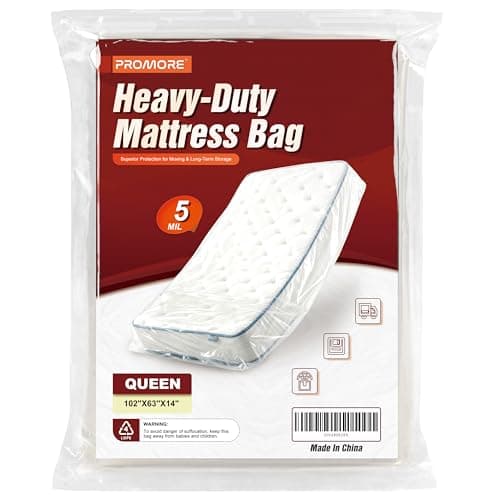 PROMORE Queen Mattress Bag for Moving and Storage, 5 Mil Heavy Duty The best-specified plastic bag here, because it publishes the one number this category should be judged on: 5 mil. Most mattress bags are 1.5 to 2 mil, which is grocery-bag territory and tears on the first corner it catches. Five mil is more than three times that, and at this price it is the cheapest honest way to get a bag that will survive the trip rather than shred on it. Best for: The thickness number that actually matters | The thickness number that actually matters | |
| 5 | 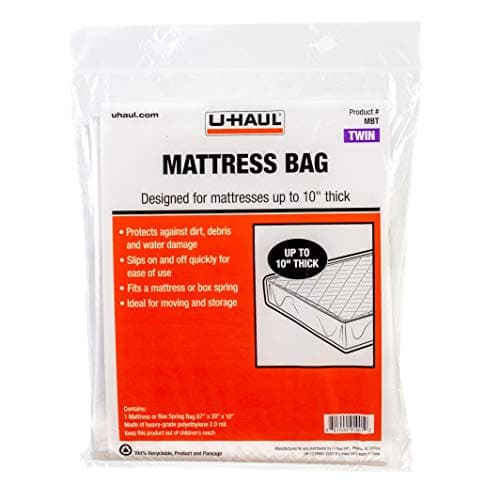 U-Haul Standard Twin Mattress Bag, 87 x 39 x 10 Inches The one-move answer, from the only brand on this shelf whose actual business is moving. It is a plain plastic bag and it does not pretend otherwise - but it publishes exact inches (87 x 39 x 10), which almost nothing else here does, and that is the specification that decides whether a bag fits a mattress or splits trying. Covers a box spring as well as a mattress. Best for: The cheapest bag that tells you its dimensions | The cheapest bag that tells you its dimensions | $6.95 · View on Amazon Price as of November 4, 2026. #ad — we earn a commission. |
| 6 | 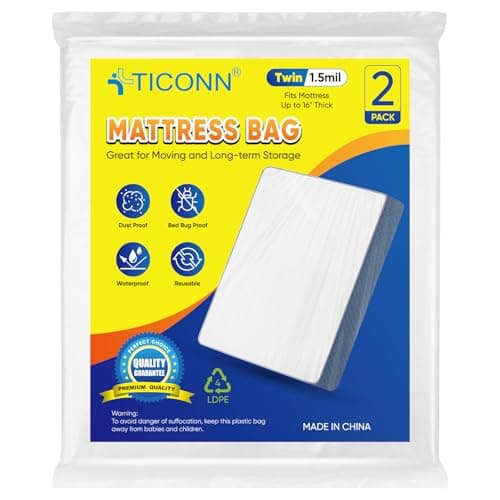 TICONN 2-Pack Plastic Mattress Bags, 1.5 Mil, 98 x 40 x 16 Inches, 3D Gusset Two bags, published dimensions, and a gusseted shape rather than a flat sleeve - which is the detail that matters for anything thick. A flat bag has to stretch around a 14-inch mattress and stresses the seams doing it; a 3D gusset is cut with depth built in. At 16 inches deep and 98 long it is the only pick here that comfortably takes a modern deep mattress, and the two-pack covers the box spring too. Best for: A mattress and a box spring, or a deep mattress | A mattress and a box spring, or a deep mattress | $9.99 · View on Amazon Price as of November 4, 2026. #ad — we earn a commission. |
| 7 | 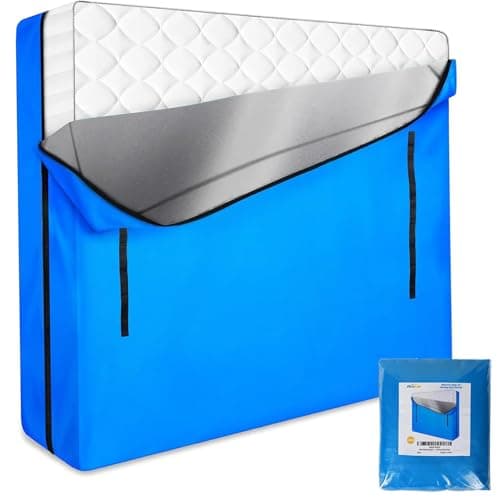 ANALIM Zippered Mattress Storage Bag with 8 Strong Carrying Handles, Reusable The storage pick rather than the moving pick, and the distinction is the zipper. A taped bag is opened once, destructively. A zippered bag can be opened in month three to check for damp, aired, and closed again - which is the single most useful thing you can do to a mattress sitting in a garage. Eight handles as well, so it moves as competently as it stores. Best for: Long-term storage you will open again | Long-term storage you will open again | $23.99 · View on Amazon Price as of November 4, 2026. #ad — we earn a commission. |
Two different products share one shelf
Almost everything sold as a "mattress bag" is one of two things, and buying the wrong one is the main way people are disappointed by this purchase.
A plastic sleeve is a sheet of polyethylene, taped shut, used once and cut off. It costs a few dollars. It stops dust, dirt, rain on a driveway and scuffs from a door frame. It has no handles, it is slippery, and it tears if something sharp catches it.
A reusable bag is fabric or tarpaulin with carrying handles and a zipper. It costs several times as much. It survives repeated use, it can be reopened, and — crucially — it gives you something to hold.
Neither is better. They answer different questions. If the mattress is going from a bedroom to a van to another bedroom this afternoon, the sleeve is the rational purchase. If it is going into a storage unit, or down an exterior staircase, or into a truck alongside a dining table, pay for the bag.
The criteria we ranked on
Four, in this order.
Handles. The reason a queen mattress is awkward is not its weight — it is that there is nothing to grip, so two people end up pinching a floppy slab between their palms. Handles change the job more than any other feature on this shelf, which is why the top three picks all have eight of them.
A published mil thickness.The one number this category should be judged on, and most sellers will not print it. "Heavy duty" with no figure behind it generally means 1.5 or 2 mil. Two picks here state a number.
Published dimensions. Bags fail at the seams because they were cut for a mattress thinner than yours. A listing that gives length, width anddepth in inches is worth more than one that says "Queen." Two picks publish all three.
Closure. A zipper you can reopen is worth paying for if the bag is going into storage, and worth nothing if the mattress is coming straight back out.
What we did not rank on: a score out of ten. We have not loaded these into a truck, so every specification above is quoted from the seller's listing and marked "as listed." How we review sets out the method.
Mil thickness, in plain numbers
A mil is one thousandth of an inch. The whole useful range on this shelf is between 1.5 and 5, which sounds trivial and is not — 5 mil is more than three times the material of 1.5.
- 1.5 to 2 mil: dust, dirt, rain and scuffs. Correct for a same-day move that ends in a bedroom. The TICONN two-pack and the U-Haul sleeve are here.
- 3 to 4 mil: the middle, usually unmarked. Noticeably harder to puncture.
- 5 mil: genuinely tear-resistant. Correct for a truck shared with furniture, an exterior staircase, or storage. The PROMORE pick is here and it is the cheapest way to get this thickness.
Fabric and tarpaulin bags do not use the mil scale at all, which is why they are ranked on material and handles instead. Tarpaulin is the most abrasion-resistant option on this page; woven fabric is comfortable to handle and less tough.
Measure the depth, not just the size name
This is where bags actually fail, and it is entirely avoidable.
Mattress bag sizes were established when a mattress was 8 to 10 inches thick. A modern 14-inch hybrid, or anything with a pillow top on it, can be half again as deep. A flat bag cut for 10 inches does not stretch to 16 — it goes on tight, and it splits at a seam the moment somebody lifts one end.
So, before ordering:
- Measure the mattress length, width and depth — the third one is the one people skip. Our mattress thickness guide covers how much variation there now is.
- Buy from a listing that publishes inches, or buy a gusseted bag whose depth is stated. A gusset is cut with depth built in rather than relying on the plastic stretching.
- If you are between sizes, go up. A loose bag is fine; a tight one is a torn one.
And if you are bagging a box spring or foundation as well, that is a second bag — which is why one pick here is sold as a two-pack.
Storage is a different problem from moving
If the mattress is going into a garage, a loft or a storage unit for months, the bag is only part of the answer and sealing it tight is actively the wrong instinct.
A mattress that has been slept on holds moisture, and foam releases it slowly. Seal that into a fully waterproof, non-breathing bag, leave it through a humid summer, and the moisture has nowhere to go. What you find in month seven is mildew on the underside — the surface nobody looks at.
Four things, in order of how much they matter:
- Let it dry first. Strip the bed and leave the mattress uncovered in a ventilated room for a day or two before it goes anywhere near a bag.
- Climate-controlled beats cheap. The single biggest factor in whether a stored mattress survives is humidity, not the bag.
- Use a zipper, not tape. So you can open it in month three, look, air it and close it again. That is the whole argument for the ANALIM pick.
- Store it flat. A mattress on its edge for months deforms, and foam deforms worse than coils.
Our guide to storing a mattress covers the full process and what is recoverable afterward.
What a mattress bag is not
Two things get confused with this product, and both confusions cost people money.
It is not a bed bug encasement. An encasement is a fitted, fully zippered cover with a sealed zipper end, tested to contain insects, designed to stay on the mattress in use for a year or more. A moving bag is a loose sleeve for transport. A taped plastic bag will contain bugs well enough to get an infested mattress out of the house — which is a genuinely useful job — but it is not a treatment and not protection for a bed you intend to keep sleeping on. Our encasement roundup covers the products built for it.
It is not a mattress protector. A protector lives under your sheets and stops sweat and spills reaching the foam every night. A bag goes over the whole mattress and comes off when the mattress arrives. If you are buying one of these because the mattress keeps getting marked, the protector is the product you want.
What we cannot tell you about these bags
We have not carried a mattress in any of them. Our editorial policy states the limits, and on a product this simple they are worth naming precisely.
Every specification above — mil thickness, handle count, dimensions, material, closure — is quoted from the seller's published listing and marked "as listed." The verdicts reason from what the thing is made of: plastic tears where tarpaulin scrapes, a gusset fits where a flat sheet stretches, handles solve a grip problem, a zipper solves an access problem. None of that requires a test; all of it requires reading the listing properly, which is most of the work on this shelf.
What we cannot tell you: whether a particular zipper will survive its tenth use, how a specific seller's stitching holds under a 90-pound queen, and whether the bag in the photograph is the bag that ships. On a product bought once and used immediately, the practical defense is buying from a listing with a returns operation behind it and opening the package the day it arrives rather than the morning of the move.
Where to go from here
- How to move a mattress — the process this bag is one step of, including why you should not fold a hybrid.
- How to store a mattress — humidity, orientation and how long is too long.
- How to get rid of an old mattress — if the move is a disposal rather than a relocation.
- The best mattress encasements — the fitted, sealed covers people often come to this page looking for.
- How to store bedding — the sheets and comforters going into the same storage unit.
The picks, in full
1. Best for Moving day - the handles are the feature
Nordic Elk Queen Size Mattress Bag for Moving and Storage, 8 Reinforced Handles
The one that understands what the product is for. Eight reinforced handles and an extra-strong zipper, in a reusable bag rather than a sheet of plastic - and the handles are the whole point, because the reason a queen mattress is hard to carry is that there is nothing to grip. A plastic bag gives you a slippery surface and a prayer; this gives two people four handles each.
Key specs
- Queen size (as listed)
- 8 heavy-duty reinforced handles (as listed)
- Extra strong zipper closure (as listed)
- Reusable (as listed)
- Also sold in Twin and King (separate listings)
What's good
- Handles turn a two-person wrestling match into a carry, and on a staircase turn they are the difference between controlling the mattress and letting it control you
- A zipper rather than tape means you can open it, check the mattress and close it again - which matters if the bag is also going into storage after the move
- Reusable is genuine value if you move more than once or store seasonally; a 1.5 mil plastic bag is a single-use item however carefully you treat it
What's not
- Several times the price of a plastic bag that will technically get the mattress to the same truck, so if this is a one-off move within town the money is hard to justify
- Fabric construction is water-resistant rather than waterproof - it is not the bag for a mattress sitting on a damp concrete floor for six months
- Sold per size as separate listings, so ordering the wrong size is a return rather than a slightly loose fit
Skip this one if
This is one short move and the mattress is going straight into a bedroom. The U-Haul bag below does that job for a fraction of the price.
2. Best for The toughest material here
TICONN Mattress Bag for Moving, Heavy Duty Water-Resistant Tarpaulin, Queen
Tarpaulin rather than woven fabric or thin plastic, which is a meaningful step up in abrasion resistance. If the mattress is going in a truck with furniture, through a doorway with a rough frame, or down an exterior staircase, this is the material that does not tear when something catches it. Carry handles and a smooth zipper too, so it loses nothing to the Nordic Elk on usability.
Price as of November 4, 2026. #ad — we earn a commission.
Key specs
- Queen size (as listed)
- Water-resistant tarpaulin (as listed)
- Carry handles (as listed)
- Smooth zipper closure (as listed)
- Also sold in King (separate listing)
What's good
- Tarpaulin shrugs off scrapes that tear plastic and snag fabric, which is the real failure mode on a move - bags do not usually fail from the inside
- Water resistance in a coated material is more reliable than in a woven one, so this handles a drizzle on the driveway better than the Nordic Elk
- A smooth zipper is a small thing until you are closing a bag around a compressed mattress with one hand
What's not
- Fewer handles than the Nordic Elk, which is the trade for the tougher material - on a long carry you will notice the grip positions more than the fabric
- Tarpaulin does not breathe at all, so this is the wrong bag to seal a slightly damp mattress into for months - moisture that goes in stays in
- Stiffer and bulkier to fold away between uses than a fabric bag
Skip this one if
You are storing a mattress long-term in a humid space. A fully sealed coated bag traps moisture against the foam - see the storage section below.
3. Best for Best value - two layers for the price of one bag
WTREE Double Shield Mattress Bag with 8 Reinforced Handles and Internal Clear Protector
The clever one. It is a handled outer bag with a separate clear protector inside, which means the layer touching the mattress is a clean plastic sheet and the layer taking the abuse is the handled outer. For a move that ends in storage, that two-stage construction is genuinely the right design, and it costs about half what the single-layer reusables do.
Key specs
- 8 reinforced handles (as listed)
- Double shield: outer bag plus internal clear protector (as listed)
- Mattress cover for moving and storage (as listed)
- Reusable (as listed)
- Multiple sizes on the listing (as listed)
What's good
- Two layers means the dust-and-damp barrier is separate from the abrasion barrier, which is how the job is actually meant to be done and how almost nothing else at this price does it
- Eight handles matches the Nordic Elk, so you are not paying for grip with the saving
- If the outer bag tears on the move, the mattress is still covered - a single-layer bag that tears has failed completely
What's not
- Two layers to wrestle onto a queen mattress rather than one, and the inner protector is the fiddly part - budget an extra ten minutes and a second person
- A newer seller with a short listing history, so there is no track record on how the zipper and handles hold up over repeated moves
- The internal clear protector is thin by design; it is a barrier, not a structural layer, and it will not survive being reused many times
Skip this one if
You want the simplest possible thing to do in a hurry. One bag, one zipper - buy the Nordic Elk or the TICONN.
4. Best for The thickness number that actually matters
PROMORE Queen Mattress Bag for Moving and Storage, 5 Mil Heavy Duty
The best-specified plastic bag here, because it publishes the one number this category should be judged on: 5 mil. Most mattress bags are 1.5 to 2 mil, which is grocery-bag territory and tears on the first corner it catches. Five mil is more than three times that, and at this price it is the cheapest honest way to get a bag that will survive the trip rather than shred on it.
Key specs
- Queen size (as listed)
- 5 mil thickness (as listed)
- Heavy duty, tear-resistant (as listed)
- Waterproof (as listed)
- Reusable (as listed)
What's good
- A published mil figure is the single most useful fact on any mattress bag listing, and most sellers will not print one - the ones that say only 'heavy duty' are usually 1.5 or 2 mil
- Genuinely waterproof rather than water-resistant, because it is a solid plastic sheet - this is the bag for a mattress that may sit on a wet driveway or a concrete floor
- Costs a third of the handled fabric bags while being thicker than any of them in the layer that matters
What's not
- No handles, which is the real cost - you are gripping plastic over a slippery mattress face, and on a staircase that is a worse problem than thickness solves
- Fully waterproof plastic is also fully non-breathable, so anything sealed in slightly damp stays damp - see the storage section below before using this for months
- Reusable in principle; in practice a 5 mil bag that has been taped shut once comes out of the move with tape residue and a torn opening
Skip this one if
You need to carry the mattress any distance by hand, especially up or down stairs. Pay for handles - the Nordic Elk or the WTREE.
5. Best for The cheapest bag that tells you its dimensions
U-Haul Standard Twin Mattress Bag, 87 x 39 x 10 Inches
The one-move answer, from the only brand on this shelf whose actual business is moving. It is a plain plastic bag and it does not pretend otherwise - but it publishes exact inches (87 x 39 x 10), which almost nothing else here does, and that is the specification that decides whether a bag fits a mattress or splits trying. Covers a box spring as well as a mattress.
Price as of November 4, 2026. #ad — we earn a commission.
Key specs
- Twin size (as listed)
- 87 x 39 x 10 inches (as listed)
- For a mattress or a box spring (as listed)
- Single pack (as listed)
- Moving and storage cover (as listed)
What's good
- Published exact dimensions is the thing to shop on, and it is rarer on this shelf than it should be - a bag an inch short does not stretch, it tears
- Cheap enough to buy three of without thinking about it, which is the correct frame of mind for a product you will use once
- U-Haul rents trucks for a living, so the sizing is derived from mattresses that actually went in vehicles rather than from a spreadsheet
What's not
- No handles, no zipper and no pretence of being reusable - it is a sleeve you tape shut and cut off at the other end
- Standard-gauge plastic rather than a stated mil thickness, so treat it as a dust and scuff barrier rather than protection against anything sharp
- The 10-inch depth is sized for a conventional mattress; a deep pillow-top or a 14-inch hybrid will stretch it tight or not fit
Skip this one if
The mattress is thicker than about 10 inches, or it is going into storage rather than straight into a room. Size up and buy thicker.
6. Best for A mattress and a box spring, or a deep mattress
TICONN 2-Pack Plastic Mattress Bags, 1.5 Mil, 98 x 40 x 16 Inches, 3D Gusset
Two bags, published dimensions, and a gusseted shape rather than a flat sleeve - which is the detail that matters for anything thick. A flat bag has to stretch around a 14-inch mattress and stresses the seams doing it; a 3D gusset is cut with depth built in. At 16 inches deep and 98 long it is the only pick here that comfortably takes a modern deep mattress, and the two-pack covers the box spring too.
Price as of November 4, 2026. #ad — we earn a commission.
Key specs
- 2-pack (as listed)
- 1.5 mil thickness (as listed)
- 98 x 40 x 16 inches (as listed)
- 3D gusset design (as listed)
- Tear resistant, dust protection (as listed)
What's good
- A gusseted cut is the right geometry for a deep mattress, and 16 inches of stated depth covers almost anything sold today including a pillow top
- Two bags in the pack is exactly what a move usually needs - the mattress and the box spring or foundation under it
- Publishes both the mil thickness and the dimensions, which puts it ahead of most of the shelf on disclosure even though the number itself is modest
What's not
- 1.5 mil is thin, and the listing is honest about it - this is a dust, dirt and scuff barrier, not protection against a tool or a sharp corner in a truck
- No handles, so the same carrying problem as every plastic bag here
- Tape-shut rather than zippered, so opening it to check the mattress means it is no longer sealed
Skip this one if
The mattress is going in a truck with furniture and tools. Thin plastic is the wrong barrier for that - buy the tarpaulin or the 5 mil.
7. Best for Long-term storage you will open again
ANALIM Zippered Mattress Storage Bag with 8 Strong Carrying Handles, Reusable
The storage pick rather than the moving pick, and the distinction is the zipper. A taped bag is opened once, destructively. A zippered bag can be opened in month three to check for damp, aired, and closed again - which is the single most useful thing you can do to a mattress sitting in a garage. Eight handles as well, so it moves as competently as it stores.
Price as of November 4, 2026. #ad — we earn a commission.
Key specs
- Zippered closure (as listed)
- 8 strong carrying handles (as listed)
- Reusable (as listed)
- Mattress storage and moving cover (as listed)
- Multiple sizes on the listing (as listed)
What's good
- A zipper you can reopen is what makes long-term storage survivable - a mattress sealed for six months and never checked is how people discover mildew in month seven
- Eight handles plus reusable construction means it does both jobs rather than specializing, which is the right buy if the move ends in a storage unit
- Cheaper than the Nordic Elk for a similar handle count, so it is the value option among the zippered reusables
What's not
- A newer brand with no durability record, and on a reusable product that is the specification that matters most
- No stated mil thickness or material weight anywhere on the listing, so the abrasion resistance is unknown - treat it as fabric, not tarpaulin
- Zippers are the part that fails on bags like this, and a failed zipper on a storage bag is a bag that no longer closes
Skip this one if
You are moving in a truck with furniture and nothing else. Abrasion resistance is what you need there, and the TICONN tarpaulin states a tougher material.
Common questions
What thickness mattress bag do I need?
Thickness is measured in mils, where one mil is a thousandth of an inch, and the useful range is roughly 1.5 to 5. A 1.5 or 2 mil bag is a dust, dirt and scuff barrier - fine for carrying a mattress from a bedroom to a van and into another bedroom on the same day. A 4 or 5 mil bag is genuinely tear-resistant and is what you want if the mattress shares a truck with furniture and tools, goes down an exterior staircase, or sits in storage. Most listings never state a mil figure at all; when a bag says only 'heavy duty' with no number, assume it is at the thin end. Two of the picks on this page publish a figure, which is why they rank where they do.
Should I seal a mattress in plastic for long-term storage?
Not airtight, and this is the mistake that ruins mattresses in storage. A mattress holds moisture from months of use, and foam in particular releases it slowly. Seal that into a fully waterproof, non-breathable bag and the moisture has nowhere to go - over a humid summer in a garage, the result is mildew on a surface you cannot wash. The right approach is: let the mattress dry out thoroughly before bagging it, store it in a climate-controlled space if you possibly can, use a bag you can reopen (a zipper, not tape) so you can check and air it, and leave it flat rather than on its side. Our guide to storing a mattress covers the full process, including why standing one on its edge for months deforms it.
Can you reuse a mattress bag?
It depends entirely on which kind you bought. Zippered fabric and tarpaulin bags are designed for it and are the sensible buy if you move every couple of years or store bedding seasonally - four of the picks here say reusable on the listing. Thin plastic sleeves are reusable only in theory: they are taped shut rather than zipped, which means getting the mattress out involves cutting the bag or peeling tape off plastic, and what comes out the other end has a torn opening and adhesive residue. If you expect to use the bag twice, buy a zipper. If this is a single move, the plastic sleeve is the rational purchase and there is no shame in throwing it away.
Do mattress bags protect against bed bugs?
A moving bag is not a bed bug product and should not be bought as one. The two things look similar and do different jobs: a mattress bag is a loose cover for transport and storage, while a bed bug encasement is a fitted, fully zippered cover with a sealed zipper end, tested to keep insects in or out, and designed to stay on the mattress in use for a year or more. A taped plastic sleeve will contain bugs during a move, which is genuinely useful if you are disposing of an infested mattress - but it is not a treatment and it is not protection for a mattress you intend to keep sleeping on. Our mattress encasement roundup covers the products built for that.
What size mattress bag should I buy?
Buy by published inches rather than by size name, and size up if you are between options. The problem is depth: bag sizes were set when mattresses were 8 to 10 inches thick, and a modern 14-inch hybrid or a pillow top can be half again as deep. A flat bag cut for a 10-inch mattress does not stretch to 16 - it goes on tight and splits at a seam when somebody lifts it. Measure the mattress length, width and depth, then buy from a listing that publishes all three, or buy a gusseted bag whose depth is stated. Two picks here publish exact dimensions; the rest give a size name only, which is a reason to measure first.
Sources
Where the facts on this page come from. We cite other people's testing because we don't do our own — here's what that means.
Read next
- How to Move a Mattress Without Damaging ItHow to move a mattress without damaging it or yourself — bag it to stay clean and dry, carry it flat with a second person, and never fold an innerspring or hybrid, which bends the coils for good.
- How to Store a Mattress the Right WayHow to store a mattress without ruining it — clean and dry first, lay it flat instead of on its side, and keep it off a damp floor. The mistakes that quietly wreck a stored bed.
- The Best Mattress EncasementsAn encasement is not a protector with a zipper - it is a sealed box around the whole mattress, and it is bought for containment rather than for spills. Five ranked on stated depth range, zipper design and what each one can honestly claim to stop.
- The Best Mattress ProtectorsSix mattress protectors that block liquid without sleeping hot or crinkling — fitted pads and zippered encasements — with an honest note on who each is wrong for.
- How to Get Rid of an Old MattressSix real ways to dispose of an old mattress — retailer haul-away, municipal bulky pickup, mattress recycling, donation, junk removal, and resale — with the honest catch on each.
- How to Store Off-Season BeddingHow to store off-season bedding so it comes out fresh, not musty or crushed: wash and fully dry it first, let it breathe instead of sealing it airtight, keep it cool, dry and dark, and don't crush the loft out of it. Item-by-item notes for down, synthetic and cotton.
- Mattress Thickness: How Many Inches Do You Need?The typical mattress thickness ranges from 6 to 14+ inches, what each is really built for, and why total thickness matters less than comfort-layer depth and build quality.